Episode 120
Multi-Passionate Adventures and the Olivine Ice Plateau with Alexander Hillary

Episode 120
Multi-Passionate Adventures and the Olivine Ice Plateau with Alexander Hillary
Spotify Apple Podcasts Everywhere else Download
Nobody had talked about the Olivine Ice Plateau on the podcast before this one. Which makes sense, because hardly anybody goes there. So I was really really excited to hear Alex tell it (and he's such a good storyteller, I was on the edge of my seat).
Alex is a Kiwi, the grandson of Sir Edmund Hillary, and he calls himself a generalist: mountaineering, kayaking, trekking, all sorts. For him it's about exploring new places, getting outdoors and having fun with great people. He also runs the Himalayan Trust, carrying on the work Ed began in the Himalayas.
So we get into how he got outdoors as a kid, a winter Stewart Island kayak that didn't go to plan, and then the big one: crossing the Olivine Ice Plateau from Glenorchy to Haast, with a packraft finish. Plus his advice for getting into mountaineering, and the Summit Challenge, which I might have to sign up for.
In this episode
- Growing up outdoors and becoming a generalist
- Adventures overseas and kayaking in Antarctica
- Bailing on a winter Stewart Island kayak
- Crossing the Olivine Ice Plateau
- Packrafting the Arawhata and the Ten Hour Gorge
- How to get into mountaineering
- The Summit Challenge and the Himalayan Trust
- Grand adventures close to home
Growing up outdoors and becoming a generalist
Alex has always been super keen to get outdoors. It started on Auckland's west coast: scrambling along the coast with wild waves on the rocks, and survival nights where they went out without tents and foraged along the coast.
At nine, someone asked him if he'd ever climbed Mount Everest, which is ludicrous. He didn't actually start mountaineering until well into his teens, when he took the climbing gear and headed for Mount Ruapehu. It took a while to get from hiking into the alpine environment.
Being outdoors is his meditation. He's interested in botany, birds and the alpine environment, and he likes pushing himself, because every pursuit brings its own challenges and skills. So he's collected hobbies (far too many, he says).
Adventures overseas and kayaking in Antarctica
Alex has been on climbing expeditions in the Himalayas, climbed Kilimanjaro for his 18th birthday, and been on trips through Patagonia and kayaking in Antarctica.
The Antarctic trip was with the Antarctic Heritage Trust, based out of Christchurch: a group of Kiwis from all walks of life kayaking the Antarctic Peninsula for 10 days. With all sorts of skill levels, they moved slowly and enjoyed being there, a nice change from his usual small groups pushing hard.
That trip is also where he met Mike Dawson, and they spent a lot of it hatching ideas for future adventures.
Bailing on a winter Stewart Island kayak
During COVID, Alex and Mike decided to kayak around Stewart Island. Alex likes sea kayaking and says he's all right at it, but Mike is an Olympic-level kayaker, so a very different level. There were four of them, two of them Olympians, and they set off in the middle of winter, in July. It was snowing on the beaches. In hindsight, he says, it was absolutely nuts.
They paddled into headwinds for a few days, and the forecast ahead was dire: huge waves and high winds around the exposed South Cape. With big cliffs on one side and sharks in the water, Alex felt way out of his comfort zone in a seriously unforgiving environment. He told Mike he was bailing, headed back to Oban and let the others carry on. He learned a lesson from the sea that day. Mike has since called it one of the really tough trips he's done, because they ended up stranded in one of the bays down south.
So the next adventure, Alex decided, would be a mountaineering one, in his wheelhouse. They came up with the idea on a phone call, and three days later they were in Queenstown with their bags packed.
The ocean will always remind you who's boss. When we recorded, I was researching a three-month kayak expedition from Cape Reinga to Tauranga, reading all the kayaking books.
Crossing the Olivine Ice Plateau
The Olivine Ice Plateau is a remote, high plateau of ice between Fiordland and Westland, in Mount Aspiring National Park. It gets tons of rain and is locked in bad weather a lot. New Zealand's glaciers are disappearing really quickly, and this is one of the big ones that hardly ever gets visited.
Getting in
Alex calls the plateau a fortress, with very few ways up onto it. It's a wilderness area, so you can't fly in by helicopter. It's on foot or nothing.
Three days isn't much research time, so he'd probably do the route differently now. They started at the Routeburn car park, went over Sugarloaf Pass and up the Rockburn, then over several of the passes on the Five Passes route into Olivine Creek, a steep-sided creek they waded knee deep, sometimes waist deep, for what felt like a very long time.
That brought them into the Forgotten River valley and a sensational rock bivvy. Alex says it's the best rock bivouac you'll ever be in, with two stone rooms. It took a couple of days to get there, and on the day they were meant to go up onto the plateau, the weather socked them in. So they spent a day resting in their rock hideout, reading books and looking out over a valley that very few people ever visit.
Onto the plateau
The next day, they threaded their way up through tussock and really steep rock bluffs. Everyone kept slipping on the wet rock, and Alex has a photo of Mike with his helmet on sideways and a kea on the rock behind him, looking at them like, who are you, and what are you doing here?
Then the plateau opened up into a massive, wide, open space, with small glaciers tumbling onto it and steep little mountains walling it in. Their plan was to cross it from east to west, on the way from Glenorchy to Haast. Alex was pretty nervous about the obstacles ahead. Mike wasn't a mountaineer and was wearing crampons for the first time, so he was happy to follow Alex. They watched for crevasses as they crossed, until the far end, where it all breaks up into a Himalayan-style icefall that plummets straight down.
The chute
The real crux was getting off the plateau and down towards the Arawhata River. Alex had spoken to an old climber from Cromwell who'd done it. His advice: get to the rock, glissade down the chute next to the glacier, jump out before you go too far, sidle across and over the rock bands, and you're out.
It wasn't that easy. Alex later found out the beta was 30 years old, and there'd been so much melt since then. They spent hours in that chute, climbing over big chunks of ice and edging along little cracks in the rock, with ice and boulders collapsing around them.
Mike did his first abseil since a school camp there, next to a big rock topped with ice and down through a waterfall. Alex showed him how the abseiling device worked and said good luck. Mike had an adventure mindset, and it didn't faze him at all. That, Alex reckons, is the really transferable skill: being able to look at a situation, stay confident and know you can do what needs to be done. And it balanced the equation after Stewart Island.
Packrafting the Arawhata and the Ten Hour Gorge
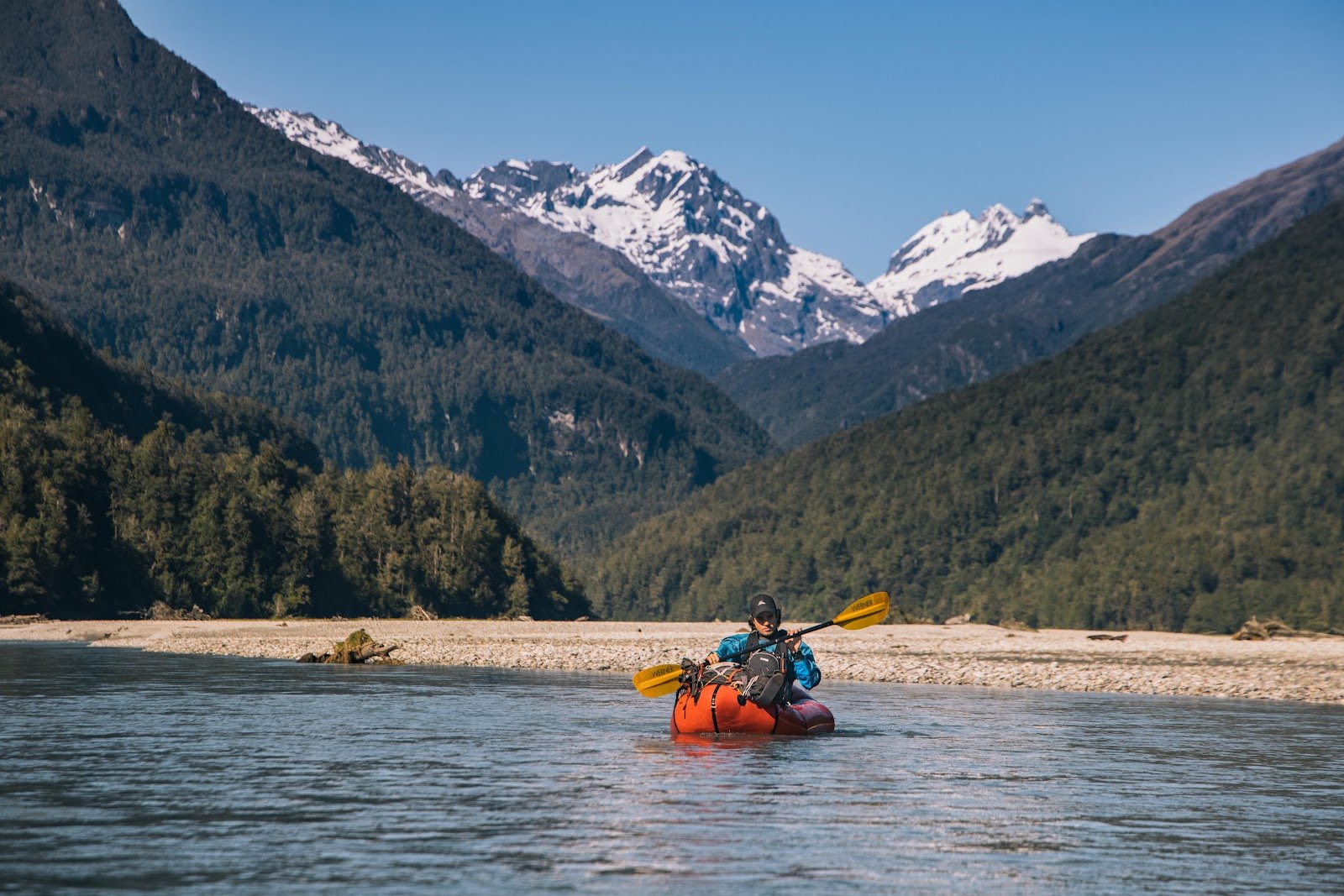
Getting from the plateau to the coast was still a long way. There was a 60-kilometre packraft down the Arawhata River, and a hunting friend had stashed packrafts at the top of the river for them. Alex calls that cheating. Sixty kilometres in a packraft is a day's work, but walking it along a braided river after everything else would have been a bit much.
First they had to get through the Williamson, with endless, ruthless bush bashing like nothing he'd ever experienced. Then came the Ten Hour Gorge, where two rivers converge and plummet down into serious rapids. Alex and Mike looked at it on the topo map the night before and reckoned they could do it in three or four hours. It definitely took them 10. It was incredibly steep, with bare rock where tree and mud avalanches had peeled everything off, and Mike took a small fall of about five metres. When they finally made it out onto the flats at the top of the Arawhata, they collapsed in relief.
Being out the back of wilderness areas like that is really exciting for Alex, because when you're away that long, everything falls away:
"Those emails that you cared about so much that were still … nagging in your mind for like two days or three days, they're evaporated."
Weather was critical too. Every trip report they found for the Olivine had a disaster story, from being stuck by a river until the food ran out to helicopter rescues. They went at the last minute on a fine forecast and had only one bad day. His lesson: plan around the weather, and go with what you're given.
Not everyone can do the Olivine Ice Plateau, he says, but every New Zealander should get to feel nature's power and beauty, which is why passing on outdoor skills to younger generations matters so much.
How to get into mountaineering
A lot of Kiwis start outdoors young, and that makes a huge difference. For moving into mountaineering, Alex recommends building hard hiking skills first: trips where you might need microspikes or crampons, more challenging weather, camping in tougher conditions. You can get really good at all of that without reaching the alpine environment.
Then do an alpine course, through the New Zealand Alpine Club or Hillary Outdoors, to learn the alpine-specific skills like avalanche rescue and reading the landscape. His reasoning:
"you don't want to be worrying about camping basics. You want to have that so dialed, you know, that you're just not even thinking about it."
His tip: take it slow, focus on the hiking and the basic skills first, and build up bit by bit.
There are tramping tracks at every level here, from huts two hours from the road end upwards. This winter we did half of Round the Mountain at Ruapehu, which I found really challenging, before bad weather stopped us.
The Summit Challenge and the Himalayan Trust
The Himalayan Trust began with Kiwi climbers and hikers going to Nepal and helping with projects in schools and hospitals, combining a love of mountains with doing some good. The Summit Challenge does exactly that, at home in New Zealand.
You have the month of March, until the 31st, to run, walk or bike the height of Everest, 8,848 metres, or a lesser or higher option (the Triple Crown is for the really hungry people). You build up vertical metres bit by bit while raising money for education and healthcare projects in Nepal, a bit like a marathon over a month.
Some people go big: two people battling it out one year were doing Roys Peak, a 1,300-metre slog, before and after work. Plenty of others do the height of Everest Base Camp or Aoraki Mount Cook, on Auckland's maunga or the Port Hills. It's a great way to get fit, with an amazing community to do laps with.
Some students Alex has met go hundreds of metres down into a valley and up the other side every day to get to school. Climbing your own vertical metres to fund their scholarships gives you a bit of kinship with them.
A friend did the Summit Challenge back in March, and I got to go along on a few summits. When we recorded, I was in Nepal, just back from a week in the Manang Valley, where we hiked to 4,900 metres from a start at three and a half thousand, about the height of the top of Aoraki. Nepali flat is definitely not flat. Alex's reminder, bistari bistari (slowly, slowly), was a lifesaver at that altitude.
Grand adventures close to home
There's no shortage of adventures, Alex says, overseas or right at our back doors. When we recorded, he was heading to the subantarctic islands in December, a lesser-known, awesomely wild part of New Zealand, and back to Nepal the next year for the Manaslu region and the Tsum Valley. He keeps a list and ticks away at it.
Being Sir Ed's grandson has brought a lot of privileges and opportunities, he says, including his work with communities in the Himalayas. Plenty of people get involved with the Himalayan Trust's work too. Antarctica is hard to get to no matter who you are, which is why he thinks it's important to look at Aotearoa. Standing on the Olivine Ice Plateau, it feels like there's nothing but ice and snow for miles. If COVID did one good thing, it made us look at what we could do locally, and he reckons we should remind ourselves of that often:
"there are grand adventures to be had in New Zealand."
He also thinks we underestimate how special New Zealand's outdoor community is, from our hut network to our maps and all the shared information. We shouldn't take it for granted. We need to invest in it, bring new people in and make sure we don't lose it.
Being in Nepal, with no topo maps on our trail, made me appreciate that too. So if you want to get outdoors more, find your community: a tramping club, an outdoor or alpine club, a Facebook group. You might meet someone awesome, and three days later find yourselves on the Olivine Ice Plateau.
Places from this episode
- Olivine Ice Plateau
- Mount Aspiring National Park
- Fiordland
- Westland
- Routeburn
- Sugarloaf Pass
- Rockburn
- Five Passes
- Olivine Creek
- Forgotten River
- Arawhata River
- Williamson River
- Ten Hour Gorge
- Glenorchy
- Haast
- Queenstown
- Stewart Island
- Oban
- South Cape
- Ruapehu
- Aoraki Mount Cook
- Roys Peak
- Port Hills
- Subantarctic islands
Links from this episode
- Follow Alex on Instagram: instagram.com/alexhillary/
- Summit Challenge 2025
- Follow Abigail on Instagram: instagram.com/abigailhannnah
- Follow Aotearoa Adventures on Instagram: instagram.com/aotearoa_adventures_
More like this
- Enchaining New Zealand's 3000m Peaks with Alastair and Hamish
- An 85-Day Southern Alps Traverse with Penzy Dinsdale
- First Ascents on Mount Lindenfeld and Mount Haast with Justin Wimmer
- Five days on the Sladden Glacier climbing Mt Sealy and Mt Jeanette with Kaleb Anderson
Until then, keep adventuring :)
The ultimate
NZ road trip adventure guide
Packed with insider tips and stunning photography, this is the only resource you need to plan your journey.