Episode 089
Skiing to the South Pole on a 50 Day Antarctic Expedition with Mike Dawson

Episode 089
Skiing to the South Pole on a 50 Day Antarctic Expedition with Mike Dawson
Spotify Apple Podcasts Everywhere else Download
Okay, so this one is technically not New Zealand. But Mike reckons skiing to the South Pole is still white water, just frozen, and New Zealand has a base down there, so I've decided Antarctica counts.
Mike is a white water kayaker who represented New Zealand at the Olympics in canoe slalom, where a race lasts about 90 seconds. Then he applied to go on a 50-day ski expedition across Antarctica as the videographer. And got in. With very little cold weather experience. I love that so much.
So we start with his childhood on rivers and what canoe slalom is, then get into the expedition: flying in, the Messner Start, a typical day hauling a sled, what he ate, filming with frozen thumbs, reaching the pole and coming home to a very loud cafe. And his advice at the end is something I really needed to hear (I like to plan for every eventuality).
In this episode
- Growing up on rivers
- Canoe slalom and an Olympic career
- Joining a South Pole ski expedition
- Flying in to the Messner Start
- A day skiing to the South Pole
- Filming in Antarctica at minus 30
- Reaching the South Pole and coming home
- Mike's advice for big missions
Growing up on rivers
Mike's family always went on big camping trips, including month-long camping trips around the South Island over summer. His parents were feeling it out and learning as they went too, and they were super encouraging about getting out there and pushing themselves as far as they wanted.
As he got older he picked up kayaking and had a real passion for it. He and a mate would drag their boats up rivers that were probably a bit above their pay grade, more for the exploring than for competing. They learned as they went, and a lot of older paddlers gave them guidance. His parents and family have always been super supportive.
Canoe slalom and an Olympic career
As a teenager, Mike got more into racing slalom and headed to Europe for the junior world champs, where he got absolutely whipped by the Europeans. He came back pretty fired up, and for close to 16 years after that, racing in Europe was basically his job: World Cups, world champs and the Olympic Games, where he got to represent New Zealand a couple of times. That's all done now.
How canoe slalom works
Canoe slalom is raced on an artificial course, basically a concrete river. Wero Whitewater Park in South Auckland is the national training centre, and it was built just as Mike was finishing his career, so he missed out on much time there.
- The gates. A course setter sets gates, two poles each, with a direction. You go down through some, and for others you spin around and come up through them.
- The race. About 90 seconds.
- No practice runs. You don't get to practise the course before the race. The sport has its roots in teaching people to run rapids better on real rivers, and evolved into an Olympic discipline.
River missions and the Olivine
Even during his racing years, Mike's priority was missioning. After the world champs there were usually one or two months of downtime before training started, and he'd head around the world to paddle rivers that hadn't been done before.
A couple of weeks before we recorded, he'd tried to get boats into the Olivine wilderness to paddle the Joe River. He's been trying to do it for four or five years, but crossing that range is hard with the snow conditions and heavy boats. They didn't make it in this time, and it's still on the cards.
Joining a South Pole ski expedition
The expedition celebrated Roald Amundsen, the Norwegian who first reached the South Pole in his historic race with Scott. It was run by the Antarctic Heritage Trust, through its Inspiring Explorers programme, which anyone could apply for. Mike applied to go as the videographer, to film and document the trip, and got through.
There were five of them: two Norwegians and three Kiwis. They skied from the far side of the continent, starting at the Messner Start, about 1,000 kilometres to the South Pole.
The Trust led the logistics, and Mike was grateful. He's planned heaps of expeditions before, but always in warm climates, and you can only fit about ten days of food in a kayak. Fifty days in Antarctica was a mammoth undertaking. Once you're dropped off, there aren't many stops, so your food and gear have to be right.
Flying in to the Messner Start
They flew from the bottom of South America to an ice runway in the interior of Antarctica, more of a logistics hub, which a few hundred people a year pass through. Landing on a glacier in a big jet was pretty cool. You step out at minus 30, trying to capture the moment, and it's freezing.
Then they jumped in a Twin Otter, a slow little plane on skis, down to the edge of the continent at the Messner Start. It's named after Messner, a big climber who did a trip from that point in the early 90s. The Twin Otter landed on the snow, they pulled their sleds out, and with the plane still running, it was gone. Just the five of them.
They were actually standing on the sea, about seven kilometres from the edge of the continent, though it all looks the same. White everywhere, and pretty quiet. And they started skiing south.
A day skiing to the South Pole
It's pretty much ski touring without the downhill. They started at about sea level and finished just over 3,000 metres, so you get slowly higher every day. It gets harder as you go, because it gets colder and colder, and up on the polar plateau it's super cold and feels harder to breathe.
All day you're going up and over sastrugi, snow the wind has chopped up into waves. Really beautiful, and hard work to get around when they get big.
The daily routine
The first week, with good weather, they took it pretty easy, and Mike was grateful, because he and one other teammate had very little cold weather experience. It took time to get a grip on things like frostbite and working in that environment.
After about a week they got into a groove:
- Around 6am: up and cooking snow for water, for breakfast and the whole day, which took around three hours.
- 9am: packed up and skiing, at about two kilometres an hour dragging the sleds, in pushes of 50 minutes to an hour with five to ten minute breaks.
- Evening: set up camp, three hours to cook, have dinner and catch up, then sleep. Rinse and repeat.
They covered between 20 and 25 kilometres a day, and the whole idea was not to overcook themselves at the start. That happens to a lot of people who try something like this.
There's 24-hour daylight. You wake up feeling tired, open your eyes to blinding daylight, and you're awake straight away.
Sleds and food
The trip wasn't self-supported: a plane flying to the pole dropped food along the way. So each sled held about 20 days of food, about a kilo a day, plus the tent, warm gear and five to ten litres of fuel, and Mike had 17 to 20 kilos of camera gear too. There are things he'd leave behind next time.
Antarctica is a giant freezer, so you can take anything. They ate mostly freeze-dried food, and the fun part is you can eat tasty, high sugar, high fat food nonstop and burn it all off:
- Breakfast: oats with dried fruit, heaps of butter, a bunch of sugar and a couple of coffees.
- During the day: chips, pretty much a block of chocolate a day, butter, hot noodles or another freeze-dried meal for lunch, and trail mix in the afternoon.
- Dinner: another freeze-dried meal.
It wasn't enough. Mike lost 12 kilos over the expedition.
Filming in Antarctica at minus 30
Filming was more of a blessing than a job. There isn't much conversation or stimulus out there, only white, and documenting gave him something to occupy his mind.
The cold made everything hard:
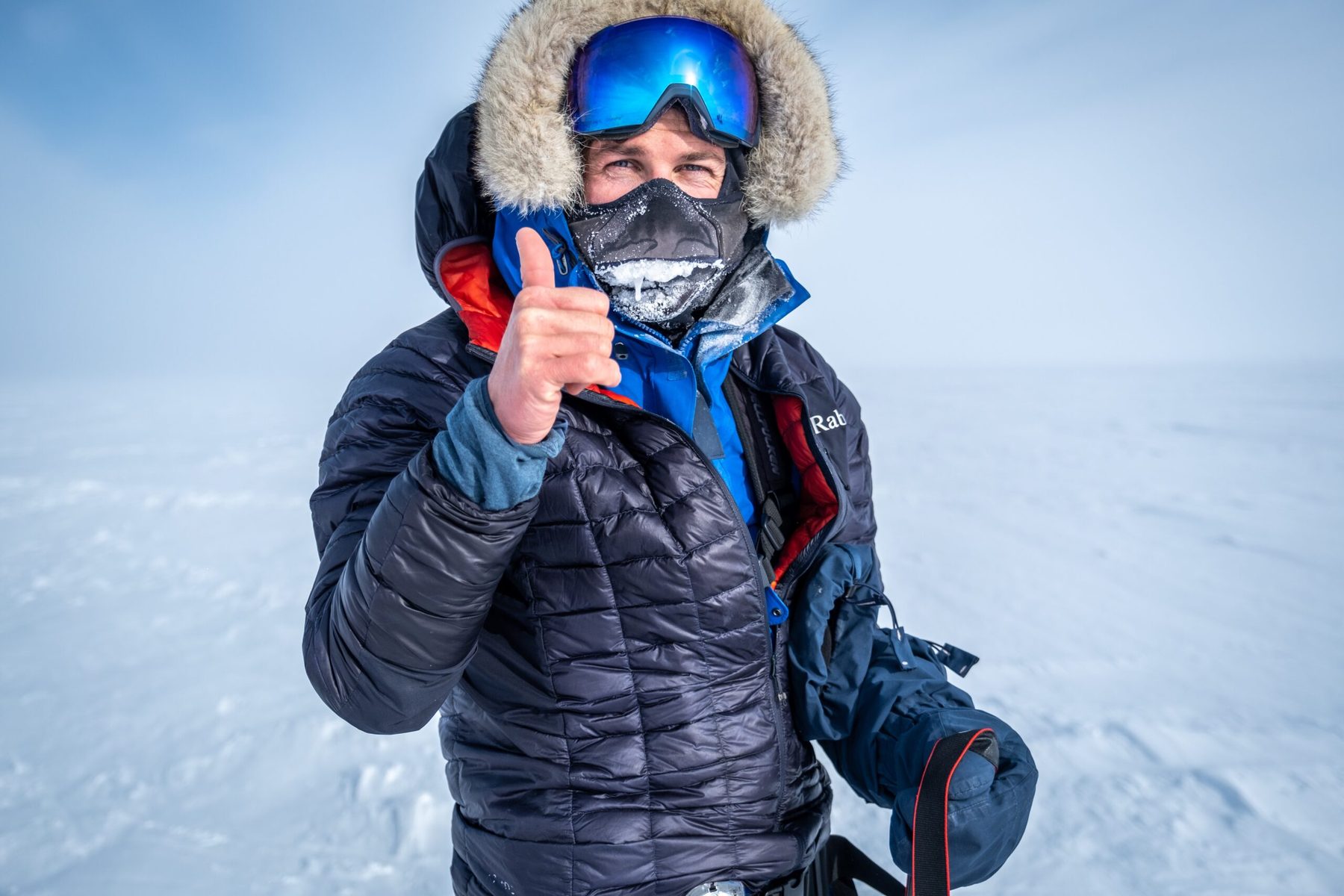
- Bare hands. Below minus 30 you've got about a minute before your hands freeze, especially if they're a bit sweaty from skiing. He'd take his gloves off to shoot, then shove his hands back in or up under his armpits.
- A screen pen let him press buttons and focus with his gloves on, until the LCD screen got so cold it slowed down and stopped working.
- The drone. Flying it is where your hands get coldest, with your thumbs out in front of you in the wind, and it's stressful with the drone in the air and everyone skiing away. You get pretty savvy after a week or two.
- Fog. The tent is warm and humid from cooking and people. Bring a minus 20 camera into it and it fills with fog, which freezes on the lens and glass. Then the camera is useless until you sleep with it for a day or two.
He'd had advice from people who'd filmed down there, but you have to be there to figure out the hacks.
Navigating a white landscape
There's no wildlife, no trees and constant daylight. The only colour is your tent and the clothes you and your teammates are wearing. So you get really attentive to detail, and you notice changes in the snow as you climb.
You start navigating by compass. As you get better, you use where the sun is, cross-referenced with the angle of the sastrugi against your skis, and walk a straight line without really thinking about it. A mountain will pop up in the distance, and you'll walk towards it for ten days as it slowly gets bigger.
Reaching the South Pole and coming home
There's a huge American base at the pole, so you see it as a speck on the horizon, disappearing and reappearing over the big rolling hills. If the weather is clear, you might see it a day or two before you get there.
Reaching the pole after 50 days was exciting. For Mike, though, the real highlight was disconnecting for seven weeks:
"you're just living in your tent and life's simple. It's just wake up ski set up the tent eat go to sleep wake up ski … it's quite a simplistic way of living and you get really good clarity in your head"
I think a lot of us miss out on that. People who walk Te Araroa from Cape Reinga to Bluff often talk about something similar, taking it one day at a time with plenty of time to reflect.
At the pole the journey ended. They hitched a lift back on one of the planes that fly tourists to the South Pole, then flew off the glacier and out of the continent.
Scott, Amundsen and the old explorers
What blows Mike's mind is that Scott and Amundsen started from the Ross Sea side, the New Zealand side of the continent, walked further than his group to reach the pole, then walked back, in the early 1900s. They had caches and dogs, but nothing was mapped. Mike's team could see crevasses on satellite images. Those explorers had no idea.
I'd put the Antarctic explorers among the greatest of all, and I need to read more of their stories.
Coming home
Mike was tired. He'd lost so much muscle, and skiing isn't stepping up, so even a set of stairs was hard. He reckons it took a good three months to recover properly, where after other missions he'd usually be fine after a week, and he didn't want to do any big missions for a while.
Walking into a cafe straight after, the noise and smells hit him like a tennis racket to the face.
He'd love to go back to Antarctica. He's been to the Antarctic Peninsula a few times, and a kayak project there would be cool. He'd also love to cross the whole continent, or do more on the New Zealand side, where so much of the history is: Shackleton's hut, Scott's hut and Hillary's hut.
When we recorded, he had his eye on the rivers of the west coast of Greenland, and he was coaching slalom athletes for the Paris Olympics.
Mike's advice for big missions
What Antarctica taught Mike is that you can go and do something totally abnormal and out of your skillset, and it works out. So whether it's a day trip, an overnighter or a traverse of the Southern Alps, if you've been parking an ambition because you're not quite sure, get amongst it:
"you can always turn around. You can always go back and have another go later on"
Set an objective and start. You don't have to make it to the end. It gets you out there, you meet people, they suggest the next thing, and suddenly you're doing seven-week trips across a continent.
That's something I needed to hear. I love the outdoors, but I always want to make sure we've assessed all the risks, planned for everything and have someone capable with us.
Mike agrees it's a catch-22. You do have to assess the risks and have a robust plan in case something goes wrong. In kayaking, he checks a river has the characteristics of a good one, and he'd never drop into a blind gorge without safety, because that's reckless. But he'll give it a nudge, and if he can't get down safely, he climbs out and heads back the way he came.
Learn from people better than you
Having someone experienced with me is a massive comfort. I recently did some sea kayak overnighters around Auckland with a group in big swells and lots of wind, well out of my comfort zone, and having a really experienced kayaker in the group made it fine.
Mike's advice is to always find someone better than you at what you're doing, and learn from them. You can't get cold climate experience until you're there, and three of their team were very experienced (they must have watched the two Kiwis at the start thinking they were absolute gumbies). By the end, Mike was in his element. On his own, it would have been a really slow learning curve.
If you're young and want to start your adventure journey, Mike encourages you to follow the Antarctic Heritage Trust on social media and keep an eye on the Inspiring Explorers programme.
Places from this episode
- Wero Whitewater Park
- South Auckland
- South Island
- Olivine wilderness
- Joe River
- Antarctica
- Messner Start
- South Pole
- Ross Sea
- Antarctic Peninsula
- Southern Alps
Links from this episode
- Follow Mike on Instagram: instagram.com/mrmikedawson/
- Watch the documentary at the NZ Mountain Film Festival 2024
- Follow Abigail on Instagram: instagram.com/abigailhannnah
- Follow Aotearoa Adventures on Instagram: instagram.com/aotearoa_adventures_
More like this
- Growing Up in the Bush and Antarctica Expeditions with Chris Long
- Ski-Touring and Camping on Tasman Glacier in a Storm with Helena Sodergren
- A Ski-Packraft-Tramping Expedition from Mt Aspiring to Waiatoto with Nick Pascoe
- Moving to New Zealand and Learning to White Water Kayak with Isaac Naylor
Until then, keep adventuring :)
The ultimate
NZ road trip adventure guide
Packed with insider tips and stunning photography, this is the only resource you need to plan your journey.