Episode 155
Five days on the Sladden Glacier climbing Mt Sealy and Mt Jeanette with Kaleb Anderson

Episode 155
Five days on the Sladden Glacier climbing Mt Sealy and Mt Jeanette with Kaleb Anderson
Spotify Apple Podcasts Everywhere else Download
Kaleb and I have known each other for ages, and for a long time he's been my backup guest. But he's had some really cool adventures lately, so it was time to get him on.
Kaleb, aka Adventuring Kiwi, is a full-time freelance photographer and videographer who moved from Auckland to Lake Hāwea and has never looked back. I've watched him go from sunrise missions on Ruapehu and Taranaki to some epic stuff in Aoraki Mount Cook National Park. This winter, he spent five days on the Sladden Glacier climbing Mt Sealy and Mt Jeanette, and his stories had me hooked.
So we cover how a homeschooled Auckland kid got into the mountains, his first ice axe and crampons climb, and the Sladden Glacier trip day by day (including the sunglasses made from a freeze-dried meal packet). Then his advice for moving from hiking to mountaineering, and a ski accident that ended with a helicopter. And yes, he still says I need to go to Mueller Hut ASAP.
In this episode
- Who is Kaleb Anderson, aka Adventuring Kiwi
- Duke of Edinburgh and the Tongariro Northern Circuit
- From photography to alpinism on Ruapehu
- Mount Wakefield and rockfall in Aoraki
- Planning the Sladden Glacier trip
- Mueller Hut to Sladden Saddle
- Camping on the Sladden Glacier
- Climbing Mt Sealy and Mt Jeanette
- From hiking to mountaineering: snow safety
- A ski accident and an inReach rescue
Who is Kaleb Anderson, aka Adventuring Kiwi
Kaleb played a key part in our van. We bought it during lockdown while we were stuck in Auckland, and Kaleb, already down south, went out past Gore with a friend to check out a white van with old sign printing, some rust and moss on the side. In exchange, Isaac and I drove his recently bought Land Cruiser down from Auckland to Wānaka.
That drive is probably the scariest thing that's happened to me on a road. Past Fairlie, in Burkes Pass (no signal back in 2020), the truck started swerving and wouldn't go where I steered. Isaac and a mechanic who happened to be in the car park found one control arm bolt missing and the other halfway out. They zip-tied it, we crawled to Tekapo, and the mechanic there wouldn't even move the truck into the workshop. Two new bolts from Fairlie later, we were good to go. Kaleb reckons we're both far more on top of vehicle maintenance now.
Duke of Edinburgh and the Tongariro Northern Circuit
Kaleb was homeschooled in Auckland, and the catalyst for his love of the outdoors was the Duke of Edinburgh's Award. Someone in the community set up a programme for homeschooled kids in the area, and the qualifying assessments include multi-day hikes you build up to. For a lot of Aucklanders, that meant the Waitākere Ranges, with the Hillary Trail a staple for practice.
For his gold award, Kaleb wanted to go further. Little old him caught an intercity bus to Tongariro National Park, made friends doing the same qualifying hike, and spent four days on the Tongariro Northern Circuit. They had perfect weather, blue skies, golden sunrises and Ngāuruhoe covered in red, scenes you never see in the north of the country.
"that like memory to me is like some of the most incredible days of my life."
Then, past Red Crater, they stopped for lunch at the Emerald Lakes under a blue sky, and the weather came in: rime ice on their jackets, wind burn and zero visibility. One of the group had left her rain jacket at the previous hut, and by chance Kaleb had packed two. It showed how quickly New Zealand weather changes, and it cemented his fascination with the alpine environment.
I've only done the crossing as part of the circuit, and Kaleb's right: it can be a bluebird day and you still need a rain jacket and layers in your pack. It is not a short little Instagram hike.
From photography to alpinism on Ruapehu
Kaleb drifted away from the outdoors for a while, then found his way back through photography, poring over maps and wondering what photos they could get. The birthplace of that was Ruapehu: summer hikes up high, camping, or early starts for sunrise before the cloud came in.
Then he and three good friends decided to start working on actual skills and get into alpinism, still dragging their big heavy cameras up. He'd taken his ice axe, crampons and helmet on a few trips before, like up to Syme Hut on Taranaki, but conditions weren't great, so they came down. That's a big part of it, he says: learning decision-making, and not pushing on if you're not ready.
A first climb on Ruapehu, straight out of lockdown
The first time he properly expected to use his ice axe and crampons, his Wellington friends were coming to climb Ruapehu at the end of a lockdown. If Kaleb got through the checkpoint at 11pm, an hour before lockdown ended, he'd get an hour's sleep before the climb. The officers decided he couldn't do much damage in an hour and let him through. After a power nap in the car park, they practised crampon technique and self-arrest in the dark, then climbed to a beautiful sunrise over the Crater Lake. He got cramps from not resting or hydrating enough, something to work on.
Kaleb credits the Duke of Edinburgh assessors for his group decision-making: taking turns leading and checking in with everyone. Rock climbing together, I've seen how good he is at challenging people while staying aware of the whole group.
Mount Wakefield and rockfall in Aoraki
That whole North Island crew has ended up in the South Island, and it's rare for everyone to be free at once. Mount Wakefield was one of those times.
Their route was really ambitious. Part way up Wakefield, battling giant blocks of scree, they realised it wasn't going to go fast, so they camped below the summit, looking over the Hooker Valley towards Mount Sefton, and summited in the morning.
It was one of Kaleb's first experiences of rockfall in Aoraki Mount Cook National Park, and he's had many since. That place wants to fall down, so you have to be careful where you go.
Planning the Sladden Glacier trip
If you keep going past Mueller Hut, you'll eventually reach the Sladden Glacier. It's not as simple as that, but it's the general direction.
The idea began a few years earlier, on Christmas Day. Kaleb and a friend camped on the Annette Plateau, on the way to the Sladden, and spent Christmas up by the glaciers, away from everything, with peaks poking up through the clouds. He wanted to go back and climb some of them. Mount Sealy especially had been on his list, after looking across at it from other peaks in the park.
A last-minute change of plan
The trip came together last minute. A Mount Aspiring plan became an invite on a ski touring trip to Tasman Saddle, which fell through over the helicopter's weight limit. With an amazing weather window, it would have been a crime not to do something.
Two friends had tried the same area earlier that week on foot, and had to be flown out because the snow was too deep to make progress. That beta told them they'd definitely need skis.
The team and the gear
There were three of them:
- A friend with a lot of skiing experience
- Kaleb, with his mountaineering experience, who's been working on ski touring and ski mountaineering
- His flatmate, from the Lake District in the UK, with lots of summer scrambling and climbing experience, new to winter mountaineering, and on snowshoes
They weren't going light and fast: five days of food, winter layers, rope, harnesses, a crevasse rescue kit, avalanche gear and snow stakes. Kaleb left his camera at home and used his iPhone.
Mueller Hut to Sladden Saddle
A helicopter bump would have needed permission to land, and there wasn't time to apply, so after a late start they skinned up to Mueller Hut. Skins stick to the bottom of touring skis so you slide forwards and grip going up, a really efficient way to travel on deep snow. After an amazing sunset, they got up at 4am to navigate in the dark.
Always take the beta
Beta is information about the climb you're going to do, and Kaleb always takes it when it's offered. What you do with it is up to you.
They met two skiers coming down from a similar trip, who'd gone over the higher part of the Annette Plateau. The Metelille Glacier has sunk so far that the rappel there was too long for their 60-metre rope. So they stayed lower and went up the side of the glacier instead. Glaciers change so much, so recent beta matters.
A sunglasses hack
Skinning up the Annette Plateau at sunrise, Kaleb's flatmate realised he'd left his sunglasses in the car. His buff was too thick to see through. So they took the freeze-dried meal packet from the night before, cut it into a sunglasses shape with little slits for his eyes, and taped it to his face. It worked, and there are photos to prove it.
Around the rock band and up to the saddle
The Mueller Glacier is mostly rock, choss and scree at the moment, and they wanted to keep their elevation. So they sidled around Kitchener, went part way up the Annette Plateau, then around the big rock band that separates the Annette from the Metelille. From below, it's a huge cliff now.
They stayed high on the Metelille, because the crevassing they could see was down low. With enough snow cover and their skis spreading the load, they didn't feel they needed to rope up for that section. Kaleb watches for the bergschrund, where the ice meets the rock and there's always a gap.
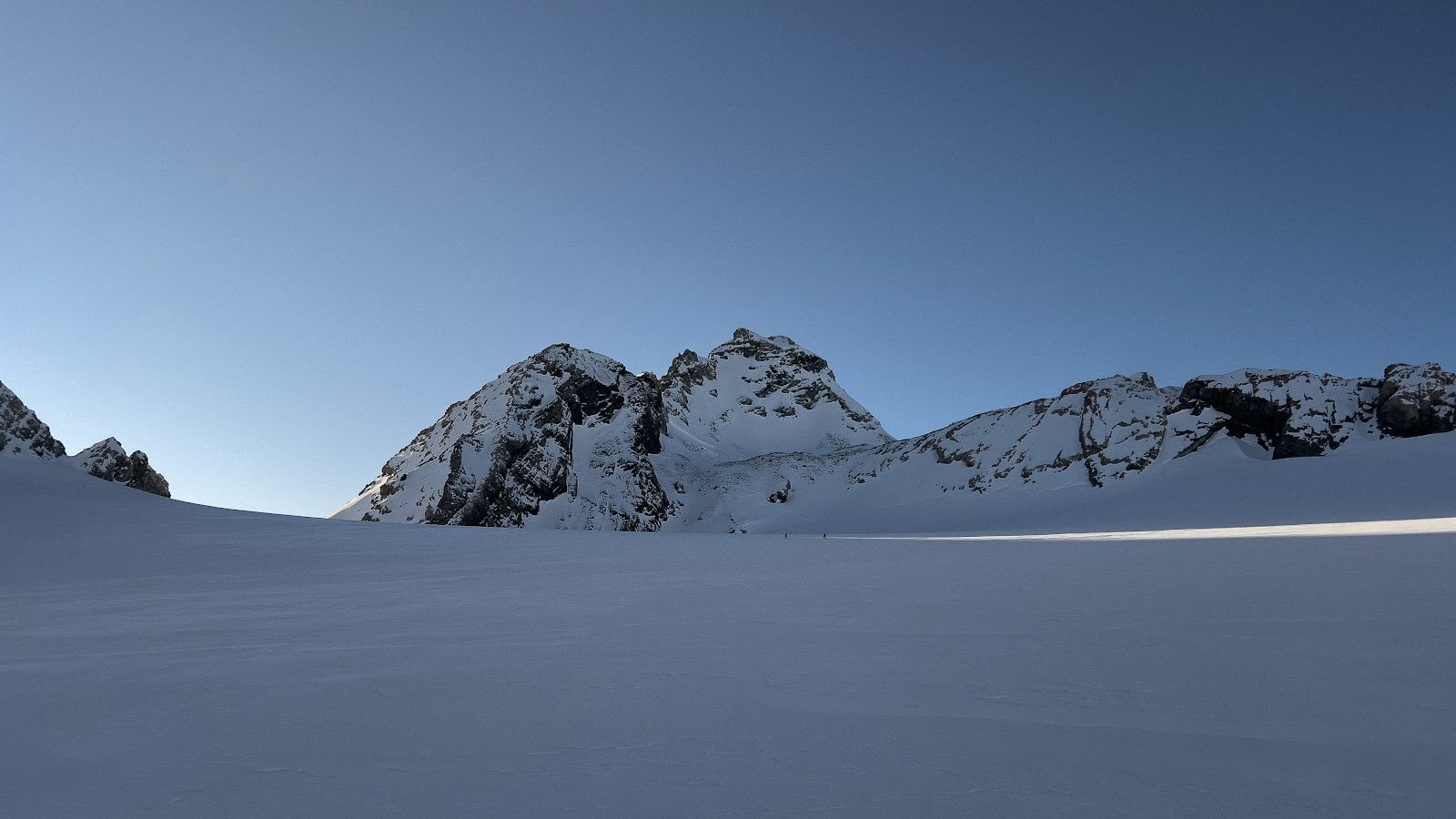
It got really hot, with so much sun reflecting off the snow. After a snack, they boosted straight up Sladden Saddle, front pointing up the steep snow. Over the top, the Sladden Glacier opened up, with Sealy on the left and Jeanette straight ahead. Kaleb's first thought: this is where we're spending the next couple of days.
Camping on the Sladden Glacier
Any saddle funnels wind, so they camped tucked back from Sladden Saddle. They camped off the ice, on ground where they knew things would melt into gravel and rock, and designated a toilet area to keep their part of the glacier as clean as possible.
Because they were in avalanche terrain for part of the trip, each of them carried a transceiver, shovel and probe. So out came the shovels to dig a flat platform, with lots of communication about how deep and how flat, and they built a big snow wall around the tent.
They had one two-person tent for three people. The first night they were sardines, and his friend woke up with his face frozen to the side of the tent. The next night they slept top and tail, which worked quite well.
Scouting and route planning
That afternoon, Kaleb and his friend skied a couple of laps down the glacier, scouting. Kaleb took photos of the peaks to plan routes after dinner, because guidebook and online photos can be ten years old, and Topo doesn't show what's covered in snow. On Mount Madeline the year before, the river they needed wasn't even named on Topo anymore.
When Alex Hillary came on to talk about the Olivine Ice Plateau, it looked wildly different from Topo because of the snow melt, and the beta was from someone who'd been there 20 years earlier.
Climbing Mt Sealy and Mt Jeanette
Bailing on Sealy, then a new route
Heading up in the dark, they reached the base of their chosen route on Mount Sealy and found a massive crown wall from an avalanche in the previous few days, on the slope they wanted to climb. They checked it out, decided it was probably okay, and bailed anyway.
Nobody got trapped into "it's right there, we're so close", and they watched an epic sunrise over the Dobson Valley instead.
Skiing back to camp, they looked up and spotted another route on Sealy that they couldn't see in the dark. In daylight it looked good, so they committed to doing it safely: go up to the first bit, run a test, bail again if it was dodgy. It was good, and they climbed it, with some cruxy bits, popping out on top. It was a shaded slope, so a later start didn't matter, because it was still cold on that side.
Back down, his friend, who's working on a ski guiding logbook, boot-packed back up and skied it, with the others watching from a safe place.
As Kaleb sees it:
"It was a really good test for everyone in that group. Cause it just showed that we were all on the same page."
A flow state on Jeanette
That afternoon they headed over to Mount Jeanette. His flatmate was keen to learn more about snow safety, so they dug a test pit on the aspect they planned to climb. It looked pretty good, with maybe a thin wind slab on top to watch for.
The next morning, Jeanette was a flow state. They all felt really good, went way faster than expected and were on top of the ridgeline, well inside their conservative turnaround time, as the sun peeked over the horizon. Both objectives ticked off.
They skied down, then the wind picked up as the weather window turned. Carrying their full weight again, they crashed out at Mueller Hut, ate the rest of their food and slept in on the last morning.
From hiking to mountaineering: snow safety
A listener asked what the biggest thing is to know when making the jump from hiking to mountaineering. Kaleb says the jump is about confidence and skills, built slowly through experience. The first time you do something, you'll be terrified, and the more you do it, the more used to it you get.
The biggest thing to be aware of is snow safety. Kaleb says avalanche deaths and incidents are dramatically higher among mountaineers in New Zealand. A lot of people getting into mountaineering think a shovel, probe and transceiver mean they can dig their friends out. Then, on a professional course, you learn:
"the actual only way to really be safe and not be just digging or recovering bodies is actually to avoid being in that terrain at the start."
So be conservative with snow and learn as much as you can. The more you know, the more you realise you don't know. Always look for the safest route, and if it's out of your control and you're not feeling good about it, bail or pick a different objective.
Avalanche courses
- The level one avalanche skills course is a good start for people who don't know what they're looking at. Kaleb recommends it for anyone heading into the outdoors where there's snow, and considers it essential for ski touring, so that more experienced partners know you understand the group's decisions.
- Avalanche Risk Management level 5 is tailored for professionals and is full-time study, but if you can afford it and have the time, you learn so much about reading terrain yourself.
How hard is the Sladden Glacier trip?
Kaleb puts the mountaineering at maybe a notch above intermediate. You need to be confident on steep terrain, with the odd section of mixed climbing on rock in crampons, confident at crevasse rescue if anyone has an issue, and good at terrain choice.
For a much more beginner-friendly ski touring trip, he suggests going from Mueller Hut up to the Annette Plateau and having a blast around there. A past guest of mine has done first ascents in Aoraki, which is very high level.
A ski accident and an inReach rescue
When we recorded, Kaleb was recovering from a badly broken shoulder, from another alpine mission. It was a beautiful day, and they'd summited. On the way down, he picked up speed to get through a sketchy patch of snow with a drop on each side, so he wouldn't have to turn. What looked like wind-blown snow was a dusting on a block of ice. He hit it fast, a ski came off, and he went down hard. In hindsight, he thinks he should have had the bindings on his new skis set a little higher.
He even wondered whether he could walk it off, then decided they really should call for help. The group had a PLB and two inReaches, and they used an inReach so they had two-way communication and could tell the rescuers what was going on. The helicopter arrived within about 45 minutes. A friend with pre-hospital emergency care training ran the checks, and the others kept him comfortable in a bothy bag.
His lesson: he'd taken the pain relief out of his first aid kit the night before for someone else and hadn't put it back. Now he's focused on getting his shoulder back on track, and with no fixed timeframe, all his goals for next year have changed. Adaptability is key, says Kaleb.
Places from this episode
- Lake Hāwea
- Waitākere Ranges
- Tongariro Northern Circuit
- Ngāuruhoe
- Red Crater
- Emerald Lakes
- Ruapehu
- Crater Lake
- Syme Hut
- Burkes Pass
- Tekapo
- Fairlie
- Mount Wakefield
- Hooker Valley
- Mount Sefton
- Aoraki Mount Cook National Park
- Mueller Hut
- Annette Plateau
- Metelille Glacier
- Mueller Glacier
- Kitchener
- Sladden Saddle
- Sladden Glacier
- Mt Sealy
- Mt Jeanette
- Dobson Valley
Follow Kaleb
- Instagram: @adventuringkiwi
Links from this episode
- Follow Kaleb on Instagram: instagram.com/adventuringkiwi/
- Follow Abigail on Instagram: instagram.com/abigailhannnah
- Follow Aotearoa Adventures on Instagram: instagram.com/aotearoa_adventures_
More like this
- Summitting Mt Earnslaw and Mountaineering for Beginners with Wiktoria
- Arthurs Pass and Three Attempts at Mount Philistine with Amelia Hayes
- Enchaining New Zealand's 3000m Peaks with Alastair and Hamish
- A Ski-Packraft-Tramping Expedition from Mt Aspiring to Waiatoto with Nick Pascoe
Until then, keep adventuring :)
The ultimate
NZ road trip adventure guide
Packed with insider tips and stunning photography, this is the only resource you need to plan your journey.