Episode 196
Packrafting the Landsborough River from the West Coast with Tom Waters

Episode 196
Packrafting the Landsborough River from the West Coast with Tom Waters
Spotify Apple Podcasts Everywhere else Download
I'll be upfront: I'm not a whitewater person. I'm happy on the sea, where it's flatter and warmer, and the idea of coming out of my boat in a freezing river terrifies me. So I was really really curious to hear from someone who loves it.
Tom Waters is a Christchurch-based paddler and a bit of an all-rounder. He paddles whitewater kayaks and packrafts, and he also tramps, hunts, mountain bikes and dabbles in rock climbing and ski touring. He's been part of the packrafting scene since 2020 and served three years on the committee of the Packrafting Association of New Zealand (PRANZ).
And his story is a big one. Five days of walking to reach the paddling, with ice axes in one hand and paddles in the other, a glacier lake at dawn and an icefall that would not stop.
We cover how Tom got into the outdoors, what a packraft actually is, the whole Landsborough trip from the West Coast, and where beginners can start. Plus his key safety rules, which I think everyone should hear.
In this episode
- How Tom got into the outdoors
- Coast to Coast and coming back to whitewater
- What a packraft is
- The Landsborough River and planning the trip
- The walk in: Karangarua to the Douglas Traverse
- Weather calls at Horace Walker Hut
- Paddling the glacier lake and crossing Douglas Pass
- Down the Landsborough to the Haast River
- Packrafting for beginners and staying safe
- Tom's bucket list and the Hollyford-Pyke
How Tom got into the outdoors
Tom grew up on a farm in the Mackenzie Country, near Tekapo, so he was outside all the time. But he didn't love the outdoors as a kid. That came later.
His first introduction was hunting on the farm, and for a long time it was about the hunting more than the outdoors. Then a mountain bike race came through the farm, from Burkes Pass, the closest village to where he grew up, through farmland to the Albury pub. Tom saw all these cool people on mountain bikes, thought he had to get amongst it, and got himself a super old bike.
There was a prize for the first local to finish, which was a big motivator. Tom won it as a kid, a massive achievement. When he went back as a teenager, he got blitzed by another local little boy.
I know Burkes Pass a bit myself. During COVID, I was driving a friend's Land Cruiser south when it started shuddering and swerving, and I slowed right down and limped into Burkes Pass. There was no signal, so I popped into the one little store and asked to use their landline. We fixed it with a zip tie and limped on to Tekapo, where the mechanic took one look underneath and couldn't believe I'd driven it there on a zip tie. Last time I passed through, Burkes Pass had 4G. No more catastrophes.
Coast to Coast and coming back to whitewater
At high school, Tom saw a poster of people running up a mountain pass (he later found out it was Goat Pass) and decided he had to do the Coast to Coast. Luckily, he was at boarding school at St Kevin's College in Oamaru, where a teacher who was super into kayaking was a driving force behind the kayak club. He taught a little brood of ducklings to kayak in the school pool, then took them to events like the Otago slalom meets on the Clutha River.
Tom did the Coast to Coast and kept up whitewater for about a year. But whitewater is a brutal sport at times. He got spanked a couple of times and gave it up for years.
He came back to it in the central North Island. He was running ultramarathons and tramping when a bad knee injury stopped him, so he turned back to paddling. This time it clicked, and it was the start of a healthy obsession.
My husband got more into whitewater the same way, when an injury stopped his climbing. You can pause something for years and pick it up again.
What a packraft is
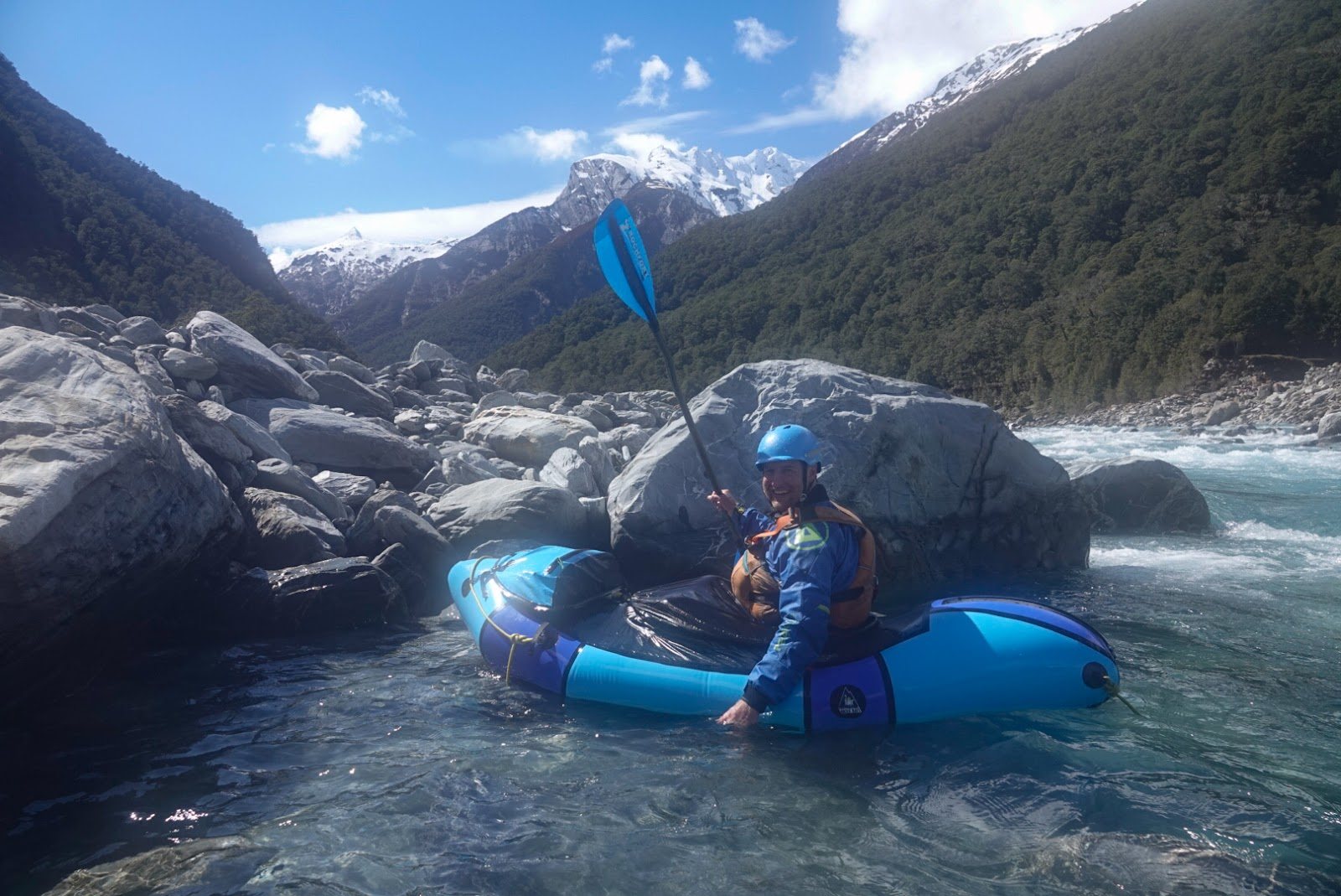
A packraft is a raft you can deflate, fold up and fit into your pack, so you can carry it to some really cool places. Folded, it's about the size of a large sleeping bag, and they typically weigh four to five kilos. It paddles a lot like a kayak, and the joy of it is carrying it into crazy places.
Tom's pitch will sound familiar to anyone who's done a harder tramp down a river valley. You're tired, you're suffering in the bush and mud, and the river looks so beautiful and inviting. If only you could float down it instead.
He bought a second-hand instruction boat from the owner of a Queenstown packraft business, so he knew it could paddle pretty decently. He'd only paddled it in a pond when he took it to a PRANZ meetup in St Arnaud and immediately surrounded himself with 100 keen packrafters for a week.
Compare that with a hard-shell whitewater kayak. Tom has done his fair share of hauling them into places: they stick up so far that they catch every bit of foliage, roots and trees, and his creek boat weighs about 22 kilos. It's a bit of a suffer face. Crazy carries into rivers are part of the New Zealand whitewater scene, but a packraft makes them a lot easier.
My own river experience stops at rafting grade two.
The Landsborough River and planning the trip
The Landsborough is held up in the backcountry scene as a place to go and test yourself. The top of it is in the Adams Wilderness Area, so there are no helicopters, no tracks and no huts. It's remote and wild.
To find it on Topo, follow the Haast Highway from Haast to the big kink where it turns south. On that corner, the Landsborough runs into the Haast River from the north. It goes right up behind Aoraki Mount Cook.
Tom already knew what the Landsborough was about. His big adventure before this was a solo traverse: from Lake Ōhau over Brodrick Pass, the classic route in, all the way up the Landsborough, over the Karangarua Saddle and out the Karangarua. He did it in four massive days, and it was a real test of his will, physical ability and mental strength. Incredibly hard and rewarding.
At the PRANZ meetup he'd met a paddler who was very keen to send it, and who had also paddled the Landsborough after coming in over Brodrick Pass. So they put together a different route, from the West Coast side. When their planned third paddler was injured, a world-class paddler joined them who could look after them on the river.
They timed it for the spring flows, so there'd be a bit of juice in the river, and met in Harihari in October.
The walk in: Karangarua to the Douglas Traverse
It took them five days to reach the point where they could paddle the Landsborough. Part of classic packrafting, Tom says, is skipping the easy way in and doing something really convoluted and crazy. That's what made the trip so epic: the walk in threw so much at them.
Day one: Cassel Flat Hut
A short day. They set off from the Karangarua car park in the afternoon and reached Cassel Flat Hut. After grovelling through the bush, you come out onto a classic West Coast river flat, with the hut there and the mountains looming above you.
Day two: the climb to the saddle
They left the Karangarua River and went up a side stream to begin the Douglas Traverse, with a big climb to a saddle. It was classic New Zealand tramping: raincoats on, thoroughly sodden, a cold lunch under a log. Then straight into horrible deadfall, where it took them 20 minutes to move a couple of hundred metres. They looked at each other and wondered if it would all be like this.
They broke free eventually. It's a route, with ladders up some of the rock faces, and they camped in the saddle with epic views out over the Southern Alps and craggy, bushy peaks swirling in the mist.
Day three: ice axes and paddles
The Douglas Traverse proper starts with a ridge, lots of scrub bashing and clambering over rocks. It got a bit dicey, because they were all carrying single-piece paddles while hanging by their fingertips off the hill.
Most packrafters carry two-piece or four-piece paddles that break down and strap to the outside of a pack. A single piece has no movement between the pieces, so it's stiffer and more solid for technical paddling, and they expected to be up against it. For most people, Tom says, a four-piece is the way to go.
Then they sidled across the face above the Douglas River, over snow left from the winter. They stopped to put their crampons on, picked up their ice axes and realised how odd it is to hold an ice axe in one hand and a paddle in the other.
That reminded me of Nick Pascoe, who climbed Mount Aspiring, skied, then packrafted down the Waiatoto, with skis, ice axe, crampons and a packraft all in one trip.
The snow went fine. But once they were back on tussock, a big bank of fog rolled up the valley and they were in a whiteout. That was the worst timing, because the route crosses steep ravines that are only crossable at certain points. Moir's Guide gives a good crossing on the 1,400-metre contour, and they had no idea how high or low they were. They spent a while getting cold and wet before they bumbled through, then descended all the way into the Douglas Valley to Horace Walker Hut, their little haven from the elements.
Weather calls at Horace Walker Hut
The plan had been to cross the glacier lake above the hut that afternoon. But it was windy and getting late, and it didn't seem a good time to be crossing a lake. You can walk around the lake, but that's a serious undertaking, so the packrafts were a definite advantage for getting into the upper Douglas.
Nobody wanted to leave the hut. But the forecast had a serious front coming through the next day, and another massive front four or five days out. They had enough food to wait a day, but if they waited and still couldn't get across, they might get stuck in the Landsborough with a massive storm coming. If they couldn't get over Douglas Pass the next day, they'd probably have to bail. So they decided to leave really early.
That's a good lesson in reading the long-term forecast, which I learned on day one of our kayak expedition. The weather looked mint and I wanted to keep going, and my husband pointed out that if we did, we'd be stuck for a week with no water, no stream and no road access. That stretch around Cape Reinga and North Cape is so exposed. Our mentor agreed we should stay put. Sometimes you sacrifice a good day to stay safe in the long run.
Paddling the glacier lake and crossing Douglas Pass
They got up in the dark and walked up the upper Douglas River to the Douglas Glacier lake, a couple of hours on. Tom remembers getting the gear out by head torch and blowing up the packrafts as it started to get light. It was calm in the end: a pebbly beach, little waves hissing on the stones in the blue light, and gargantuan cliff walls emerging out of the gloom around them.
"started paddling across this lake, just feeling like tiny little dots in this giant world"
As a general rule, you're more likely to get calm in the morning, and an updated forecast on their InReach said the front would hit in the afternoon. So they were hoping for a window.
Over the pass
Back on land, they transitioned to walking. If you're new to packrafting, people generally allow an hour each way to switch between walking and paddling. They climbed out of the lake up a dry riverbed, where they found pīwauwau, rock wren, a tiny alpine bird. They're pretty rare, and seeing them up there always gives Tom a buzz.
Next was Harper's Rock Bivvy, a humongous rock with a hollow underneath you can sleep in. They had lunch there, and Tom was gutted they couldn't stay. Anyone who gets there has done some serious work to get there, so it's a well-earned shelter from the storm.
Further up the upper Douglas, in the mist, they crossed a perfectly flat area. It felt like walking in the Mackenzie Basin, or on the moon: a pool table in a high alpine environment.
Then the climb up Douglas Pass itself, tussock first, then more alpine, and it clagged in again. You're basically right behind Aoraki there, in the middle of the Southern Alps, and they could hear icefalls coming off the Douglas Névé across the valley, big thunderous sounds reverberating around them. One kept going for so long that after 30 seconds they started climbing again.
"we stopped and we're like oh my goodness this thing is still going like that just has to be like hundreds of tons of ice"
A little spooky, Tom says, when you're surrounded by fog, standing on the snow.
They got over Douglas Pass and dropped down the other side as it got windy and cold, and reached the valley floor at the very head of the Landsborough. Yes, they'd made it.
Down the Landsborough to the Haast River
That was day four, and they were cold and wet. They had to work hard to get into a nearby rock bivvy, which was leaking, so they put up a fly, got dry clothes on, had a feed and went to bed.
There wasn't enough water to paddle at the head of the river, and they knew a big gorge below was probably too steep. The normal put-in is Kea Flat, miles further down, and there was no information about the upper Landsborough. So the plan was to walk until it looked paddleable. You can read the contours to judge how steep a stretch is.
I find that terrifying: heading down a river nobody has scouted, when rivers change. A new massive rock could be sitting in the middle. Tom agrees that West Coast rivers in particular are notorious for changing.
The gorge and the avalanche debris
The next day was a long one through a really nasty gorge full of massive boulders. They'd climb up onto a boulder, pull their packs up, walk across and down-climb the other side, and at times they were down to 300 metres an hour. Avalanches from the winter had choked the valley floor and the river, leaving walls of ice five metres high sitting amongst the bush and scrub, which they had to get around. They camped one more night.
On day six, after a couple more hours of walking, they put in at Percy Creek. Then it was two days of paddling to the Haast. They finished by paddling about 400 metres of the Haast River, from the confluence to the road, where a car was parked. So Tom can say he's paddled the Haast.
Time-wise, it was far more walking than paddling, and they went in knowing that. Some trips have a much better walking-to-paddling ratio. But they all love a sufferfest.
Packrafting for beginners and staying safe
The Landsborough is hard whitewater and not a beginner's trip at all. But New Zealand is a bit of a paradise for packrafting, with the right amount of road access to get where you need to go and combine some really cool walking and paddling. There are heaps of easier trips on lakes and grade one rivers. PRANZ runs a website with a map of packrafting trips around the country that you can sort by grade.
Understand the risk
Before any packraft trip, understand the different kind of risk involved. Tom puts it like this:
"If things go wrong, you're kind of just on that conveyor belt and everything just keeps going. … if you're walking if things start to go wrong You can just stop walking and everything stops, generally."
On a river, everything keeps moving and multiplies what's going wrong, so plan well.
Grades and progression
- River grades. Grade one is easy moving water with no obstacles, up to grade five, which is expert territory. Grades one and two are generally manageable for beginners.
- Don't trust the stability. Packrafts are stable boats, which often gives people a false sense of security.
- Build skills before you step up. A log can float down a grade five rapid. Tom's bar is being able to control the boat and catch eddies on a grade before you move up.
- Check the flow before you go. Council websites show flows for a lot of rivers, and an app called Flowrate has heaps of gauges.
Tom's key safety rules
Tom points to research from Alaska tracking packraft fatalities, with clear themes:
- Don't paddle alone. Solo paddlers are one of the biggest groups of people to die packrafting.
- Stay with your boat. People get separated when a boat blows away on a lake or the river takes it.
- Dress to swim. You're more likely to die in cold water. Dress for falling out, losing your boat and sitting on the bank for an hour.
- Leash on lakes, never on rivers. On a lake, be leashed to your boat. On a river, being tied to anything is a real hazard, because it can tangle and flush around you.
I love how clear that is, especially the leash rule, which I know can be a controversial point. People outside the kayak community often ask me if we're tied to our boats.
Joining PRANZ
PRANZ represents packrafters, and anyone can join, whether you have a packraft yet or not. When we recorded, it was $45. Membership is affiliated with the Federated Mountain Clubs and Whitewater New Zealand, who advocate for our rivers and wild places. The main drawcard is the events around the country, where you can turn up, meet cool people and find paddle buddies. Members also get the PRANZ newsletter.
Tom's bucket list and the Hollyford-Pyke
Tom's list is never-ending, but one has been on it for a while: climb Tititea Mount Aspiring, then drop down into the Waipara River and paddle out. The Waipara is held up as a pretty staunch river, so it would combine some decent mountaineering with some decent whitewater.
Linking pursuits like that might be my favourite kind of story, like traversing Fiordland with a packraft, or bikepacking to the ski fields and skiing them.
One I want to do is the Hollyford-Pyke, and I'll start on grade ones and twos and see if my husband convinces me to go further.
Tom did the Hollyford-Pyke over New Year's. It's definitely easier, but not without hazards: there are some tree jams and logs to avoid. And it's so cool to access Fiordland while you sit on your butt for a lot of it.
Places from this episode
- Landsborough River
- Haast River
- Adams Wilderness Area
- Karangarua River
- Cassel Flat Hut
- Douglas Traverse
- Douglas River
- Horace Walker Hut
- Douglas Glacier lake
- Harper's Rock Bivvy
- Douglas Névé
- Douglas Pass
- Percy Creek
- Kea Flat
- Lake Ōhau
- Brodrick Pass
- Karangarua Saddle
- Harihari
- Mackenzie Country
- Tekapo
- Burkes Pass
- Albury
- Goat Pass
- Oamaru
- Clutha River
- St Arnaud
- Hollyford-Pyke
- Tititea Mount Aspiring
- Waipara River
Links from this episode
- Follow Tom on Instagram: https://instagram.com/alpine_dog_/
- Find packrafting trips by grade: https://www.packraftingtrips.nz/
- Join PRANZ: https://www.packrafting.org.nz/
- Follow Abigail on Instagram: instagram.com/abigailhannnah
- Follow Aotearoa Adventures on Instagram: instagram.com/aotearoa_adventures_
More like this
- First-Time Packraft Adventures and Hiking to Lake Crucible with Charlotte
- Two NZ Epics - Bicycle Circumnavigation and Packraft Traverse with Dunc Wilson
- White Water Kayaking and a Harrowing Accident with Ryan Lucas
- Jetboating 27 Wild Rivers on a Solo Trip with Ollie Sharpe
Until then, keep adventuring :)
The ultimate
NZ road trip adventure guide
Packed with insider tips and stunning photography, this is the only resource you need to plan your journey.