Episode 059
Two NZ Epics - Bicycle Circumnavigation and Packraft Traverse with Dunc Wilson

Episode 059
Two NZ Epics - Bicycle Circumnavigation and Packraft Traverse with Dunc Wilson
Spotify Apple Podcasts Everywhere else Download
This chat covers two massive expeditions, and I had so many questions about both.
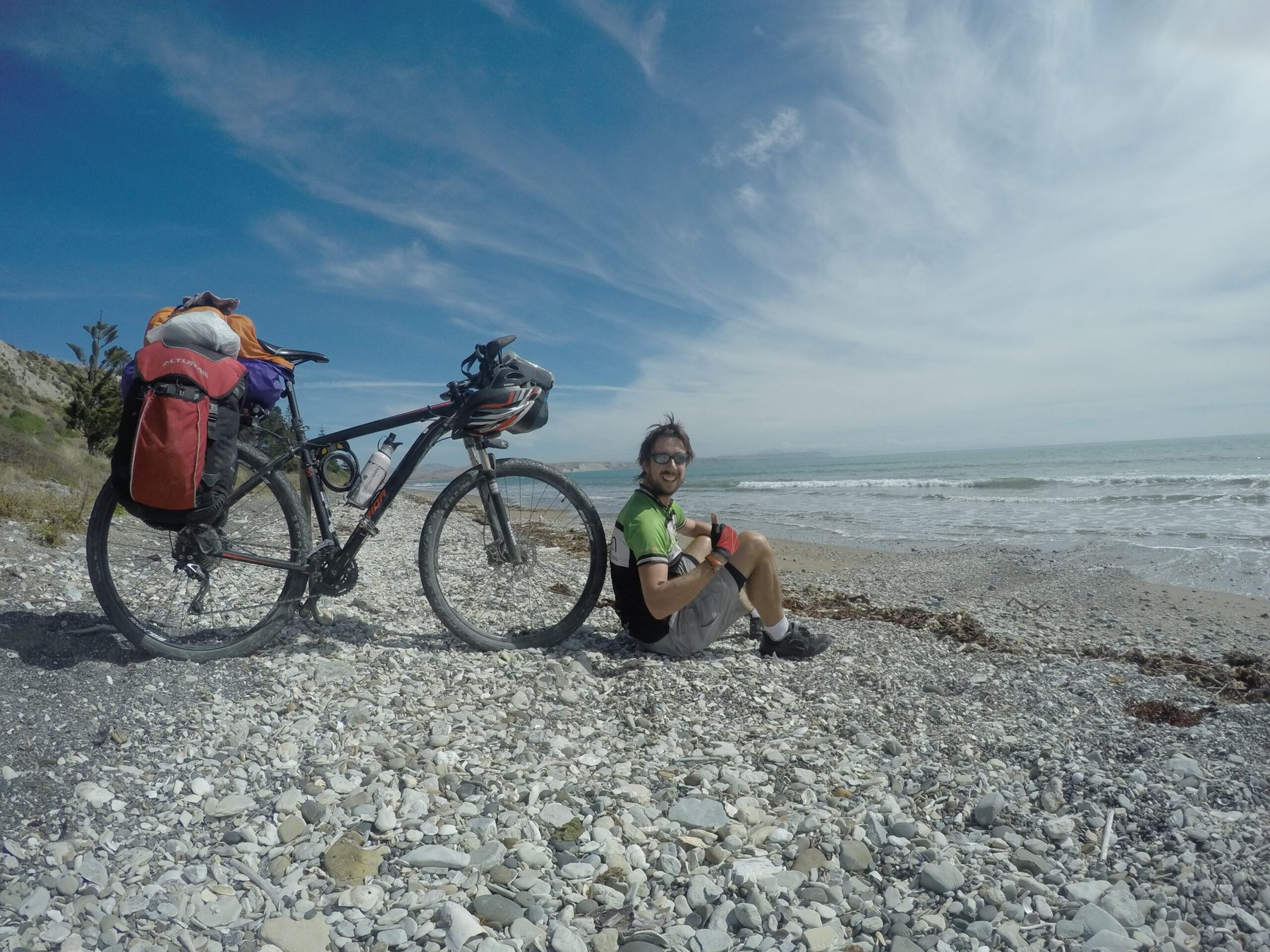
Dunc calls himself an adventurer, an official author and a content creator who likes to spend as much time as possible outdoors. He grew up in London, spent most of his 15 years in Aotearoa as an Aucklander, and when we recorded he was based in Nelson. In 2015 he jumped on a bike at Mission Bay and followed the coastline of New Zealand all the way round, beaches and all, then wrote a book about it. And more recently, he's packrafted the length of the North Island.
So we cover both. How the coastal loop came about, how he planned it (half of it, anyway), where he slept, and the cyclone, crash and cracked wheel that slowed him down. Then what a packraft is, and his North Island traverse from Cape Reinga to Cape Palliser, including quitting after four days and picking it back up again. Plus his one big lesson from both, which lines up really really well with two moments of my own, and his hot chip habit.
In this episode
- From Shooters Hill to Aotearoa
- Why Dunc cycled the coastline of New Zealand
- Cycling the coastline of New Zealand
- Cyclone Pam, a crash and a cracked wheel
- What a packraft is for
- Packrafting the North Island, Cape Reinga to Cape Palliser
- The South Island section and Dunc's big lesson
From Shooters Hill to Aotearoa
Dunc grew up in London, which by his count has about one and a half hills. He grew up on the biggest of them, Shooters Hill in South East London, at a whopping 100 metres above sea level.
His childhood holidays were camping holidays: in France, in the Lake District with its fells and lakes, and in North Wales, where there are actual mountains. He spent a lot of time sleeping in tents, riding bikes around campgrounds and paddling weird and wonderful watercraft, including rafts he built out of barrels.
He moved to New Zealand at 27 and lived in West Auckland, and he's grateful for the chance it gave him to live in and see this country.
Why Dunc cycled the coastline of New Zealand
For five and a half years, Dunc worked in Auckland in a job that was the equivalent of a nine to five. He turned 30 in that time, and he'd travelled a little around Aotearoa, but there was something in the back of his mind and his heart telling him to get out and see this place. He'd moved here, and all he'd done was work. Most of his leave went on flying back to the UK.
I absolutely resonate with that. For us, the 2020 lockdowns were a blessing in disguise, because we could finally explore our backyard. That winter was our first South Island road trip, and our whole world has grown a bit bigger since.
What draws him to long-distance adventures, whether it's a hike, a bike ride or a raft journey, is how simple life becomes:
"your entire existence goes down to getting from a to b every day that's all you have to look after there's no emails. There's no social media."
The simplicity gives you time to take in everything around you too:
"you actually taste the air and you actually hear the breeze in the trees and you actually smell the smells of New Zealand native Bush"
A lot of people I've talked to about the Te Araroa trail say something similar. For me, it's the salt air. I keep finding myself needing more of it.
Cycling the coastline of New Zealand
On 2 January 2015 (the second, because the first with a hangover would have been a terrible idea), Dunc left Mission Bay in Auckland and followed the coast as best he could, keeping left. That meant a clockwise loop of the North Island to Wellington, an anticlockwise loop of the South Island to Bluff, then straight on the ferry to Stewart Island, where he rode to the southernmost point you're allowed to take a bike and did a loop of Rakiura. From there he went back up the West Coast of the South Island, then the west coast of the North Island, back to Mission Bay. All up, that's 11,000 kilometres.
Planning half the route
His planning was fifty-fifty. He plotted points on a map (could he cross this gravel road, was that beach made of stones?) as far as the Wairarapa, from Mission Bay round the Coromandel and East Cape. Then he decided to wing it and worry about the South Island when he got there.
There was only so much he could plan, because his daily distance swung so much:
- Tar-sealed road: about 150 kilometres a day fairly comfortably, once he had his fitness.
- Bush, grass behind the beach, beach riding and stream crossings: it could take all day to do 30 kilometres.
So he learnt to guesstimate where he'd get to.
Where he slept
He started in summer in a tent and camped most of the way. He was raising money for St John, and as more people heard about the journey, St John volunteers offered him beds, including the guest room at the Timaru St John ambulance station. A friend he'd worked with put him up in Bluff.
By winter, other touring cyclists had told him to email the holiday parks, and he got some really kind replies. When he rolled into Westport right after a thunderstorm, there was a cabin with a heater and a kettle, which was all he needed.
That Kiwi hospitality went straight to his heart, and the ride sealed the deal on his love for this country.
Cyclone Pam, a crash and a cracked wheel
The ride took eight months, with six and a half months on the bike. His back-of-the-napkin estimate of six to seven months didn't factor in:
- A head-first crash down a bank on the Queen Charlotte Track, which put him out for two weeks.
- A big crack in his rear wheel, found on the morning he was leaving Karamea to ride the Heaphy Track, more than 100 kilometres from the nearest bike shop.
The hardest stretch was Mid Canterbury, with the spin-off effects of Cyclone Pam. Between Banks Peninsula and Timaru the beaches are all pebbly stones, so he couldn't ride them, and he took the farm gravel roads half a kilometre inland instead. A 100-kilometre wind lashed in from the east. He rode south with the wind on his left, leaning the bike over to counteract it, and when it dropped he'd almost fall off. That went on for a few days, with rain in his eyes too.
Wind is the absolute worst on two wheels. I commute on a motorbike, and on windy days I'm fighting it on a lean too.
All of this was also his crash course in cycle touring. Before he left, his entire experience was one overnight trip on the same bike, from Auckland up to the Whangaparāoa Peninsula and back. He's an all or nothing kind of guy.
What a packraft is for
After the bike ride, Dunc spent eight months back in London, then came back and worked full time for five years. He got really into hiking, because New Zealand is wonderful for it, and into challenging himself on mini overnight missions. If a trek ended at a lake, he wanted to go beyond it, and that's how he found packrafts.
A packraft is an inflatable boat that fits on the back of your pack. A lot of people use them for whitewater. For Dunc, it's about getting across places very few people have ever been.
He'd done the coast, so he wondered: what if he could do the centre of both islands? Raft as much as possible, pack the boat up and hike, then blow it up again at the next water, put his pack on the front and cross, right down the whole country.
Packrafting the North Island, Cape Reinga to Cape Palliser
Dunc plotted a route from Cape Reinga to Cape Palliser, the top to the bottom of the North Island, and spent many months on and off in 2022 completing it. He finished on 31 December.
Cape Reinga to Pukenui
He started at the cape in the height of summer, with a couple of mates for the first day. Where Te Araroa heads down Ninety Mile Beach, he went east to Spirits Bay. They ran out of water, and the nearest stream wasn't nice looking, so he was glad of his water purifier.
From Spirits Bay he crossed the harbour on the east side to Great Exhibition Bay, and walked down it thinking how few people ever come here.
At the DOC camp at the end of the bay, one of the camp wardens took Dunc's pack off and said it weighed a lot. That's when it dawned on him he wasn't going to complete this in one hit. He got to Pukenui, the last Four Square as you drive north to Cape Reinga, after four days, and quit. He was convinced it was for good. It wasn't. At the beginning of March he picked it back up.
The Whanganui River, take two
He was going great guns on the Whanganui River, in the national park, which he calls a wonderful part of the country, when his wrist started crunching. That was the end of take one. The cause was a tin of beans at a DOC camp. He had no can opener, because he was travelling light, so he woodpeckered his way in with a fork. His tip: don't.
Take two was that November, with his girlfriend. She got off at Pipiriki, where most people do, and he carried on with a group of other paddlers. The river flooded while they stayed at the Flying Fox, and the next day they flew down it.
The Aorangi Range
His girlfriend joined him again for the Aorangi Range, a little-known tramping zone at the southern tip of the North Island, south-east of the Tararua Range. It offers a really wild traverse, north to south, and you won't get a bike through there. They did it in two days, and to this day he has no idea how, especially with him carrying a packraft.
The South Island section and Dunc's big lesson
The plan is to carry on and do the South Island, starting at Cape Farewell, because he's a completist. Would he packraft the Cook Strait? With support, definitely, and on his own, no.
His big lesson from both journeys:
"stuff will go wrong and it's how you deal with it when stuff goes wrong that matters."
With the cracked wheel at Karamea, he didn't flip out. He decided to ride the Heaphy with the broken wheel and got the zip ties out, wrapping them round the tyre as tightly as he could to stop it pushing out of the rim where it had split. On the packraft journey, when he got trapped at the end of a lake, he didn't panic. He had dinner, a tent and shelter, so he found the best place to set up and carried on in the morning.
Or, in Dunc's words: carry zip ties, don't panic and make sure you've got water.
I've had two of those moments myself, and one was solved by zip ties. The other was a case of: I can stay here if I need to, I have water and food, and we can deal with this later. Solid advice.
Hot chips and the book
Dunc is vegan, and in a small town the only vegan option is often hot chips. On an adventure you crave carbs, salt and potatoes, so he's become a bit of a hot chip connoisseur.
His book about the coastal ride, The Big Loop, is out of print. He still sees copies in some Paper Plus stores, libraries around the country have it (ask yours to track one down if not), and you can message him through his website.
Places from this episode
- Nelson
- West Auckland
- Mission Bay
- Coromandel
- East Cape
- Wairarapa
- Wellington
- Bluff
- Stewart Island (Rakiura)
- West Coast
- Westport
- Karamea
- Heaphy Track
- Queen Charlotte Track
- Banks Peninsula
- Timaru
- Mid Canterbury
- Whangaparāoa Peninsula
- Cape Reinga
- Spirits Bay
- Great Exhibition Bay
- Pukenui
- Whanganui River
- Pipiriki
- Aorangi Range
- Cape Palliser
- Cape Farewell
- Cook Strait
Follow Dunc
- Website: duncwilson.co.nz
- Instagram: @duncwilsonnz
Links from this episode
- Follow Dunc on Instagram: instagram.com/duncwilsonnz/
- Follow Dunc on Facebook: facebook.com/DuncWilsonNZ/
- Subscribe on YouTube: youtube.com/c/DuncWilson
- www.duncwilson.co.nz
- Follow Abigail on Instagram: instagram.com/abigailhannnah
- Follow Aotearoa Adventures on Instagram: instagram.com/aotearoa_adventures_
More like this
- Bikepacking from Cape Reinga to Bluff with Greg and Lauren
- A Solo Kayak Circumnavigation of New Zealand Over 5800km with Red Paterson
- Packrafting and Tramping 48 Days Through Fiordland with Penzy Dinsdale
- An 85-Day Southern Alps Traverse with Penzy Dinsdale
Until then, keep adventuring :)
The ultimate
NZ road trip adventure guide
Packed with insider tips and stunning photography, this is the only resource you need to plan your journey.