Episode 139
Slow Travel in an EV and Catlins, Dunedin and Oamaru with Mature Flâneur Tim Ward

Episode 139
Slow Travel in an EV and Catlins, Dunedin and Oamaru with Mature Flâneur Tim Ward
Spotify Apple Podcasts Everywhere else Download
I love hearing how New Zealand looks to someone seeing it for the first time. And Tim saw a lot of it: three whole months, top to bottom and back again, in an electric car.
Tim Ward is Canadian by birth, insatiably curious, and the author of five books, the latest about Aotearoa. He and his wife had been to pretty much every continent, and when they retired in their mid 60s, New Zealand was the one place they both still really wanted to go. It had always felt too far away from everywhere. (It is. Tell me about it.)
So we talk about the history that blew his mind in Russell, his helicopter ride up Franz Josef Glacier, and the bottom corner of the South Island I haven't covered much on the podcast: the Catlins, Dunedin and Oamaru. Little blue penguins, a haunted castle and a town of rival Victorians and steampunks. Then slow travel, Marlborough wine and his tips for road tripping in an EV.
In this episode
- Becoming a mature flâneur
- Russell, Waitangi and New Zealand's history
- A figure eight from Northland to the Catlins
- The Catlins: Curio Bay and Niagara Falls
- Dunedin, the Otago Peninsula and Larnach Castle
- Oamaru's Victorians and steampunks
- Slow travel, Marlborough wine and the cities
- Road tripping New Zealand in an EV
Becoming a mature flâneur
Tim's love of the world started the summer he was about to turn 18, on his first full-time job: a pipeline survey crew on the TransCanada Pipeline, across the prairies. The crew camped out every single night, under spectacular prairie summer skies. The world exploded open for him, and he's never fallen out of love with it.
He and his wife both love to travel, and their work took them around much of the world. After the pandemic, they decided to travel full time. They moved to France and set about seeing the places they'd always wanted to see, starting with three months in Norway.
Along the way, Tim found a lovely French word, flâneur: one who wanders without a specific destination, just poking around. That was them. Tim also writes a travel blog, and he called this part of their travels Mature Flâneur, because he's in his mid 60s. Whenever they talked about where to go next, New Zealand kept coming up.
The push came from a rare work gig in Mongolia. That put them only 10 hours by plane from here, so in 2023 they came, and they weren't going to do just a week or two. They got three months, rented an electric car because Tim doesn't like petrol engines, and toured from the top of the North Island to the bottom of the South Island and back again.
Russell, Waitangi and New Zealand's history
They arrived with a week booked in Auckland and only general ideas after that. After Auckland they headed up to Russell, in Northland.
They spent about 10 days there, getting a crash course in the early history: a tiny town that was a Māori settlement, which attracted whalers to trade, and where some of the first open battles broke out over how the British interpreted the Treaty of Waitangi. Waitangi is just around the corner.
This history was the most mind-blowing thing for Tim. He arrived with his head full of Milford Sound and kiwi birds, and knew little of Māori beyond the haka. As a Canadian who has lived in Canada and the United States, he already had a template for how colonial powers treat Indigenous people. From a distance, New Zealand seemed to fit it. Up close, he was struck by how far ahead of the curve New Zealand seemed to be: conversations about decolonisation, one nation of two peoples, two official languages and the name Aotearoa New Zealand itself. He's clear it wasn't handed over, either: it took the marches, the protests and injustice brought to public attention to create the Waitangi Tribunal.
It's refreshing to hear that perspective from outside. We're not perfect, and we have so much further to go. But we're only a few generations away from Te Tiriti, so it's still quite fresh, and we can make amends.
A figure eight from Northland to the Catlins
They had planned to go all the way to Cape Reinga, but it was pouring with rain on the days they'd set aside, so that's for next time. From Russell and Auckland, they did a figure eight: down the east coast of the North Island, across to the South Island at Wellington, and down the west coast past the Abel Tasman, Pancake Rocks and Franz Josef Glacier. Then Queenstown and Milford, and all the way around the southern point to the Catlins.
Franz Josef Glacier by helicopter
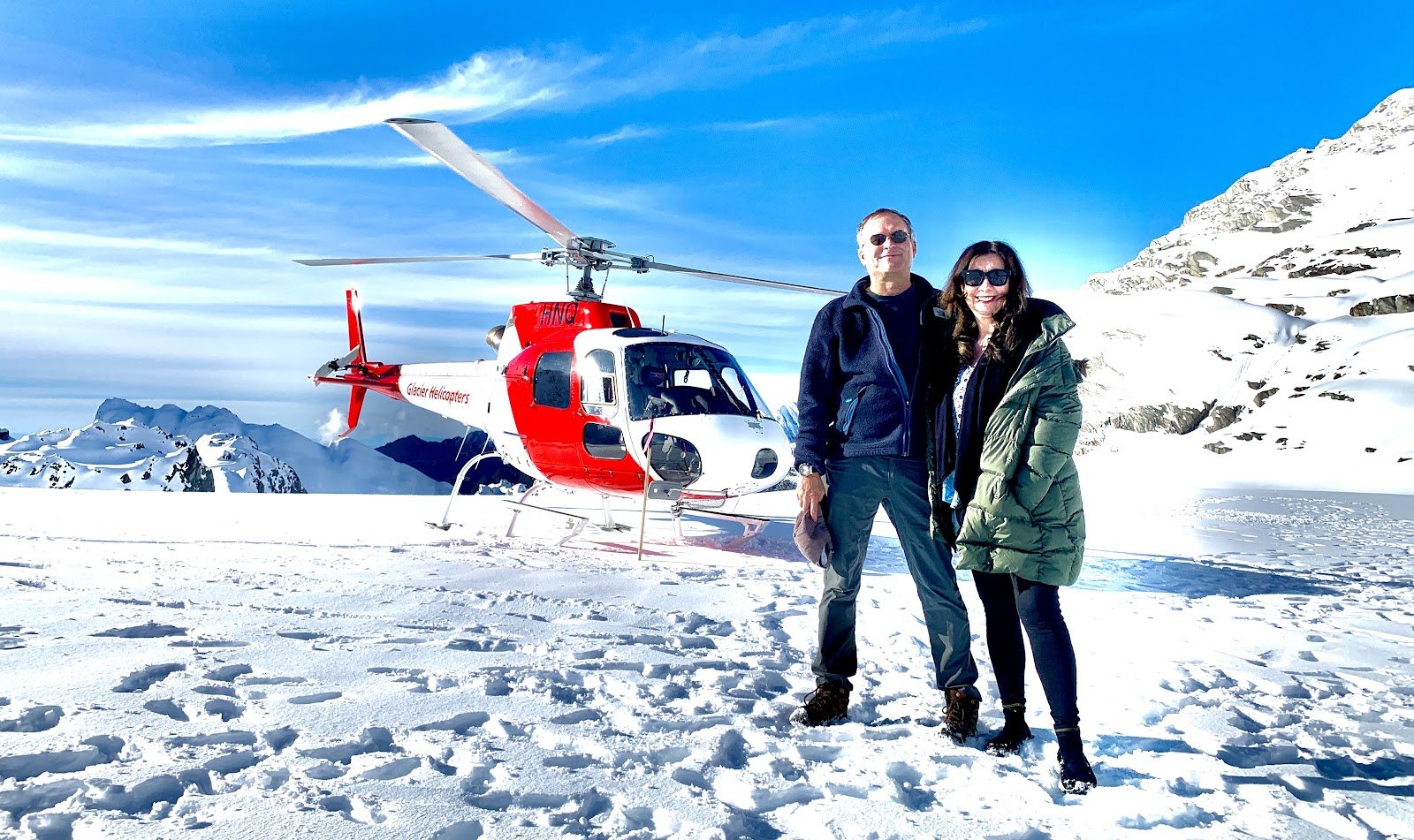
At Franz Josef, they took a helicopter up the length of the glacier, landing up top to look down on it. It was one of the most thrilling 25 minutes of Tim's life. Tim had ridden up front on the way up, so he offered his wife the front seat for the ride down. No way: she was in the back with her eyes closed. So Tim got the best view both ways.
That helicopter ride is still on my bucket list.
The napkin that put the Catlins on the map
They didn't even know about the Catlins. Early in the trip, sitting in a little cafe discussing their plans, they got talking to a woman from California at the next table who'd married a Kiwi and been here for years. She wrote her top recommendations on a napkin, and they used that napkin more than any guidebook. She's the one who put the Catlins literally on the map for them.
The Catlins: Curio Bay and Niagara Falls
Curio Bay and the penguins
In the Catlins, they stayed in a rental cottage at Curio Bay. Along the shoreline is a petrified forest, where volcanic ash turned a forest to stone, so you can still tell the logs from the stumps. It's also a beach where the rare yellow-eyed penguin, the hoiho, comes ashore. It was winter, and he spent two hours at the little penguin-watching station before he saw one.
Their own beach was thick with little blue penguins, nesting under the floorboards. You could hear them at night. They're tiny and so adorable, but:
"they sound like cats are being murdered in the dunes."
That's just them chit-chatting with each other.
I've been to Curio Bay and spent ages waiting to see little blues, but only in the daytime, when they're out fishing. Up north, you can see little blues in the Hauraki Gulf, surprisingly close to the biggest city in New Zealand.
Niagara Falls, New Zealand
Driving the Catlins was amazing, with tiny, quirky communities, and as a Canadian, Tim's favourite was Niagara. You see a sign for Niagara Falls, follow it, and find a little set of rapids next to a big sign with pictures of the American and Canadian Niagara Falls, labelled Niagara Falls, New Zealand. It's so tongue in cheek, and to Tim, that's New Zealand humour through and through.
It's the most underwhelming thing, and I highly recommend stopping. They also stopped again and again for waterfalls, forests and lighthouses.
When we drove the Catlins in our campervan, it was waterfall after waterfall all day: just follow the brown signs. Purakaunui Falls is a popular one.
Dunedin, the Otago Peninsula and Larnach Castle
A surprisingly Scottish city
Dunedin is a surprisingly Scottish city, founded by Scottish immigrants. Tim and his wife have spent a lot of time in Scotland and love it, so it felt a bit weird: churches that look like they were uprooted from Edinburgh and shipped down here, and a monument to Robert Burns in the park. There are lovely New Zealand touches too, like a whole district of street art, with whole sides of buildings covered in creative, fun works.
Little blue penguins at Taiaroa Head
At Taiaroa Head on the Otago Peninsula, Tim says you're guaranteed to see little blue penguins. A charitable trust there runs viewings and acts as guardian of the birds. Even in the dead of winter, they watched penguin after penguin come out of the water in less than an hour. They flop out of the frigid sea at dusk, waddle with their flippers out, then give a whole-body shiver.
You want to cuddle them, and you also realise these are tough birds, swimming with sea lions, seals and sharks and coming home in the dark past dogs and other predators. Tim came away with tremendous respect for them, and asking how he could donate to protect them:
"I want to live in a world with little blue penguins"
Larnach Castle
The last place Tim expected a Scottish castle complete with ghosts was the Otago Peninsula. Larnach Castle is a big granite castle on one of the volcanic hills, with beautiful gardens, built as the folly of a rich industrialist and banker. Placards tell the family's story, and one room has a ghostly mannequin, because a couple of ghosts are said to haunt the place.
Some of the family's story is tragic. Larnach built a whole ballroom for his eldest and beloved daughter's parties, and she died before she could ever dance in it. His later years were unhappy, and there were family fights over the estate after his death. So much wealth and so much unhappiness: a truly Scottish tragic place, in Tim's words.
They went back for dinner at the castle on Tim's birthday. Talking ghosts with the other guests, they asked the woman hosting the evening what she thought. She didn't really like to say, but she'll never go in Mary's room.
That reminds me of St Bathans, a tiny old gold mining town in Central Otago, which has a little hotel said to be haunted. You can pay to stay in the haunted room. Not my cup of tea.
Oamaru's Victorians and steampunks
Oamaru was one of Tim's favourite places, and its story is such a New Zealand one. It had a port and became a distribution centre, booming from a tiny station into a prosperous town, with businesses putting their headquarters there in giant limestone buildings with Victorian columns. As the placards tell it, businesses, banks and brothels became the three main industries in town.
Then the economy's bottom fell out, and the town became so poor that it saw no new development for decades. The grand buildings stayed, often empty, because nobody could knock them down and replace them. Eventually people realised that architecture was something, and the lack of development brought a tourist boom.
A Victorian culture grew up, with Victorian clothes, a festival and a little museum of penny-farthings. Out of that came steampunk, the future as the Victorians saw it, like H.G. Wells and Jules Verne: a world powered by steam engines, with goggles, top hats, tailcoats and gadgets. There's a yearly festival, and a giant steampunk museum you can walk through and dress up in, which Tim and his wife did.
Afterwards, they walked into one of the Victorian shops and said to the woman working there that she must win at steampunk week. If she'd had pearls, Tim says, she would have clutched them: they do not cater to steampunks. That's when it dawned on him that the town has two rival gangs, the pure Victorians and the anachronistic steampunkers, bitter rivals over the town's Victorian history.
Slow travel, Marlborough wine and the cities
They mostly stayed in B&Bs and Airbnbs, usually four to seven days at a time. That's slow travel: they like to get a feel for a place. When you only see a place for a day, you see the highlights, which are often curated, with businesses around them. As Tim puts it:
"And if you stay longer, you get to meet some of the people, get to hear some of the stories"
In Marlborough, his wife found them a stay in a vineyard's tasting room, rented out in the off season, with the wine locked away apart from a couple of bottles left for them. At another winery, they hung around long enough to chat with a chief tour guide, who explained why Marlborough Sauvignon Blanc is unique. As Sauvignon Blanc grapes ripen, they get sweeter and the wine gets heavier, so elsewhere they're picked earlier for that light, crisp taste. In Marlborough, warm days ripen the grapes and cool nights slow it down, so they stay on the vine much longer and take in more mineral flavour from the soil without getting too ripe. You can't get that anywhere else in the world.
I had my first wine tasting last winter, around Cromwell and Bannockburn in Central Otago, and it blew my mind how much is behind it: the soils, the climate, the rain.
Tim found many of the cities less interesting than the countryside and towns. In his book, he admits he slags off Auckland a bit: after the first day, it felt like Portland, Oregon, and the Sky Tower looked like Seattle or Toronto. Then they got up high and saw volcanoes all over the city. Once his eyes got tuned, he started seeing powerful Māori influences in the cityscape, and people with moko, something he doesn't see walking around Toronto. It took a while to see beyond the surface.
Road tripping New Zealand in an EV
A listener asked about travelling New Zealand in an EV. Tim did a little research beforehand, and it was amazingly easy. Very few New Zealanders drive EVs, so there were almost always spare charging spots. His tips:
- Get a charge card. It's an RFID card linked to your bank account: tap to start, tap to finish, and it's so much cheaper than petrol.
- Use the car's screen. Most EVs show you where the charging stations are.
- Learn fast chargers from slow ones. Fast chargers top you up quickly, slow ones take hours, so search for fast chargers when you're on the move.
- Charge overnight from a regular plug. These cars usually come with a cable for slow chargers that can also plug into a regular household socket. It's very slow, but works overnight. Ask permission first, and they leave the owners some money for the power. Most people don't mind if you pay.
- Carry an extension cord. Lots of places' cords aren't long enough, so they travelled with an extension cord and the charging cord in the boot.
In Europe, Tim flâneurs on foot. In New Zealand, it really helped to have a vehicle, though passing through the countryside is the greatest joy on foot or on wheels.
He wrote his book because he fell in love with New Zealand and wanted to encourage people, especially from the other side of the world, to stay longer and really fall in love with it. That's always my advice too: when people ask how long they need here, I say as long as you've got.
Places from this episode
- Russell
- Waitangi
- Northland
- Cape Reinga
- Auckland
- Wellington
- Abel Tasman National Park
- Pancake Rocks
- Franz Josef Glacier
- Queenstown
- Milford Sound
- The Catlins
- Curio Bay
- Niagara Falls (Catlins)
- Purakaunui Falls
- Dunedin
- Otago Peninsula
- Taiaroa Head
- Larnach Castle
- St Bathans
- Oamaru
- Marlborough
- Cromwell
- Bannockburn
Follow Tim
- Book: Mature Flâneur in New Zealand: Slow Travels in the Land of the Kiwi, available as an e-book from Amazon and other retailers
- Blog: on Medium, under Tim Ward, Mature Flâneur. He's also on LinkedIn
Links from this episode
- Follow Tim on Medium: https://medium.com/mature-flâneur
- Buy his book: Mature Flaneur in New Zealand: Slow Travels in the Land of the Kiwi
- Follow Abigail on Instagram: instagram.com/abigailhannnah
- Follow Aotearoa Adventures on Instagram: instagram.com/aotearoa_adventures_
More like this
- Unforgettable Experiences in New Zealand with First-Time Visitor Tracy Collins
- A Bucketlist Birthday Group Trip to New Zealand with Travel Podcaster Jackie Nourse
- The Ultimate New Zealand South Island Road Trip in Winter with Barb and Reg
- Pushed to her Limits on the Hump Ridge Track and Slow, Mindful Travel with Helen Griffiths
Until then, keep adventuring :)
The ultimate
NZ road trip adventure guide
Packed with insider tips and stunning photography, this is the only resource you need to plan your journey.