Episode 108
Fastpacking from St Arnaud to Arthur's Pass in 8 Days with Alice Brice

Episode 108
Fastpacking from St Arnaud to Arthur's Pass in 8 Days with Alice Brice
Spotify Apple Podcasts Everywhere else Download
I'm a slow hiker. I like to touch the moss, look for mushrooms and take as many snack breaks as possible. Alice is not. She'd even listened to me talking about going slow that morning, and her verdict was that the world's made of different people. Fair.
Alice is a mum of two from Timaru who loves mountain biking, trail running and tramping. And over the last couple of years she's fallen for fastpacking: moving light and fast, often at a jog, so she can cover big distances and still get home to her family.
So we talk about what fastpacking actually is, the gear that gets your pack light without costing a fortune, and then the big one. Eight days and 254 kilometres on Te Araroa from St Arnaud to Arthur's Pass, with two mums racing a weather bomb over Waiau Pass, a "quiet day" that turned into an ultra, a hot spring full of sandflies and a very cold, very spontaneous swim in Lake Mavis. Plus her advice for giving it a crack yourself.
In this episode
- From farm kid to fastpacker
- What fastpacking is
- Fastpacking gear and pack weight
- St Arnaud to Waiau Pass: days one and two
- St James Walkway and Hope Kiwi: days three to five
- Harper Pass, Goat Pass and Lake Mavis: days six to eight
- Fastpacking mindset and getting started
From farm kid to fastpacker
Alice grew up on a farm about half an hour out of Timaru and went to boarding school in town. Farming is outdoorsy in its own right, but her family wasn't a backcountry family, and the tramping she did as a kid was pretty low-key.
As a mum, she's compensated a little for her kids growing up as townies by taking them to the outdoors.
Before kids, Alice was an adventure racer, doing rogaines and the Spring Challenge. After kids, she narrowed in on trail running, because one sport was easier to sort out as a mum. Then on a tramping trip with a girlfriend, she kept wanting to break into a jog. With a heavy pack, that was really hard. For Alice, being on a trail means moving fast.
Then she came across fastpacking on social media and thought it could really work for her.
What fastpacking is
In Alice's words:
"fastpacking is a combination of ultralight tramping and trail running And so we cover greater distances by moving faster and by carrying a lighter load."
As a mum, it's also about time. When she did the Kepler Great Walk, she did it in two days where most people take three nights. With six hours of driving each way, she was away for three nights in total and back with her family.
Fastpacking gear and pack weight
With a tent in autumn, Alice's pack can reach about nine kilos including water, and for the eight-day trip below it was about ten. She doesn't fastpack in winter: she can't carry enough warm clothes, and for her it's unsafe in the South Island.
Ultralight can also mean ultra expensive, so her key tip is to work with what you've got and make changes over time. The first things she invested in were a pack that works for fastpacking and a sleeping bag upgrade.
Her ways to cut weight:
- Go stinky. She wears the same clothes the whole time, with two pairs of socks (one for night, one for day), even for eight days.
- Don't overspend on a tent. She bought a cheap one-person tent and has slept in it once, so she's pleased she didn't spend much.
- Go small on the mat. Hers is a woman-specific mat one centimetre longer than her. It's light, though when she lies on her side her knees hang over the edge and she gets cold.
- Choose lightweight layers that still pack a warmth punch. She wouldn't carry a thick merino jersey.
- Size the pack to the trip. She takes a 30-litre pack for overnighters and bought a 40-litre one for the eight-day trip, cinched down.
Alice started the Fastpacking New Zealand Facebook group, where the community built a gear spreadsheet anyone can use, trampers included.
St Arnaud to Waiau Pass: days one and two
The trip was a plan B. Alice had been asked to do GODZone, figured no one would ever ask again and said yes. Then GODZone was cancelled, and she had a week-long leave pass to use. So she teamed up with a fellow fastpacker from New Plymouth she'd met through the Facebook group, and they flew into Nelson with a plan to fastpack two sections of Te Araroa, plus a couple of side trips.
They wore trail running shoes and mixed running with walking. Her friend was stronger early in the day and Alice later on, so nobody felt like a muppet the whole time.
Day one: St Arnaud to Upper Travers Hut
They'd booked Angelus Hut for the first night. Then came two flight delays (Alice blames the Crocs she bought for her feet) and a weather bomb on the way. They had to get over Waiau Pass before it hit or the rest of the trip would be stuck, so they let Angelus Hut go.
They left St Arnaud at 1.30pm and didn't reach Upper Travers Hut until 9.15pm. Along the way they picked up a Te Araroa walker who was very relaxed about the weather bomb and had lost his torch. He borrowed Alice's spare and used his app to keep them on the trail in the dark bush.
Arriving at a hut full of sleeping Te Araroa walkers was so embarrassing. She lay in bed with her feet already knackered and her legs tired, worried she wouldn't make it to Lewis Pass.
Day two: over Waiau Pass to Waiau Hut
Day two was 35 kilometres, with 2,000 metres up and 2,500 metres down. The Te Araroa walker joined them, and they put their watches in hike mode and power walked.
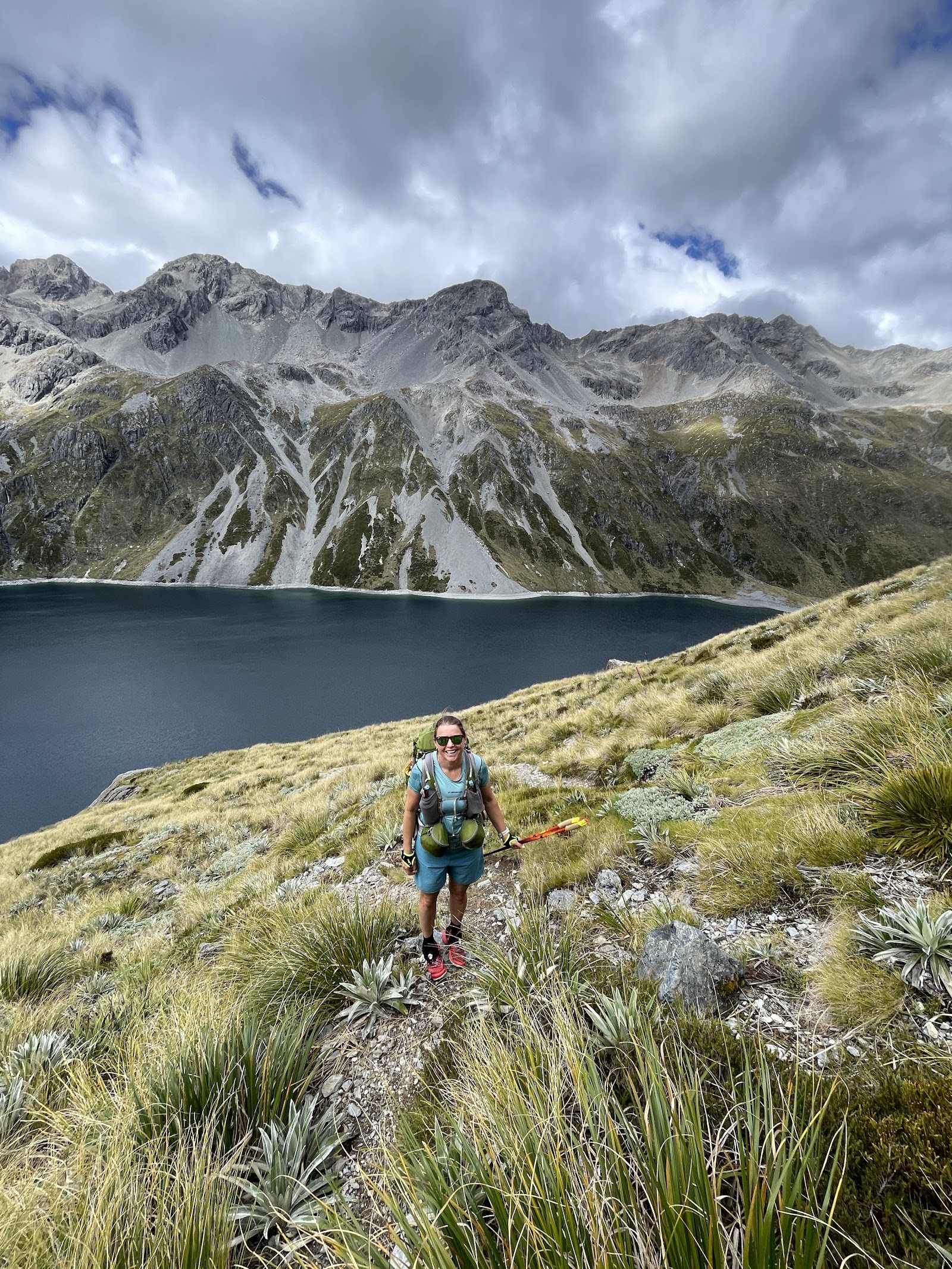
Then came Blue Lake and Lake Constance.
It took an hour of scrambling on hands and feet up a zigzag scree trail to the top, at 1,870 metres. Sitting up there knowing they'd beaten the weather and could carry on was an amazing feeling. Coming down the other side was rock climbing with a big pack, which is hard when your companions' limbs are longer than yours.
In the dark they thought about putting the tents up, then pushed on and reached Waiau Hut at 9.15pm, after 13 and a half hours. The weather bomb hit overnight, and they met someone the next day whose tent had ripped in it. Alice, on the top bunk with everything aching, didn't sleep well.
St James Walkway and Hope Kiwi: days three to five
Day three: the ultra on the easy day
Day three was meant to be easy, so they left at 9.30am. They joined the St James Walkway, part of Te Araroa, and the drizzle turned to rain. They reached Anne Hut at 2pm, with the fire going, and looked at each other. Too early to stop. "Let's push on" became their mantra.
The St James has good bridges, but one creek was raging after the rain. Her friend leapt it, and with her help, and some careful risk assessment, Alice made it across.
They passed Rokeby Hut, a pretty basic hut, and pushed on 3 kilometres to Boyle Flat Hut, a serviced hut that was immaculate. That made 45 kilometres in nine and a half hours, with 900 metres of climbing: an ultra on their easy day. A friend had told Alice she wouldn't be doing much running on a trip like this, and she wished they could see her running in the rain.
Day four: food drop and hitchhiking
They'd sent a food parcel to the Boyle River Outdoor Education Centre. Their tip: it's kept in a container, so on a hot day their chocolate had melted (still tasted like chocolate). Don't send yourself a block of cheese.
At the Lewis Pass road there are three options: cross the river (too high for them), walk 10 kilometres along the main road, or hitchhike. Te Araroa walkers had made hitching sound easy. It took 40 minutes, which she blames on the Crocs again. They aimed for Hope Halfway Hut, pushed on, and reached Hope Kiwi Lodge, more like an old farmhouse, at 5pm after 30 kilometres.
Day five: Hurunui hot spring
Day five on the Hope Kiwi track had a cool swing bridge over the Hurunui River, fungi and birds, and more than once they said thank goodness this wasn't GODZone.
They hadn't had a swim yet, and they were very excited about finding the hot spring and cleaning their bodies. Her tip for finding it: when you see water running down a rock face, touch it. If it's warm, you're in the right spot. Keep walking a little and there's a sign up to it. It's been concreted into a pool, and the sandflies are real, so they didn't last long in the water.
That night they stayed at Hurunui No. 3 Hut, which had bunks three storeys high. They'd expected to tent a lot on Te Araroa, so Alice was using hut tickets, but when there's a hut, you stay in it. By the end she worked out she owed DOC $50, so she emailed them, and they sent their bank details and were really grateful she was honest.
Harper Pass, Goat Pass and Lake Mavis: days six to eight
Day six: Harper Pass
Day six went over Harper Pass, from the Lewis Pass side towards Arthur's Pass. The weather wasn't flash and they couldn't see much at the top. On the way down, the plants started to look different.
A 1930s plan to make this area a tourist destination like the Milford Track left five huts and nothing else, which makes it ideal for hut bagging. Alice bagged 20 huts on this trip.
That night they tented about two kilometres from the main road, hearing traffic and the train after days in the backcountry. Tenting is very brave for Alice, and her friend kindly carried the light two-person tent and the Jetboil.
Day seven: Goat Pass and a swim in Lake Mavis
Day seven crossed Goat Pass, on the Coast to Coast run route. Alice had done the Coast to Coast as a team in 2008, and it's a really cool section: boulder hopping, river crossings and whio. They had one fright in the river, linking up to get through a section. It's so important to be really careful and make sure the river isn't too high. Alice also had her first cold swim, seven days in.
At Goat Pass Hut, Alice wanted to go and see Lake Mavis, off the track above the hut. They stood looking up at it, doing the maths with the topo on their phones. Then Alice said YOLO, and that's all her friend needed to hear. Within 10 minutes they'd grabbed their locator beacon, snacks and a drink, told the people in the hut where they were going, and set off. It added two hours, five kilometres and 750 metres of climbing to their day.
At the lake, Alice said she had to get in. This from someone who doesn't like water. It was freezing, so she stripped down to her birthday suit while her friend filmed. Waiau Pass and Lake Mavis were the highlights for both of them.
Day eight: the finish
Hunters came in at 12.30am for dinner, so Alice slept terribly, and on the final 14-kilometre day she was exhausted while her friend was high on life. Alice messaged her husband an ETA through their locator beacon, and he was waiting with a bottle of alcohol-free bubbles, which they sprayed everywhere.
Celebrating matters to her, whatever Instagram says about doing the whole trail.
"two mums out there doing an eight-day trip, we nailed pretty much all of our goals."
The final stats: 254 kilometres, 8,000 metres of climbing, 70 hours of moving time and 20 huts bagged.
I'm all about celebrating. If something is big or meaningful to you, it's worth celebrating, no matter what anyone else says.
Fastpacking mindset and getting started
The biggest challenges were fighting the weather and fighting the pain in her legs.
"It's amazing how a bit of belief in yourself can get you through."
Both of them did a lot of self-talk. On the ultra day, Alice kept repeating to herself, "I can do hard things." That night in bed, she thought maybe she can.
She doesn't want an eight-day trip to put anyone off. Find something that would be a lot of work in one day, add a jog, and make it achievable. Even with a lighter pack on a normal tramp, you can jog the downhills.
As a parent she mostly goes solo, because it's easier, and sometimes she doesn't know where she's going until she's driving there.
Next on her list are more of the passes on Te Araroa (she's done her local section, the Two Thumb Track) and more of the Great Walks. Her kids are getting right into tramping too, so summers are packed. When she bought her expensive gear, she told her husband she'd need to use it once a month to make it worthwhile, so her goal is a bikepack or fastpack about once a month.
I'd love to do St Arnaud to Lewis Pass, which people say is one of the most beautiful parts of Te Araroa, maybe all the way from the Richmond Ranges. That would take me about 10 days, not three.
Alice's advice for getting into fastpacking: work with what you've got, slowly make changes to your gear, give it a crack and make it your own.
Places from this episode
- St Arnaud
- Upper Travers Hut
- Travers Saddle
- Blue Lake
- Lake Constance
- Waiau Pass
- Waiau Hut
- St James Walkway
- Anne Hut
- Rokeby Hut
- Boyle Flat Hut
- Lewis Pass
- Hope Kiwi Lodge
- Hurunui River
- Hurunui No. 3 Hut
- Harper Pass
- Goat Pass
- Lake Mavis
- Arthur's Pass
- Angelus Hut
- Timaru
Follow Alice
Alice shares her trips on Instagram, and runs the Fastpacking New Zealand Facebook group and a Fastpacking NZ Instagram page, where stories are sorted by region.
Links from this episode
- Follow Alice on Instagram: instagram.com/aliceinthehills/
- Follow Abigail on Instagram: instagram.com/abigailhannnah
- Follow Aotearoa Adventures on Instagram: instagram.com/aotearoa_adventures_
More like this
- Hiking the Three Passes Route from Arthur's Pass to Hokitika with Pat Nolan
- Exploring the Nelson Lakes National Park with Mel White
- Setting the Fastest Self-Supported Record on Te Araroa with Billy Meredith
- Tramping Four Epic South Island Hikes in 10 Days with Stacey Walker
Until then, keep adventuring :)
The ultimate
NZ road trip adventure guide
Packed with insider tips and stunning photography, this is the only resource you need to plan your journey.