
Spotify Apple Podcasts Everywhere else Download
Rob Hutchings swam the full length of the Clutha River. All 256 kilometres of it, from Wānaka to the Pacific, after a harbourmaster told him only an idiot would try.
Rob is a chiropractor and triathlete from Corner Brook in Newfoundland, Canada, and he moved to Christchurch with his wife just over four years before we recorded. He's been a triathlete and marathon swimmer since he was 13. His plan here is to see as much of New Zealand as he can from the water (and from a bike, and on foot).
And me? I'm not a confident swimmer in any way, so hearing about swim days of the better part of ten hours blew my mind. Completely.
So we go right back to how a kid who was hopeless at ball sports found the pool, then through the lakes and rivers he's swum since arriving, how he planned the Clutha, the whirlpools and gorges, the kayakers who kept him safe and his tips for starting open water swimming. Plus the swims still on his list, which are soooo ambitious.
In this episode
- How Rob found swimming and triathlon
- Swimming New Zealand's lakes and rivers
- Planning the Clutha River swim
- River swimming, rapids and whirlpools
- The kayak crew behind the Clutha swim
- Wānaka to the Pacific down the Clutha
- Lake Tekapo, the Cook Strait and Milford Sound
- Cycle touring and wild triathlons
- Tips for starting open water swimming
- What's next for Rob
How Rob found swimming and triathlon
Rob doesn't think he inherited his sense of adventure. As a little kid he was always running around the forest at home in Corner Brook, Newfoundland, a place of mountains, rivers and lakes that's very similar in many ways to New Zealand. Winters meant downhill skiing, snowshoeing and snow forts, and the rest of the year he was out in the bush getting dirty.
He wasn't a talented athlete. He tried basketball and baseball, and worked out that anything involving a ball wasn't going to work. After a miserable season as a bench warmer in his grade 7 basketball team, he spent most of a year not being active at all. Then, at nearly 13, he looked in the mirror and decided he didn't want that. He remembered how much he'd loved splashing around in the water as a little kid, and joined the swim team that afternoon.
One of the top triathletes in Canada at the time lived in his hometown and trained with the team. Rob went up to him with all the courage a 13-year-old could muster and said he wanted to be a triathlete too. An older kid scoffed that he could never do a triathlon, but the triathlete said there was no sense in not helping him, and took him under his wing. What Rob remembers thinking:
"I don't know who I am yet. But whoever I'm going to be, I'm going to be a triathlete."
His first triathlon was an unmitigated disaster. By 16 and 17 he'd found his feet. At a race in Truro, Nova Scotia, aged 17, he stood at the water's edge sure the older athletes would beat him on the bike and the run. Thirty seconds before the gun, he decided he'd leave everyone behind in the swim and make them work to catch him. He came out way in front, and only the top pro passed him, with Rob nearly running him down for second.
He went on to qualify for the Canadian national team. At 47 he's less competitive, and spends his time on triathlon-related adventuring: swimming, cycling, running, or two or three together, as often as he can.
Swimming New Zealand's lakes and rivers
Rob jokes that New Zealand is a lot like Canada, minus the bears, so nothing in the wilderness thinks you look like lunch.
It still blows my mind that nothing in the bush here can hurt you. I grew up in India, where snakes, tigers and bears mean the bush is not a safe place. Here we've got possums.
Rob's counter: the sheep can be pretty scary.
He'd never swum a river before he came here. His first was an event in Te Anau run by the FEAR Society (the Fiordland Endurance and Adventure Racing Society): across Lake Te Anau, into the Waiau River and down it, then across to Lake Manapōuri and out on the beach. When he heard the Waiau was a Lord of the Rings filming site, he was in.
Since then:
- Lake Coleridge, twice. Rob says he was the first person to swim across it. In March of the year we recorded, a friend swam it with him and became the third.
- Lake Tekapo, over Waitangi weekend in 2021.
- Lake Pukaki, attempted in February of the year we recorded, until the weather turned really bad. He plans another go.
- The Buller River, twice, the lower Buller from around the Old Ghost Road down to near the mouth. The upper Buller has too many rocks, even by his standards.
- The Clutha River, the full length, from Wānaka to the Pacific in February 2020, just before COVID. His most epic swim ever.
Planning the Clutha River swim
After the Waiau, Rob asked the race director whether he could swim any other rivers here. The director suggested the upper Clutha for a three or four hour swim, and said the full length was way too long.
Rob went home and googled it: 256 kilometres from Wānaka to the Pacific, the second longest river in the country and, as Rob puts it, by far the biggest by water volume. Too long? We'll see about that.
He emailed the harbourmaster in Otago, explained he was an experienced adventurer and marathon swimmer, and said what he wanted to do. The reply: that would be impossible and only an idiot would try it. Rob decided he was that kind of idiot.
Is it even swimmable?
First he had to find out whether any sections were too rocky to swim, even for someone pretty crazy. From Google Maps and Google Earth, he could tell he'd get down to Alexandra. The stretch around Beaumont, above Balclutha, he couldn't tell. It turned out fine, with some rock dodging. His rule was to swim as far as he safely could, and walk or drive around anything too rocky.
For Rob, the logistics were the biggest challenge. Planning isn't his forte: he's the person who looks at a map, decides he can obviously cycle from A to B in a day, then finds the map doesn't look like real life. A kayaker getting hurt could have stopped everything, and the fact no one had done it before was daunting. Once he was swinging his arms in the water, he was confident, as long as the weather held.
The flood three weeks out
Three weeks before his start date, a severe storm flooded the Clutha. Its average flow is 600 cumecs (cubic metres of water per second), and kayak tour companies cancel above 800, which Rob took as his own cue to get out. Three weeks out, the river hit 3,200 cumecs. Had he planned the swim three weeks earlier, it couldn't have happened.
River swimming, rapids and whirlpools
People ask Rob whether he'll swim up or down the river. He takes it as a compliment, but Michael Phelps couldn't swim up the Clutha, and Rob is not Michael Phelps.
Downstream you go faster, but the stroke is harder work, because your arm under the water is pushing against the oncoming current. On the Clutha and the Buller there are twists, turns, rocks and rapids, and the Clutha has several giant whirlpools ("and I do mean giant"). A river means sprinting around corners, out of eddies and through rapids at irregular times, with long calm stretches between. Rivers vary: the Pelorus is mostly slow moving.
Rob swam some grade 3 rapids on the Clutha. He wouldn't swim grade 4 or 5.
Devil's Nook
Devil's Nook is a hairpin bend where, if you don't get round it the right way, you slam into a rock wall. Rob says it's where the most kayak tourists get rescued on the Clutha. With his kayakers guiding, they picked the lines perfectly: one of his favourite 90 seconds of swimming ever.
Going with the flow
In his book, Rob compares river swimming to life: you have the skills to navigate, but you don't control the outcome.
"one of the things about river swimming is that you're just not in control and you just got to go with the flow, literally and figuratively"
His second Buller swim was planned on weekend after weekend before the river cooperated. Too high, too low, and one weekend both support kayakers had COVID.
Rob used to be bullheaded about nothing stopping him. A few things going wrong in life, and the first race he ever failed to finish, taught him there's merit in knowing when to switch course. On a 16-day trek in Bhutan, which he did for the culture, a training mate had asked why bother when the passes only reach around 5,500 metres. Standing on that pass, Rob decided he didn't need to go higher to prove anything.
In the previous episode, Alastair and Hamish climbed all of New Zealand's 3,000-metre peaks one after another, going as far as they could without the pressure to finish. I think that open mindset matters whenever you take on something impossible.
The kayak crew behind the Clutha swim
Rob had kayakers lined up long in advance, until both had to pull out in November. He posted on a Facebook kayaking group, and a trail running friend passed it to two Queenstown kayakers, who volunteered and became really good friends. On day two, one joked that a goal of whitewater kayaking is to not have people in the water, and Rob was in it the whole time.
How it worked:
- Out front with a radio. One kayaker stayed ahead with a VHF radio, calling back what was coming: a left turn, a rock, push him river right or river left, punch down the middle.
- Alongside with the food. The other relayed those calls and fed Rob energy drinks, gels, bars and a lot of bananas. She was an emergency room nurse, a good person to have along.
- On the road. His wife drove the support van, made all their meals and scouted exit points, finding another spot whenever a planned one didn't work.
Rob calls his wife the unsung hero of the Clutha: she worked as hard as he did, while he'd get out of the water and promptly become useless. And his message to anyone tempted to swim down a river on their own: don't. You need support.
My husband is studying outdoor education, and he'd been away on a canoe trip the weekend before we recorded (I clearly picked the wrong degree). Whitewater kayaking is one of his skills, so I know a bit of the lingo now.
Wānaka to the Pacific down the Clutha
Rob swam it in February. Even as a Canadian, he wouldn't do it in July.
It was a stage swim: the morning in the water, lunch at a pre-planned spot, an hour or so to let it settle, then back in for the afternoon. The longest day was the better part of ten hours. It took four and a half days of swimming, five days all up, and by the time he was above Balclutha his shoulders weren't terribly happy. It's the longest expedition he's done.
Alexandra and the man by the boat ramp
They reached Alexandra early, but there's only one exit point in the Roxburgh Gorge, so it was too late to start it that evening. Rob got out at the Alexandra boat ramp, right next to a no swimming sign. A man in a camping chair, watching his kids play, saw someone in a wetsuit emerge from the Clutha and asked who he was and why he was doing this. That scene opens Rob's book.
The highlights
- Lake Wānaka outlet. Getting into the water there, Rob was channelling Forrest Gump going for a little swim for no particular reason. Cheesy, and he doesn't care.
- The rapids. Every single one was thrilling.
- Roxburgh Gorge. Moving water, but tame, with no rapids, past old ruins from the gold mining days. A news team followed them on day two, so people cycling and walking the gorge called out to him.
- The river mouth. It was too violent to swim through, so Rob swam right up to the sandbar between the Clutha and the Pacific, with his wife there and the moment on video.
Of the Roxburgh Gorge, he says:
"if there was a river on the moon. That's probably what it would be like"
What struck him most was how the river changes: alpine Wānaka with its lake and mountains, then the Cromwell Gorge and the Roxburgh Gorge, completely different from each other, then rolling farmland towards Balclutha, then the Pacific. He sees plenty of it, looking to the side with each breath, and these days he isn't afraid to stop, lie on his back and take it in.
If you'd rather not swim it, you can kayak most of the river, power boats are allowed on some sections, and the upper Clutha and the gorges have cycling and walking trails alongside.
Lake Tekapo, the Cook Strait and Milford Sound
The Cook Strait is on Rob's list. When we recorded, it carried a $6,500 price tag, and as a busy shipping channel it needs special permission.
His wife is Australian, and Lake Tekapo's blue water amazed her. On their first weekend away after moving here, at Tekapo in winter, she pointed out that a Cook Strait swim could blow the season's whole adventure budget on one day, which the weather could cancel. Then she pointed at the lake: if he swam across that in summer, would he have a worse time, for the cost of a hotel room and a pizza for his kayak supporter? When he did swim Tekapo, the supporter wanted a curry. The whole Clutha swim cost a fraction of a Cook Strait crossing.
The length of Milford Sound
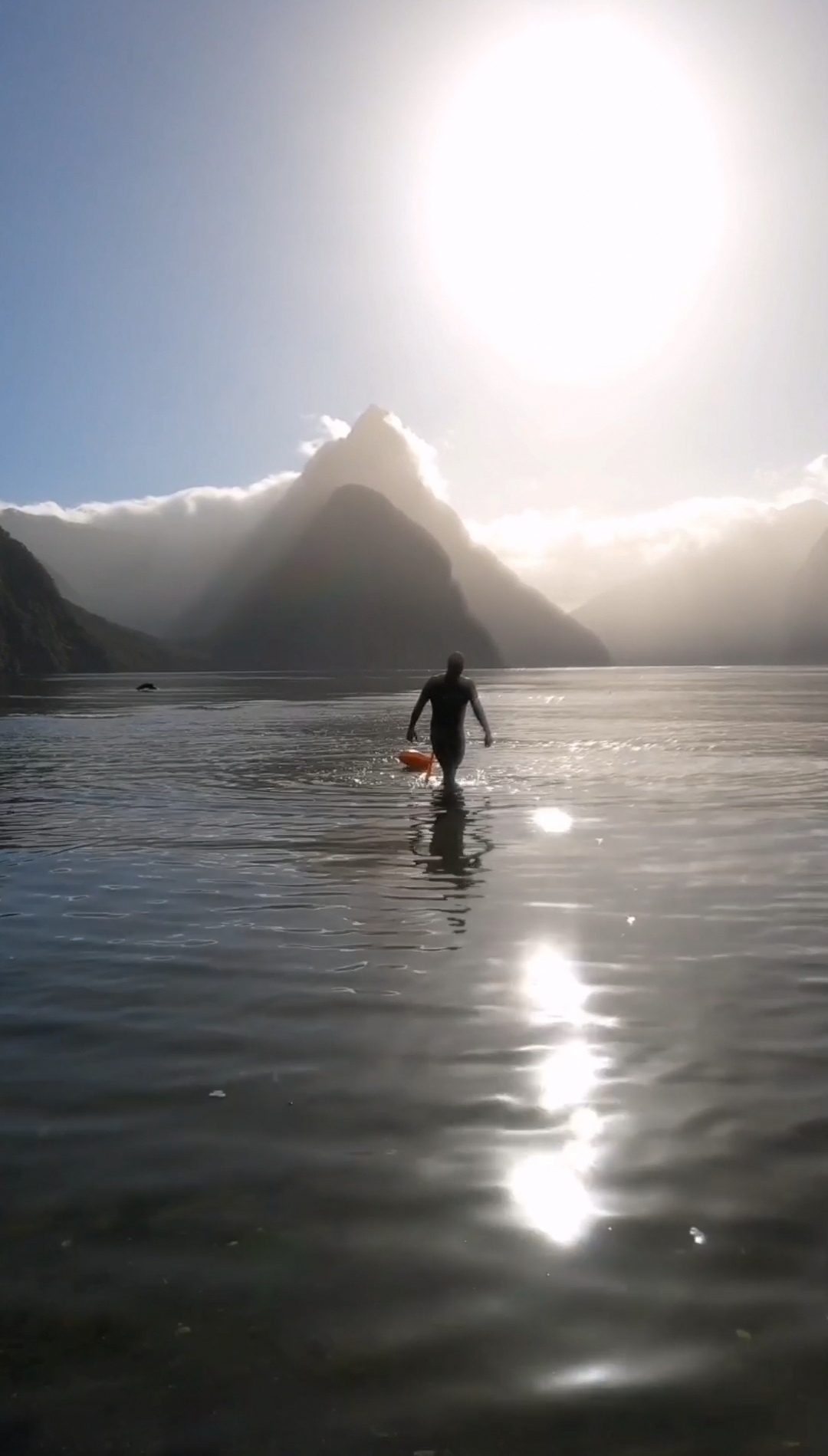
On Easter Sunday of the year we recorded, Rob swam the length of Milford Sound, with his wife on the support boat and friends in kayaks. Three dolphins swam under him, so he stopped to watch, and more than once he stopped to look around the fiord, one of the most incredible spots on earth. As he finished, people on a tour boat called out to him. Doubtful Sound is next on his wish list.
Cycle touring and wild triathlons
Rob's favourite holiday is a marathon swim followed by tramping or cycle touring. After Milford Sound, he and his wife cycled from Te Anau to Queenstown on the Around the Mountains Cycle Trail. He loves seeing the world at the pace of a bicycle, and has done the Otago Central Rail Trail and the West Coast Wilderness Trail. On that West Coast trip they had good weather through Hokitika and Franz Josef, apart from one day of rain in full West Coast force.
He also strings sports together into what he calls wild triathlons:
- Buller, Paparoa, Avalanche Peak. He swam the Buller one day, rode the Paparoa Track on his mountain bike the next, and ran Avalanche Peak with a group on the third.
- Lake Coleridge, then a traverse. The day after a Lake Coleridge swim, he did the Avalanche Peak to Bealey traverse, two thirds of a triathlon.
A while ago I talked to a father and daughter who cycled the length of the country, and I hadn't realised how many dedicated cycle trails there are here, with heaps for beginners. It's on my bucket list now.
Tips for starting open water swimming
Rob's advice for real beginners:
- Start where you're at. Don't go from a handful of pool lengths straight to big lakes or the ocean.
- Find calm water. Small lakes, ponds and quieter beaches. In Christchurch, Corsair Bay is calm most of the time when it isn't windy. A few hundred metres along a buoy line is a good start.
- Wear a wetsuit. As a Canadian, Rob reckons any water that isn't frozen is warm enough, but he's a redhead out in the sun for hours, so he wears one.
- Get used to the cold. Take cold showers, then get in the water and back out, again and again. Thermal gloves, booties and hats help.
- Tow a safety buoy. A neon one behind you means boaties can see you, and your kayaker won't lose you.
- Ask for kayak support. Rob posts in Facebook kayaking groups, and someone always helps.
I struggle to get into any water in New Zealand, because the ocean where I grew up in India was tropical. Cold showers it is.
What's next for Rob
His list, as it stood when we recorded:
- Lake Pukaki, again, ideally with the wind blowing towards Mount Cook, which was covered in cloud on his first attempt.
- Foveaux Strait, from Stewart Island to Invercargill (he's been told the currents and tides rule out the other direction), followed straight away by the multi-day tramp on Stewart Island that's one of the Great Walks.
- A Clutha River triathlon: swim a section, bike and run around it, then swim the next, to see more than he could from the water.
- A summer in Wānaka, swimming the upper Clutha and the upper Kawarau as far as the bungy bridge, and cycling the Clutha Gold Trail with his wife.
- The Clarence River, with an attempt planned for the coming New Year.
If you'd like to join him, Rob says he isn't the fastest: in still water he'll swim 10 kilometres in three hours or less.
He works full time as a chiropractor, so most adventures are a week at a time, and the Clutha was a week off work. Soon after finishing it, three or four weeks before the first lockdown, he decided it would make a cool ending for the adventure book he'd always wanted to write. He started on the second day of lockdown. It's called Downriver Nomad, it's available online, and Kiwis can get a signed copy from him directly. He also made a homemade documentary of the swim, on YouTube, and is working on a second book about resilience.
Places from this episode
- Clutha River
- Lake Wānaka
- Cromwell Gorge
- Roxburgh Gorge
- Alexandra
- Beaumont
- Balclutha
- Devil's Nook
- Lake Te Anau
- Waiau River
- Lake Manapōuri
- Lake Coleridge
- Lake Tekapo
- Lake Pukaki
- Buller River
- Old Ghost Road
- Paparoa Track
- Avalanche Peak
- Milford Sound
- Cook Strait
- Foveaux Strait
- Stewart Island
- Corsair Bay
- Around the Mountains Cycle Trail
- Otago Central Rail Trail
- West Coast Wilderness Trail
- Clutha Gold Trail
- Kawarau River
- Clarence River
Follow Rob
- Instagram: @downriver_nomad
- Facebook: Rob Hutchings
- Strava: Rob Hutchings
Links from this episode
- Request a signed copy of Rob's Book: The Downriver Nomad
- Follow Rob on Instagram: instagram.com/downriver_nomad/
- Follow Rob on Facebook: facebook.com/rob.hutchings.142/
- Follow Rob on YouTube: youtube.com/channel/UCLrTEAKTmygJW-6jxwPKzcQ
- Watch the Clutha River documentary: https://www.youtube.com/watch?v=WeIW6ioSHZA&t=1s
- Watch the Milford Sound Swim: https://www.youtube.com/watch?v=2ToVTEwwmbQ
- Read the Clutha River Swim Blog Post
- Follow Abigail on Instagram: instagram.com/abigailhannnah
- Follow Aotearoa Adventures on Instagram: instagram.com/aotearoa_adventures_
More like this
- Crossing the Cook Strait on a Paddleboard and Surf Lifesaving with Britt Spencer
- Jetboating 27 Wild Rivers on a Solo Trip with Ollie Sharpe
- Packrafting the Landsborough River from the West Coast with Tom Waters
- White Water Kayaking and a Harrowing Accident with Ryan Lucas
Until then, keep adventuring :)
The ultimate
NZ road trip adventure guide
Packed with insider tips and stunning photography, this is the only resource you need to plan your journey.