
Spotify Apple Podcasts Everywhere else Download
This one was a long time coming. Climbing was one of my outdoor passions, and the whole idea of this podcast was to talk about all the different things you can do outdoors. And yet it took me 140-something episodes to get a climber on. (In my defence, I did ask a few. Nobody was keen.)
So thank you, Josh, for breaking the streak. Josh started climbing in 2019, when some friends asked if he wanted to try the gym, and he bought his own gear the very next day. These days he's climbing two or three times a week with a goal of hitting grade 27.
This is our climbing 101. We break down all the lingo (bouldering, top rope, lead, trad, beta, crux), how New Zealand grades work, and what multi-pitch climbing is like at Kawakawa Bay, his favourite crag in the North Island. Then the mental side, the community, and how to find your way from the gym to real rock.
In this episode
- How Josh got into climbing
- Climbing 101: bouldering, top rope and lead
- Trad climbing explained
- Chasing grade 27 around a full-time job
- How climbing grades work in New Zealand
- Multi-pitch climbing at Kawakawa Bay
- Safety, fear and the mental game
- From the climbing gym to the crag
How Josh got into climbing
Josh always loved climbing trees as a kid, and he reckons that's where it started. His family didn't do outdoor stuff when he was growing up: no hikes, no camping. It wasn't until he went out on his own and started hiking, mountain biking and getting into the bush that he realised what he'd been missing. Now he's always outdoors, and he's making up for lost time.
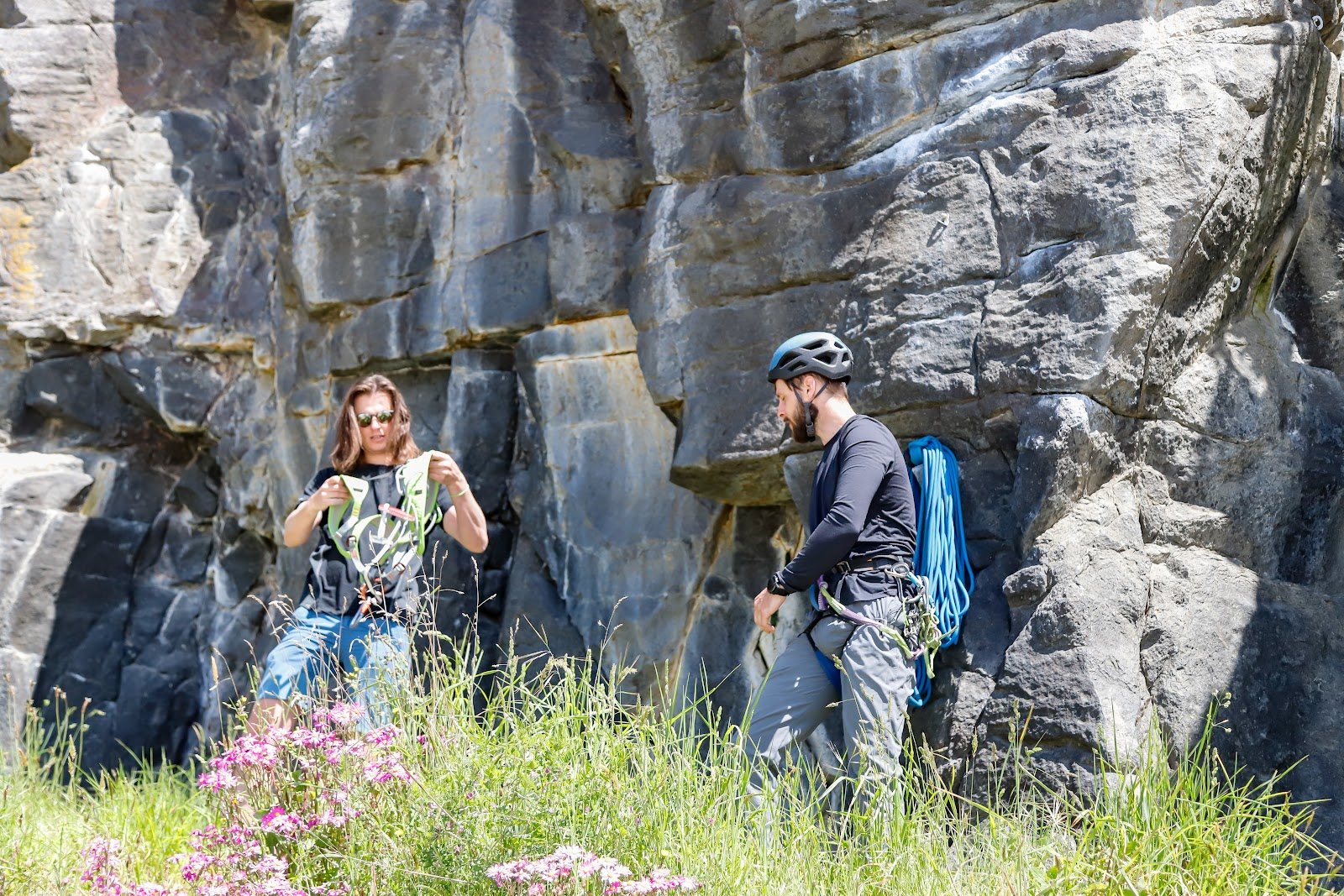
He started climbing in 2019, when his friends asked if he wanted to try the gym. He hired a harness, loved it, and the next day bought his own harness, shoes and chalk bag. The rope, quickdraws and helmet came a bit later. Climbing hooked him because it uses everything you've got:
"It uses your brain, it uses your body and it's just fully encompassing and it's quite satisfying every time you complete a climb, … even a move on a climb, it's just so satisfying."
My introduction was a lot like his. My boyfriend at the time (now my husband) used to climb as a kid and suggested we check out the gym. We started on gym harnesses and gym shoes, then got our own, then a rope and gear.
Climbing 101: bouldering, top rope and lead
There are three main types of climbing, Josh explains: bouldering, sport climbing and trad.
Bouldering
Bouldering is you, your climbing shoes and chalk. The shoes have a lot of rubber so they grip the holds, and chalk soaks up the sweat, because it's hard work. There's no rope. At the top you jump down onto big crash pads, or sometimes walk off.
Top rope and belaying
Sport climbing comes in two main types. On top rope, the rope runs up to an anchor at the top of the climb and back down. The climber ties into one end, and the belayer is on the other. As the climber goes up, the belayer pulls in the slack, so if the climber falls or finishes, the rope catches them. It's really safe.
If you go into a gym for the first time, you'll be top roping. The ropes are already set up, the gym gives you a belay lesson at the start, and you always climb in pairs: one person climbing, the other on a belay device keeping them safe.
Lead climbing
Lead climbing is more of an outdoor thing, though you can do it indoors. The belayer gives slack instead of taking it in. As you climb, you clip a quickdraw into each bolt in the wall, then clip your rope into the quickdraw. If you fall, you fall from your last clip, so the spacing matters: bolts could be every metre or two, or further apart if the route is run out.
I learned to lead outdoors in Laos, at Green Climbers Home, where the bolts were really close together: one move, clip, safe again. On a lot of outdoor climbs in Aotearoa, you're sometimes two or three metres off the ground before you can clip in, which always freaks me out a little.
Josh says that's part of climbing: the mental challenge.
Trad climbing explained
Josh has done a little trad, short for traditional climbing. He knows he'll enjoy it and he isn't scared, but it's a big commitment to gear, so he isn't ready yet.
Sport climbing has bolts drilled into the wall. Trad climbing follows cracks in the rock, and you place your own protection as you go:
- Nuts are cubes of metal on a wire. You slot one into the crack and pull it down until it wedges, then clip a quickdraw to it and your rope to that.
- Cams have two semicircular pieces of metal. You squeeze them thinner, put the cam in the gap and let go, so it widens and pushes against the sides of the crack. Pull on it and it doesn't come out.
A really solid placement is called bomber: you could fall on it any day. Cracks come in different sizes, so trad climbers carry a whole rack, and you can hear them walking round the crag jingling like it's Christmas.
Chasing grade 27 around a full-time job
For his first four years, Josh climbed pretty casually, mostly in the gym, once a week or so with a mate. If the mate couldn't climb, neither did he. About two years before we recorded, he was wandering a bit in life and decided he needed a goal: grade 27.
So he made the effort to get into the climbing community and build a group of friends. Now he climbs two or three times a week, and it doesn't matter how hard your climb is: your belayer isn't belaying any harder for it. It's your own battle.
As Josh puts it:
"the question isn't am I climbing this weekend it is where am I climbing this weekend"
For a lot of those two years he was in an office, working 10 hour days and 50 hour weeks. So he set a schedule: every Tuesday and Thursday at the gym, however tired he felt, because getting there is what matters. Weekends are for climbing outdoors, one day or two. He isn't training hard for strength yet. He's at a level where he can still climb, enjoy it and keep getting better, and he's become very aware of how much technique matters, and how much flexibility he lacks.
I'm shorter than my husband but super bendy, so I can get my legs up high, and he's taller and stronger. Everyone approaches a climb differently, with different moves for their body and strengths. Josh says tall climbers get the "tall man beta", skipping holds because they're long and lanky.
How climbing grades work in New Zealand
Almost every part of the world uses a different grading system. We're using the Australian and New Zealand grades for sport climbs, where a higher number is a harder climb (bouldering has its own grades). If you're listening from overseas, look up a conversion chart.
When Josh was new to the gym, he was climbing 15s and 16s, the beginner section. Some people climb a 19 or 20 on their first go, which he calls naturally strong, but technique matters more on the higher grades. His hardest so far, on the road to 27, is a 24, outdoors. He's loving the journey too much to push hard for 27 yet.
Grades are only a guide. There's no formula of holds and moves: someone decides what a climb is, and other people agree or disagree. The angle of the wall makes a big difference too. Vertical is straight up and down. In Josh's words, a wall leaning forwards is slab, and one leaning backwards from vertical is an overhang. Josh sometimes struggles on an 18 slab that slab lovers breeze up.
When I was climbing regularly, I was hitting 18s and 19s fairly comfortably on slab or vertical, but on overhangs, where I don't have the strength, I was back on 14s and 15s. You'll get a super easy 21 and then struggle on a 17.
Multi-pitch climbing at Kawakawa Bay
Josh lived in Hamilton, which has three or four crags within 30 to 40 minutes, each with different rock, some 30 metres high. They're perfect for climbing after work.
His favourite in the North Island is Kawakawa Bay. Every climber raves about it, and you think it can't be that good. It is that good.
He went for New Year. You drive to Taupō, then either take a boat in or walk. His group hiked in with their ropes and gear (ultralight hikers would hate carrying a 60 to 80 metre rope), while the boat lets you bring more, like chilly bins. The crag is right next to the lake, with lots of places to camp. About ten of them were there on New Year's Day, in beautiful weather. They set up their tents and went climbing. There are so many walls.
Kawakawa Bay is where Josh did his first multi-pitch.
I haven't done multi-pitch yet, so I had a lot of questions.
How multi-pitch works
On a normal sport climb, your belayer lowers you from the top. On a multi-pitch, the leader climbs to an anchor and becomes the belayer, bringing the second climber up from below. Then you do it again from that anchor, and again, so a wall a hundred metres long might be four pitches. Your rope isn't long enough to do it in one, it's safer, and because the bolts wander, a single long pitch would zigzag and create a lot of rope drag.
Belaying from the top is different. Most of the time you can't see your climber (some people use walkie talkies). You pull the rope up, coil it neatly in front of you, and keep a little tension without hauling them, because they've got to climb it themselves.
Some climbs top out after five pitches. A couple of pitches up, it's you on this cliff with a beautiful view of the lake and beyond. At Kawakawa Bay, there's a track along the top to walk out, though on some multi-pitches you have to abseil back down.
Safety, fear and the mental game
Most people have watched Free Solo, with Alex Honnold scaling Yosemite, and thought climbers must be mad. But most climbers use ropes, and everything we do on the wall is about safety: tying in, checking each other's knots and belay devices, checking again. There have been tragic fatalities, which is why those measures are there.
Josh admits climbers do have a slight edge, a little bit nutty, with some barrier in their brain that says they're not that high.
My husband is scared of heights, which surprised me, because he's the one who introduced me to climbing. In Tākaka, which has some really cool crags, he climbed a 30 metre pillar with views right across the sea, and roped in, he was all good. So even if you think you're scared of heights, maybe give climbing a go on the easy ones.
Josh has a friend who froze halfway up the wall the first time they took her outdoors. She battled through it, and the moment her feet touched the ground, she was back to being sassy.
It takes time, Josh says. Your first lead climb, with no rope above you, is terrifying, and your leg starts shaking (climbers call it Elvis leg). Over time you get more confident, because you've done it before and you know you can do it again. On top of the height, you're working out the climb itself. Sometimes you're tired, stuck and battling your own head, and you just have to take a breath.
Two more words for the lingo list:
- Beta is how to do a climb: the moves.
- The crux is the hardest move or sequence on the climb.
A belayer can often see the whole wall when you're too close to see where your hands and feet go, so beta from below helps. I've been on the wall asking to be let down, and my husband has said to give it one more try. One more try, and you're over the crux and at the top.
Josh also likes the idea that hardly anyone makes themselves scared anymore. Life is easy: you put your washing in a machine and press a button. Putting yourself on a wall, in a position to be scared, puts everything else in perspective.
From the climbing gym to the crag
The community is what makes climbing for Josh. He reckons he only gets through half his climbs because of it. Go to a gym you've never been to, and someone will try your climb with you and start talking it through. On a hard one, people shout "you've got it", and suddenly you do. He went along to watch a competition final recently, with a room full of people cheering the top six finalists through every move, and the energy was so cool. You can walk into any gym and be friends with anybody, because everyone's there to do the same thing.
I remember watching climbing at the Olympics for the first time, with bouldering, sport and speed climbing, and being on the edge of my seat. I haven't been to a comp at the gym yet, and maybe I should.
Josh's advice for anyone curious is to give it a go at your local gym. If you're an introvert, you don't have to talk to anyone, and if people start giving you beta, you can walk off and try another climb. Everyone knows you're new in your hired shoes, and that's fine. In Josh's words:
"give it your best and you could be doing the easiest climb in the gym and we'll be encouraging you"
Most of all, remember it's fun.
There are gyms everywhere now: Hamilton, a couple of big bouldering gyms in Auckland, and Uprising in Christchurch is pretty cool.
Lead licences and getting outdoors
The natural progression sounds backwards, Josh says. You start indoors on top rope, go outdoors, learn to lead outside, then come back to the gym and get your lead licence, because the gym is a business and needs one for safety.
I learned to lead outdoors in Laos because I was too scared to fall and get my lead licence indoors.
Outdoors, you need to know what you're climbing, because most routes aren't tagged. There are two ways:
- theCrag, which has almost every climb in the world. Search Auckland, for example, and up pops a seaside crag up north, with seawater underneath you. For each crag it shows the approach, the walls (often 10 to 20 climbs each), photos with lines showing where each route goes, the grade, the name (every climb has one) and how many quickdraws you need.
- Guidebooks. Dunedin has a brand new one, written as a thesis, and Josh is in it. Look for guidebooks at Bivouac or your local climbing gym. The catch is they go out of date when new climbs go up.
Places from this episode
- Hamilton
- Kawakawa Bay
- Taupō
- Tākaka
- Auckland
- Christchurch
- Dunedin
Follow Josh
- Instagram: @j.pharker, where he posts shoe pics of everyone he climbs with on his journey to grade 27
Links from this episode
- Follow Josh on Instagram: instagram.com/j.pharker/
- Follow Abigail on Instagram: instagram.com/abigailhannnah
- Follow Aotearoa Adventures on Instagram: instagram.com/aotearoa_adventures_
More like this
- Summitting Mt Earnslaw and Mountaineering for Beginners with Wiktoria
- A Mountaineering Career and Climbing Mt Aspiring with Dom Huxley
- First Ascents on Mount Lindenfeld and Mount Haast with Justin Wimmer
- Enchaining New Zealand's 3000m Peaks with Alastair and Hamish
Until then, keep adventuring :)
The ultimate
NZ road trip adventure guide
Packed with insider tips and stunning photography, this is the only resource you need to plan your journey.