Episode 081
Ski-Touring and Camping on Tasman Glacier in a Storm with Helena Sodergren

Episode 081
Ski-Touring and Camping on Tasman Glacier in a Storm with Helena Sodergren
Spotify Apple Podcasts Everywhere else Download
Confession: before this chat, I didn't even know you could ski on glaciers. So Helena had a lot to teach me.
She's from Sweden, she's been in Aotearoa since 2005, and she has a PhD in physics. She also coaches surfing, coaches horse riding, takes dogs out on adventures, and heads into the mountains to ski tour and climb. I'm still trying to wrap my head around how she fits it all in (she tells us).
So we get into how a horse rider from a Swedish farm ended up surfing in Dunedin, then her nine days camped on Tasman Glacier with a group of friends, including a snow and lightning storm she loved every minute of. Then there's a trip near Ball Pass where her pack decided to show them the way down. Plus the ice plateaus at the top of her bucket list.
In this episode
- From Sweden to surfing in Dunedin
- Getting into ski touring and mountaineering
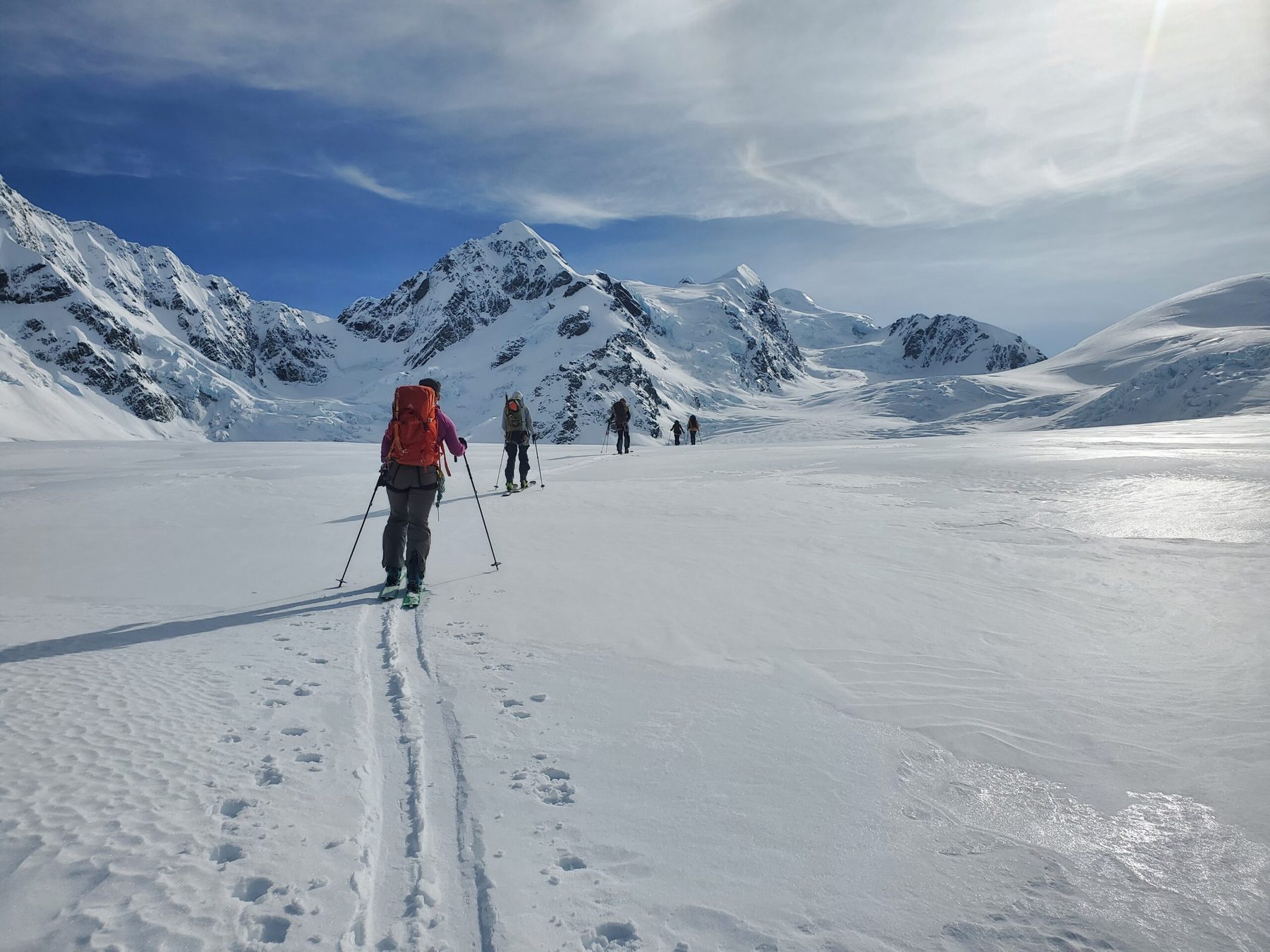
- Nine days ski touring on Tasman Glacier
- A lost pack on the way to Ball Pass
- How Helena fits it all in
- Helena's bucket list ice plateaus
From Sweden to surfing in Dunedin
Helena grew up on a farm in Sweden, far out in the bush and away from the cities. There was always a lot of forest and a lot of space outdoors, and that's where she thinks her love of adventure comes from. As kids they were always out running in the forest and building little tree houses. When she got her own pony, she explored all the trails, riding further and further away to see where she'd end up.
She's done horse riding for as long as she can remember. When she came to New Zealand in 2005 to study, she wanted a little break from horses, because there was so much of them in her life. Some friends in Dunedin told her she had to try surfing. She decided straight away she'd love it, and she got absolutely hooked.
At first she didn't really like New Zealand, because she was lonely. Then she got into the surfing community, and she's still here almost twenty years later. She admits there was more surfing than study at the time.
Dunedin's oceans are quite cold and rough, though you get good wetsuits. Helena didn't know anything else. She'd never heard of surfing in bikinis or on nice gentle waves, so she got out there.
I hate cold water, so I'm slowly getting used to New Zealand seas. Every summer I get a little bit better, and this summer I've had so many swims in the ocean, which I'm super proud of.
These days Helena does a lot of things for work in Dunedin. She coaches surfing at the local surf school and with high schools, where she also helps with PE classes, mountain biking, kayaking and hiking. She's a self-employed horse riding coach, and she takes dogs out for adventures one or two days a week. And she's a scientist: she finished her PhD in physics in 2017, and since then she's taken on shorter science projects as they come up.
Getting into ski touring and mountaineering
Helena did a lot of cross-country skiing in Sweden, where it's flatter and better suited to it than ski touring, and some downhill skiing as a teenager. Then she put it on the shelf.
After a whole summer working at the surf school, with nothing but sand and waves, she got a bit sick of it and went into the mountains. She started mountain biking, then hiking, then hooked up with some friends who did mountaineering and ski touring, and she was into it. It's a really good complement to surfing and the ocean.
Skiing in New Zealand is quite expensive, with ski field passes and equipment. Helena managed to find quite cheap equipment online, and ski touring means she doesn't have to spend much money on passes.
Nine days ski touring on Tasman Glacier
Every year, Helena and a group of friends head up onto the glaciers to ski, because the snow is better there and the whole environment is amazing. They usually camp. Last year, the seven of them decided to stay as long as they could get time off work, which came to nine days on Tasman Glacier.
They flew in by helicopter. You can hike in, but it's a long, rough hike and it wears out your ski boots. They camped on the lower part of the glacier and used it as a base, heading out on day trips all over the glacier. They'd decide the night before where to go next, depending partly on the weather.
Planning each day on the glacier
The best time to go is later in winter or early spring. There's a lot of ice and crevasses up there, and you want the crevasses filled in as much as possible for better skiing conditions.
The maps are quite accurate, so they plan from the maps, then look at the conditions and the weather for the day:
- Sun on certain aspects. They might go earlier on those slopes, to avoid avalanche risk from heated snow.
- After a big snowfall with wind from one direction. It can be better to pick a slope on a different aspect, to avoid loaded snow and avalanche risk.
Helena finds mountain safety quite overwhelming, because there are so many factors: the snowpack, its layers, and the weather pattern leading up to that day. She's been lucky to go out with people who know a lot, and she's learned from books and from avalanche and other courses. And she stays within her limits. She's quite conservative in the mountains.
Weak layers and thin snow bridges
Nothing big went wrong on the trip, but conditions were difficult that season. There was a persistent weak layer that every ski tourer was talking about. A weather pattern at the start of the season creates a weak layer underneath, and if you break it, a whole slope can go, so it can create very big avalanches. They were quite conservative because of it.
The snow bridges over the crevasses were also quite thin in places, so you have to be very careful, watch where you're going and look for bumps in the surface.
Sometimes they rope up, but most of the time they don't. On skis you spread the pressure over a big area, so you ski over the crevasses unless one is very big, and then you need some speed to get over it.
A snow and lightning storm
Out on a glacier for nine days, there's got to be a storm. They knew a big one was coming, so they prepared: they dug in, built walls around the tents and made sure the tents were pitched in the right direction.
Helena was in her element. Building those walls took her back to her childhood in Sweden, playing in the snow and making little snow houses.
The storm stayed for about 24 hours and was really really windy. It snowed and hailed, and at night there was a lightning storm at the same time, with lightning and thunder over the snow. She doesn't see that much at home in Sweden, and she found it pretty cool.
"I find it amazing and I love a good storm in the mountains … you trust your gear. You have good gear. You know you'd be all right. You know the tent's gonna hold"
You're warm, you have your clothes and enough food, so you enjoy it. And the next day was the payoff: powder everywhere, blue sky, sunshine, not much wind, and a really really nice day of ski touring. Another ski touring group came down that day, saw their tents and asked if they'd stayed there during the storm. For Helena, it's just another day.
Walking out and a PLB call
At the end of the trip, the helicopter could fit four people, so two of the group, who were really keen and like that kind of thing, decided to walk out. They repacked, and the walkers took all the sleeping bags, because they're light and take up a lot of space.
The weather was coming in fast that afternoon, with not much margin. To get off Tasman Glacier, you climb up through the moraine walls to a plateau. There's no track, just loose rock, and it's pretty gnarly. There had been a lot of rain, so the way out was washed out and didn't look the same. One of the two had been up there before and still couldn't find it.
They walked past it and kept going along the moraine wall. It was getting dark and the weather was coming in, so in the end they pulled the PLB, and a helicopter came in late that night to pick them up. Luckily they had all seven sleeping bags, so they were nice and warm.
Helena's reasoning: if the weather had been nice, they'd have been fine staying out overnight. But with weather coming in, if something had happened the next day and they couldn't get out, everyone would have been in trouble.
A lost pack on the way to Ball Pass
If Tasman Glacier was one of Helena's more awesome adventures, a trip near Ball Pass was one of the more memorable ones.
The plan was Ball Pass, cutting off earlier than the normal route from the Tasman side on an unmarked track, climbing a spur and joining the Ball Pass route further up. Things didn't go the way they expected. They climbed the spur to a really amazing lake and camped there. They were a bit slower than expected, so they decided Ball Pass would be too long, and took another route over the range from the Tasman Valley to the Hooker Valley.
The next day involved a lot of climbing, including one of the peaks, Mount Mabel, with amazing views and a bit of fun climbing that wasn't too scary. Coming down the other side, they joined the Ball Pass route above a spot where people often camp when they do Ball Pass. Then they weren't sure which way to go down.
There was a gully to the left and a gully to the right. While they were looking down the right one, they leaned their packs against a rock, and Helena's took off. She could hear her crampons clunking as it disappeared down the gully:
"my bag decided to take off … They're jumping over the bluffs and we were like okay now we know which way to go down."
So they followed her bag. It was really rough, with no route at all, and they found it a long way down. Then they kept climbing down towards Hooker Glacier. The map showed a nice flat terrace, and they found lots of washouts and rough, steep ground, with night coming on.
Helena got really tired and told her partner they had to stop. They found a ledge about half a metre wide on top of a dry creek, and slept there. It was nice weather, luckily, with stars and a clear sky, and she could hear avalanches coming off Hooker Glacier. Amazing, she says.
She'd lost her sleeping mat, her woolly hat, her chocolate and her mashed potato. The next day they saw a kea that looked a little bit too hyper, and she wonders if it had found the chocolate.
They carried an inReach, so they messaged people to say they'd be a day late, which meant nobody needed to send a helicopter. They were safe, just late. The next day was a full day of climbing and walking before they got back to the Mount Cook area. They'd have had to walk over to the Tasman Valley, but a really nice German couple gave them a ride.
If anyone sees a kea around Aoraki Mount Cook National Park in a woolly hat, you'll know who that is.
How Helena fits it all in
With surfing, horse riding, skiing, mountaineering and physics, I had to ask how she stays so multi-passionate.
Helena doesn't spend much time watching TV or movies, and a lot of what she loves is also her work, so it overlaps. She surfs on the way to work when she's instructing, and rides before she gives horse riding lessons with her horses at home. Sometimes things have to be sacrificed for a while, and then she goes back to them.
She has very long days, and she loves it. She sleeps like a rock and she's always happy to go to work. When she does need a day of doing nothing, she usually ends up gardening or going to a cafe.
I'm the opposite: I need to sit in front of Netflix every now and then and just be. That's the introvert side of me, and it's how I recharge.
Helena picked up most of these passions later in life, and her take on that is simple:
"It's never too late. … life is now … you got to do what you love"
Helena's bucket list ice plateaus
Next on Helena's list, and one she was planning when we recorded, is ski touring on the Garden of Eden and Garden of Allah, the big ice plateaus up on the West Coast, and the East Coast side too. It's very remote and a bit wild. She's very curious about it, and a little bit nervous too.
She likes remote places, because she's a bit of an introvert and wants to be out in nature without too many people. They're hoping to go when the crevasses have filled in and the snow is good.
Places from this episode
- Tasman Glacier
- Tasman Valley
- Aoraki Mount Cook National Park
- Ball Pass
- Mount Mabel
- Hooker Valley
- Hooker Glacier
- Dunedin
- Garden of Eden
- Garden of Allah
Follow Helena
Helena shares her adventures on Instagram and Facebook.
Links from this episode
- Follow Helena on Instagram: instagram.com/helena.sodergren/
- Follow Abigail on Instagram: instagram.com/abigailhannnah
- Follow Aotearoa Adventures on Instagram: instagram.com/aotearoa_adventures_
More like this
- A Ski-Packraft-Tramping Expedition from Mt Aspiring to Waiatoto with Nick Pascoe
- Five days on the Sladden Glacier climbing Mt Sealy and Mt Jeanette with Kaleb Anderson
- Multi-Passionate Adventures and the Olivine Ice Plateau with Alexander Hillary
- Enchaining New Zealand's 3000m Peaks with Alastair and Hamish
Until then, keep adventuring :)
The ultimate
NZ road trip adventure guide
Packed with insider tips and stunning photography, this is the only resource you need to plan your journey.