Episode 135
Ultra-Swimming and 11 Hours to Swim Across the Cook Strait with Ivan Polyntcev

Episode 135
Ultra-Swimming and 11 Hours to Swim Across the Cook Strait with Ivan Polyntcev
Spotify Apple Podcasts Everywhere else Download
It had been a while since I'd had a long distance swimmer on the podcast. And I find these people so so fascinating, mostly because I am not a good swimmer at all. A few lessons here and there, and I'm still not confident in the water.
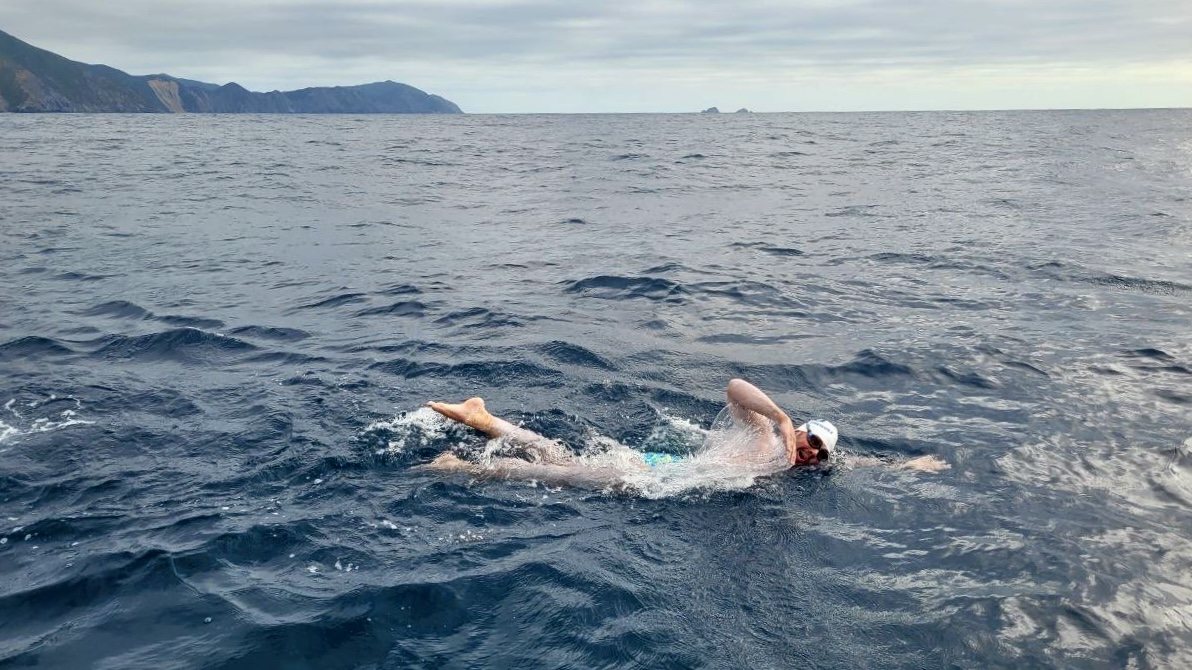
So Ivan was a real treat. He's an open water swimmer who swims anything from 10 kilometres up, and he teaches kids to swim, from three-year-olds to teenagers. He was a professional dancer from the age of three, moved to New Zealand from Russia, and only started swimming properly about six years before we recorded. Then he swam the Cook Strait. In 10 hours and 49 minutes.
But it took him two goes to get in the water. So this post covers the whole thing: the first attempt that never started, a year of training in blocks, how you book a boat and pick a crew, the swim itself (tides, an albatross, a pod of dolphins and a two-hour sprint to finish), plus what he eats on a marathon swim and what might come next.
In this episode
- From dancer to open water swimmer
- The first Cook Strait attempt and a year of training
- Planning a Cook Strait swim
- Swimming the Cook Strait, start to finish
- Wildlife and safety in the Cook Strait
- Feeding on a marathon swim
- The New Zealand Triple Crown and what's next
From dancer to open water swimmer
Ivan was a professional dancer from about three years old, right up until he graduated from dance school. He always loved sport too. Running, cycling, whatever it was, he was outside doing it, with nothing competitive. And anywhere he went, if he saw a body of water in summer, he'd jump in and swim.
When he moved from Russia to New Zealand and finished dancing, he wanted to try a new sport. He played tennis for a while, and he swam.
By coincidence, his homestay was with a man who had been a competitive swimmer in the 80s, and who became his coach, mentor and friend. When Ivan said he swam at the Tepid Baths in downtown Auckland, his coach asked to have a look at him, gave him a couple of tips, and Ivan improved. That's where it started. His coach would drive him to the pool and stay to watch, and slowly his interest grew.
Ivan is a competitive person, and he wanted something that gave him a sense of achievement. So they started talking about open water competitions. His first open water swim was a one-kilometre harbour bridge crossing in Auckland, on 6 April 2019, and the adrenaline and the dopamine he got afterwards were amazing.
He wanted a really high goal after that, and it was the Cook Strait. It's something you can't turn up and do. You need a really solid background in swimming first.
Moving from the pool to open water
I asked Ivan why so many good pool swimmers never try the ocean. He thinks some people fear deep water or marine life, and some find it too cold after a warm pool. A pool is a controlled environment, and open water is uncontrollable: within half an hour it can rain, or the wind can pick up.
Ivan went more or less straight to open water. In his early twenties, it felt a bit late to start pool swimming, and in open water he could compete with no pressure.
The first Cook Strait attempt and a year of training
Ivan was meant to swim the Cook Strait two years before he did. It didn't happen because of severe weather, and he never even got in the water.
He was so disappointed that he didn't want to swim for a while. It passed, and he learned a couple of things from it. In his words:
"Either it's a positive or negative experience, it's still an experience."
I can't imagine how devastating that would have been. And I love that he went back and gave it another shot.
Training in three-month blocks
About a year before the swim, Ivan told his coach he was ready. He planned his training for the whole year in three-month blocks, starting at the end of March.
Winter in the ocean. Through the winter he trained in the ocean to get his acclimatisation done. Auckland is pretty warm, surprisingly, and the water only goes down to 12 degrees. He has a lot of respect for the swimmers from Christchurch and Dunedin, who train in single-digit water. A degree in the water feels very different from a degree in the air, and it hurts more.
When everyone else finishes the open water season, Ivan starts his. Summer is for the pool, and winter is his ocean training ground, with the water to himself as the sun rises.
When I first moved to New Zealand, I struggled to get into the water even in summer. It felt so, so cold. I've built up my tolerance and I can do a few spring and autumn swims now, but a winter swim hasn't happened in any capacity.
Apolima Strait, Samoa, in July. A warm one, in 26-degree water, to get a long swim under his belt: 24 kilometres in 6 hours and 40 minutes, in really stormy conditions.
Around Rangitoto in September. His second official training swim was a circumnavigation of Rangitoto in 14 and a half degree water, passing between Motutapu and Rangitoto, with a crew and no touching the boat.
A 24-hour pool swim in October. You swim as far as you can in 24 hours, in a 25-metre pool. Ivan swam 38 kilometres and stopped at 13 hours. It was his third time, and he calls it a very mental swim: the physical side is easy, and the hard part is keeping going.
Holidays, races and endurance
From November, Ivan and his wife went travelling to Australia and Thailand. The day after they got back, he swam two races in one day, a 10K and a 2.5K, then got his fitness back up.
Ivan explains the two months off like this: endurance takes a long time to build and a long time to lose, while fitness is quick to get back and quick to lose. His years of consistent training held, and the month back was about fitness.
Planning a Cook Strait swim
The boat and the swim window
In March, a year out, Ivan's coach got in touch with the skipper at Katabatic Charters, out of Picton, who looks after endurance swimmers. The skipper sends a list of available windows around the neap tides through summer. Ivan picked February, because in his experience it has less wind and the tides aren't as strong, and paid a deposit to secure his window. Then he trained.
When the time comes, the skipper picks the best day for wind, tides and timing. That's what you're paying for, along with the boat.
The crew
Ivan's people all do similar swims, and he crews for them too: after his own crossing, he supported a friend's 150-kilometre Waikato River swim, a New Zealand distance record attempt. One training partner had swum from Great Barrier Island to Campbells Bay.
His crew was four people. One friend was in charge of the feeding plan, which they'd worked out before the swim. Another was there to support him. His coach and his wife were there to watch. The closer someone is to you, the more nervous they are, so the two people most emotionally connected to him weren't the ones pushing him along.
Getting to Picton
His window was 5 to 8 February 2025. This time, they'd go as soon as the skipper said so, and he confirmed the date 48 hours out. On 4 February they flew from Auckland to Nelson and drove to Picton, where the skipper told Ivan to prepare for eight plus hours of swimming.
He had never swum eight hours. A friend on the crew told him not to think about it too much, so he stayed relaxed, which seems to work for him.
Swimming the Cook Strait, start to finish
At 5 o'clock on 5 February, the first day of his window, they got to the Picton wharf and took the boat to a point at the top of the South Island.
People think the Cook Strait, Te Moana-o-Raukawa, is Wellington to Picton, the ferry route. Ivan wants people to know it's 23 kilometres in a straight line. The aim is to catch the right tides and currents, which help move you forward, so the route bends. In the water, all Ivan does is swim and look at the boat, and the crew pick the line.
The start
There's no beach to start from. On the way out he greased up with Sudocrem and lanolin (which he describes as a mix of sheep fat and Vaseline), anywhere you can chafe: neck, armpits, legs.
Then the boat backed up to a rock and he jumped. The water was 15 degrees, and it was a shock. His first thought was that he hoped he'd survive this. He sprinted to the rock, touched it, they blew the horn, and he was off.
For a swim like this, the first three hours are a warm-up, so he told himself not to think about anything. In the middle of the strait the water was warmer, in patches, and swimming from a warm, comfy patch into a cool one wakes you up.
Tides at both ends
On the day, everything went the opposite way, and it took longer than he expected. At the South Island end, the tides pushed him into the island and he couldn't escape. Once he finally got past that, the middle had pretty much no tidal movement.
Then the tide changed, and at the top of the North Island the same thing happened. For two hours he swam in one spot, because the current and his speed were equal. An unexpected current came through and started pulling him down, and the skipper told his crew he had to swim faster, or he'd end up in Kaikōura. They were aiming for the point, and he was swimming sideways along the shore.
So the crew told him to sprint, and the last two hours of the swim were a sprint. As Ivan puts it:
"I don't like sprints, but when we have to do it, we do it."
The finish
Ivan started looking at the shore a bit early. Endurance swimmers try not to, because the land looks close and it isn't. His friend told him not to look up at all and to look at him instead, so Ivan focused and kept breathing normally.
Then he passed the point where the tides had been pushing him away from the island, and he could see waves breaking. He knew he was close:
"I just put my head down and I just swam … I just was telling myself I did it, I did it, I did it."
He saw the bottom, and all the people. The tides were still so strong that he grabbed the seaweed and had to go really fast, then climbed up the rocks until he was clear of the water, which under marathon swimming rules is the official finish. The skipper picked him up in the dinghy and took him back to the boat. 10 hours and 49 minutes.
Wildlife and safety in the Cook Strait
Albatross, seals and jellyfish
Albatross have never attacked anyone, Ivan says, but they come very close. During one feed, while he was eating a banana, he turned around to find an albatross less than a metre away, looking at him. By then he was so focused that nothing bothered him.
Seals and sharks live in the ocean, so they're always around. Jellyfish are another risk. Ivan didn't meet any, luckily, but there are really venomous ones like the Portuguese man o' war and the bluebottle, whose toxins can badly injure people.
The crew's eyes and a shark shield
Spotting hazards is the whole crew's job, his own people and the skipper's three on the boat. For sharks, they used shark shields: very long lines that, as Ivan explains it, create a field sharks don't like.
The dolphins
His favourite moment, apart from the finish, came when the crew spotted a pod of dolphins and they swam right under him. It was the most memorable part of the Cook Strait. In the open water community, Ivan says, dolphins joining your swim means luck, like they're welcoming you to swim that body of water.
Feeding on a marathon swim
A listener asked how Ivan stays fuelled and hydrated, and he says nutrition is a big part of making it or not.
- Every half an hour after the first hour. Electrolytes and endurance fuel with carbohydrates and everything else you need.
- All liquid. The only exception is bananas, the one thing he chews.
- All warm. Warm drinks hydrate you and warm you up too.
- No touching the boat. The crew show him the bottle, he swims over, and they throw it to him. They tell him he's doing great, and that's it.
- No distances. Ivan doesn't like to know how far he has to go, so it's not part of his strategy.
He enjoys really cold water: it gives him a feeling of being alive.
The New Zealand Triple Crown and what's next
The Cook Strait is part of the Oceans Seven, a set of swims around the world, and Ivan calls it one of the toughest of them because of the currents and unpredictable weather.
Ivan is someone who lets his actions speak louder than his words, so nobody really knows what he's doing next. New Zealand has its own Triple Crown: the Cook Strait, Lake Taupō and Foveaux Strait, by Stewart Island. Logically, that would be the next step, and he won't say whether he's doing it. Foveaux is a lot more extreme, he says, with a great white breeding site and water around 11 to 14 degrees.
He has already crossed Lake Taupō, seven weeks after the Cook Strait, to see how he'd go. It took him 15 hours. After a big swim, though, you need time to enjoy the moment.
One day he'd like a website to tell these stories, because there isn't much information out there about marathon swimming, which he sees as a completely different sport.
Places from this episode
- Cook Strait (Te Moana-o-Raukawa)
- Picton
- Nelson
- Kaikōura
- Wellington
- Auckland
- Tepid Baths
- Rangitoto
- Motutapu
- Great Barrier Island
- Campbells Bay
- Waikato River
- Lake Taupō
- Foveaux Strait
- Stewart Island
- Christchurch
- Dunedin
Follow Ivan
- Instagram: @ivan.swims
Links from this episode
- Follow Ivan on Instagram: instagram.com/ivan.swims/
- Follow Abigail on Instagram: instagram.com/abigailhannnah
- Follow Aotearoa Adventures on Instagram: instagram.com/aotearoa_adventures_
More like this
- An Ocean Obsession, Great White Encounter and Spearfishing with Laura Kuggeleijn
- Learning to Freedive, Spearfish and Building Community with Renee Taylor
- A Solo Kayak Circumnavigation of New Zealand Over 5800km with Red Paterson
- The Underwater World and Scuba Diving with Annika Andresen
Until then, keep adventuring :)
The ultimate
NZ road trip adventure guide
Packed with insider tips and stunning photography, this is the only resource you need to plan your journey.