Episode 112
Crossing the Cook Strait on a Paddleboard and Surf Lifesaving with Britt Spencer

Episode 112
Crossing the Cook Strait on a Paddleboard and Surf Lifesaving with Britt Spencer
Spotify Apple Podcasts Everywhere else Download
When I chatted to Aimee Jules about canyoning, she mentioned a short film she'd been working on. So I went to see Paddle X at a Gutsy Girls screening, and it had me laughing and crying. And while it was still showing, I was posting on my stories asking her to come on the podcast. Not subtle at all.
Britt is a surf lifesaver and strength and conditioning coach from Nelson. And earlier in the year we recorded, she crossed the Cook Strait on a prone paddleboard, powered by her arms alone. I don't think people grasp how wild that is.
So we go through all of it: how she got into surf lifesaving and how you can too, what a rescue board actually is, the training and the logistics, and the health scare that changed how she approaches hard things. Then the crossing itself, from a 3am start to jellyfish stings, cramp and a message from her best friend that had me in tears (again), to landing on a tiny stony beach full of goats. Plus her tips for committing to your own big scary goal.
In this episode
- Growing up with a pull to the water
- Surf lifesaving in Wellington and Nelson
- Prone paddleboards and the idea for Paddle X
- Training for the Cook Strait crossing
- Coming back from a blood clot
- Picking a Cook Strait weather window
- Crossing the Cook Strait on a paddleboard
- Knowing your why, and what's next
Growing up with a pull to the water
Britt was always sporty: a gymnast and a swimmer, with no ball sports. As a kid she spent hours and hours out in native bush.
They lived somewhere pretty landlocked, and she had this dream of being a surfer who spent all day by the ocean. Then they moved to Nelson when she was 13, and you couldn't get her out of the water.
Does Nelson have waves?
Saying Nelson has waves is generous, Britt says. In stormy conditions you can surf, kind of, if the moon is in the right place. What you get is brutal, choppy, messy swell, which turned out to be perfect for training for Paddle X.
"It's either flat as glassy, silky, beautiful or just an absolute menace."
I've seen both. The first time I was at Cable Bay it was perfectly flat with beautiful sunshine. The last time I was in Nelson a big storm was coming through, and I took one look at the chop and decided I wasn't going out in that.
Surf lifesaving in Wellington and Nelson
At high school Britt was a keen competitive swimmer. When she moved to Wellington for uni she had to drop it, and she was gutted. She loves competing, training and challenging her body, and suddenly that was gone.
A childhood friend had started surf lifesaving, so Britt got in touch. Hanging out at the beach and doing cool stuff sounded like her. From there it snowballed. She joined the Lyall Bay Surf Lifesaving Club in Wellington and the club in Nelson, splitting her summers between them.
What she loves about it:
- The beach, an environment she already loves.
- The people. You form a family unit, you're into the same things and you've got each other's backs, sometimes through stressful rescues and search and rescue callouts.
- Giving back. It's volunteering, so you're helping people in your community.
- The sport, doing things she loves.
How to get into surf lifesaving
If you're keen, or even mildly curious, Britt's advice is to jump on the Surf Life Saving New Zealand website. It lists all the clubs around the country, so you can find one near you, see what they're about and get in touch. Or pop down to the beach over summer, say hi to your local lifeguards and have a yarn.
She recently competed at the World Champs, held every two years, and being around so many incredible athletes was so inspiring she couldn't stop grinning.
Prone paddleboards and the idea for Paddle X
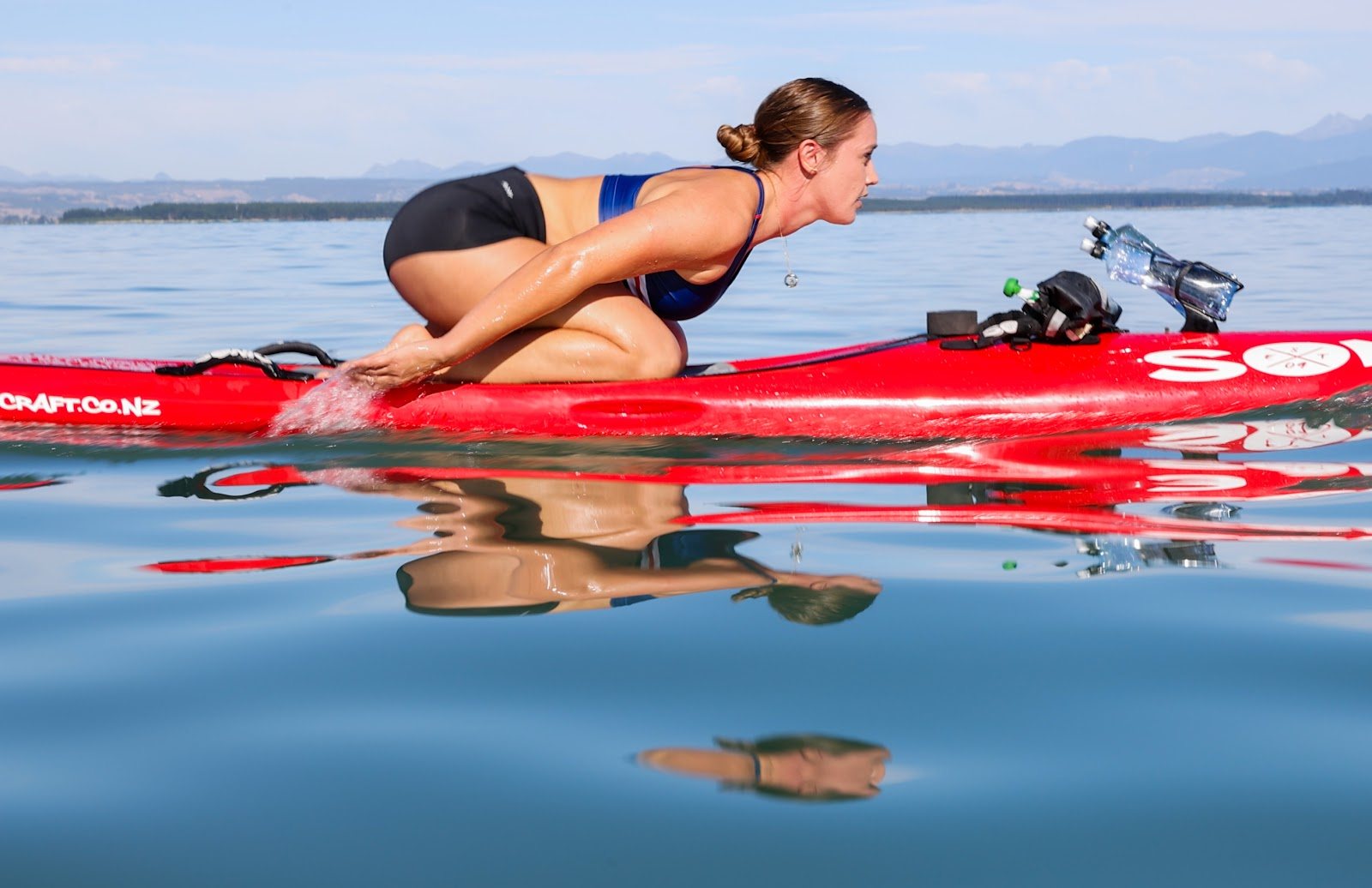
A prone paddleboard, or rescue board, is one of the main pieces of surf lifesaving gear. It's a long board, a bit thinner and taller than a stand-up paddleboard, and you propel it with your body alone: your arms and your back. You either lie on your stomach or kneel in a pretty funky position for your hips, driving your arms into the water over and over.
On the beach, lifeguards use them to reach people in trouble, because the board is a massive flotation device you can paddle back to shore. People race them too, and there's a whole subculture of endurance racing.
Before this, Britt's board time was mostly fun paddles on glassy mornings at sunrise, with a couple of mates and the odd dolphin. She'd never raced. The year before Paddle X, she paddled from Tāhunanui Beach to Kaiteriteri in the worst wind conditions for it. She raised money for her surf lifesaving club, got hooked and started wondering what was next.
So many people told her to do the Cook Strait. She had no desire to at first. She knows exactly what it's like when it's packing it in: every ferry crossing she's been on has had the worst conditions possible. Then she came round. It's part of the Oceans Seven series of open water crossings, it's in her own backyard, and she knew it would teach her so much about the ocean, the tides and the wind. She's a big believer in doing the hard things, so she picked a hard thing.
Training for the Cook Strait crossing
The prep took about eight months, with six months of really focused training. Britt paddled a few times a week: a long paddle at the weekend, then some shorter tempo sessions during the week. As a strength and conditioning coach she could programme her own gym work, to bulletproof her shoulders and back for what they were about to face.
Planning all that was intimidating, and at first she was freaking out about how much there was to do. Once the plan was set, her whole focus was the next week: what are we doing this week, and let's do it to the best of our ability. That kept her mindset in the right place for six months.
I'm the opposite. My first solo hike was 85 kilometres, the longest tramp I'd ever done, and I did zero training.
Britt gets it. We love to throw our bodies at things, she says, but there are little things you can do to make life a whole lot easier.
It's the reminder I need, because I've got my sights on a big sea kayak expedition from Cape Reinga down the east coast. I want to see the most beautiful coastline in the country from a kayak. I've done zero training, and my husband keeps saying we need to start.
Logistics and the weather
For Britt, the hardest part of the prep was logistics. She likes a plan, and the Cook Strait doesn't allow one. One of her advisers was very realistic: she had a seven-day window, and she might not get a good forecast in it at all. Not knowing when she was going, and not being able to control the variables, was a real struggle.
Coming back from a blood clot
Physically, Britt's biggest challenge has been her health, which is part of the film. Some years ago, she almost died. She had a blood clot in her leg, and parts of it broke off and went on a tiki tour around her body, through her heart and into her lungs, where they started killing off lung tissue. She's so lucky she didn't have a heart attack.
"I was just living life, feeling fine, and then one moment I was great, and then one moment I was fighting for my life."
It was a long process to get back to paddling and throwing her body at crazy things. But the whole journey gave her an appreciation for life, and a drive to do the hard things and put herself in situations she's not comfortable with. She calls it a blessing in disguise for her paddling, because it put her in exactly the right mindset for the prep.
Picking a Cook Strait weather window
Britt had an incredible team: her safety crew, her supporters and people close to her with deep knowledge of the Cook Strait and of reading weather and tides. Going into the window she was excited and nervous, and not the most confident it would line up. She knew she could physically do it. The question was whether the Strait would let her.
They'd agreed that if the wind was above a certain number of knots, they wouldn't go. Her safety crew would be out there too, getting seasick and put at risk. She's happy to push herself with safety behind her. Putting the people she loves in jeopardy was off the table.
It had been a terrible season for crossings. They were meant to go on the Monday, but the forecast didn't sit right, so they took a lay day and went the next day instead.
It was the little window of perfection. Barely any wind, big swells but spaced out and rolling, a bluebird day and an amazing sunrise. Britt has never seen the Cook Strait like that.
Crossing the Cook Strait on a paddleboard
The start at Tory Channel
Britt woke at about 3am, and they boated out to the mouth of Tory Channel as the sun was rising. It was silky and glassy, and she couldn't wait to get on the water.
She jumped in, and right as she went to touch land, a rogue swell rolled in. If she dinged her board before she'd even started, they were done, so that was a little stressful. Then came a few teething issues while they worked everything out.
The Strait looked serene on top, and the currents underneath were insane. Britt was working really, really hard, and her respect for that body of water went sky high. Once the teething issues were sorted, she got stung by bluebottles and other jellyfish. That was the moment she decided to notch it up a gear and boost across. With tunnel vision on the North Island, she shot straight for Ohau Point.
In the middle, she turned around and realised she was closer to the North Island. She grew up there, so the final stretch felt like coming home.
Her support crew read out messages people had sent, and held up signs to make her giggle: "Are we there yet?" and "You should have caught the ferry."
Dark mode and a message from her best friend
In the last stretch, the currents started really pushing her body. Every time she got up on her knees she'd start pre-cramping, and then it turned into full-on spasms and cramp.
Britt has what she calls dark mode. She can barely handle talking or taking in what's going on around her. Blinkers on, one arm in front of the next, one more paddle, and ignoring the pain as much as she can.
Her best friend was meant to be on the crew, but something came up the week before. The signs were her idea, and she'd sent Britt a message, which Britt saved until she needed it. In dark mode, in so much pain, she yelled out to her crew to read it. She was bawling her eyes out, happy tears, and it got her through some really rough currents and gnarly pain. She still cries at that part of the film.
So do I. In the screening, that was the moment I was crying waterfalls.
Landing at Ohau Point
The high was landing. She came in over rocks just under the surface and kelp everywhere, to the smallest little stony beach in front of a sheer cliff face, with a bunch of goats on it for some reason. She dodged the rocks, almost fell off, jumped off with legs that weren't really working, ran up the beach and held her board over her head, pumping it up and down. One of her support team was cheering on an air horn.
Then she took a moment, blubbering, soaking it all up, knowing they'd done it. Britt says it was a team effort all the way, and she couldn't have done it without them.
Knowing your why, and what's next
When her body is in pain and her brain is telling her to stop, Britt has two tools. The first is focusing on the step right in front of her: one paddle, one paddle, one paddle. The smallest action counts as long as it's moving you in the right direction.
The second is knowing why she's doing it, and she had layers of motivation. Making the most of this life after her health scare. Raising money for the Nelson surf lifesaving club. Getting out on a board, the thing she loves. Making her team proud after everything they sacrificed. And enjoying it all.
"And I think when you know why you're doing things, it becomes a lot easier to do the hard work, to push through the pain, to, you know, do the crazy thing."
Add people around you saying you've got this, and with internal and external motivation at the front of your mind, she reckons you can do pretty much anything.
The Molokai to Oahu race
Next, Britt wants to race the Molokai to Oahu paddle in Hawaii. Hawaii is the birthplace of prone paddleboarding. It's one of the most prestigious and hardest races out there, and she's never done a paddle race before. Even qualifying will take its own training block, so she's working out whether it's July next year or the year after. Her hands were shaking as she told me, because she was so excited and so nervous.
Her advice for committing to a big goal
- Say it out loud. Tell people, or tell yourself. Deciding to do the thing is almost the scariest part.
- Work backwards. What do you need to achieve, and how? Then chip off the milestones, one step at a time.
- Find people who know what they're doing. Britt admits she didn't know diddly squat about the Cook Strait at the start. Get curious, ask people who know more than you and immerse yourself in it.
Telling people makes it real, and I agree. We both put something out there in this chat.
Places from this episode
- Cook Strait
- Nelson
- Cable Bay
- Lyall Bay
- Wellington
- Tāhunanui Beach
- Kaiteriteri
- Tory Channel
- Ohau Point
Follow Britt
- Instagram: @brittjayspencer
- YouTube: Britt Jay Spencer, where you can watch Paddle X
Links from this episode
- Follow Britt on Instagram: instagram.com/brittjayspencer/
- Watch Paddle X on YouTube
- Follow Abigail on Instagram: instagram.com/abigailhannnah
- Follow Aotearoa Adventures on Instagram: instagram.com/aotearoa_adventures_
More like this
- Swimming the Length of the Clutha River with Rob Hutchings
- A Solo Kayak Circumnavigation of New Zealand Over 5800km with Red Paterson
- An Ocean Obsession, Great White Encounter and Spearfishing with Laura Kuggeleijn
- A Team Effort to Sea Kayak the North Island of New Zealand with Paddle for Purpose
Until then, keep adventuring :)
The ultimate
NZ road trip adventure guide
Packed with insider tips and stunning photography, this is the only resource you need to plan your journey.