Episode 165
An 18-Day Mission Through Nelson Lakes, Kahurangi and Abel Tasman with the National Park Trifecta

Episode 165
An 18-Day Mission Through Nelson Lakes, Kahurangi and Abel Tasman with the National Park Trifecta
Spotify Apple Podcasts Everywhere else Download
This was the very first episode I recorded from the van, so I'm sorry in advance for the moment my phone (which is also my hotspot) overheated and dropped out mid-story. But it's so so worth it, because these three are incredible.
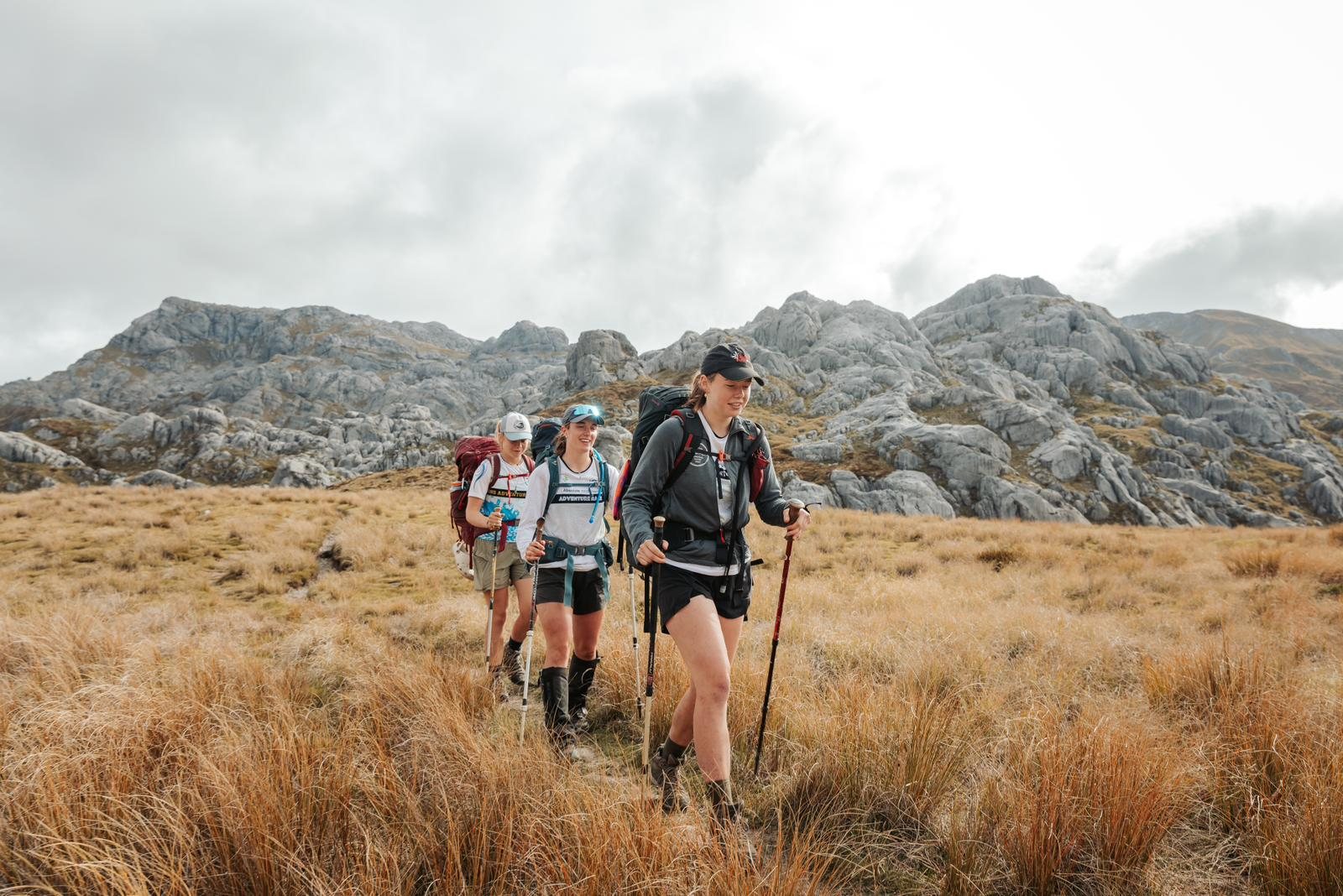
Hannah, Isabel (Belle) and Harriet (Hattie) are the National Park Trifecta. In the December before we recorded, while still at high school, they spent 18 days linking their three local national parks under their own steam: every named lake in Nelson Lakes, through Kahurangi and over its highest mountain, then a paddle through Abel Tasman. I'm so in awe. I did the Old Ghost Road over five days, and one of them is now training to run it.
So we go through the whole route, stage by stage. The packs, the food drops and the teacher's homemade dehy meals, the hut that never seemed to arrive, the scree that froze Hannah up, a wasp's nest, a rock climb they didn't plan on, and the windy crossing at the start of the paddle. Plus the low points, how they worked as a team, and their advice for anyone a couple of years behind them.
In this episode
- Growing up outdoors in the top of the South
- Planning the National Park Trifecta
- Packs, food and a tent for three
- Nelson Lakes: six days, five mountain ranges
- Kahurangi: Mount Owen to Trilobite Hut
- Kahurangi: Fenella Hut to the Dragon's Teeth
- Biking to Wainui Bay and paddling Abel Tasman
- Blisters, low points and the hard days
- Working as a team
- Lessons and advice for young adventurers
Growing up outdoors in the top of the South
All three have been in the outdoors since they were less than a year old, and they credit their parents with gifting them their love of it. Outdoor education is all three's favourite subject at school, and in their region there's so much on the doorstep.
Isabel has tramped the Dusky Track in Fiordland with her family (eight days, her longest tramp before the trifecta) and on Stewart Island. She loved seeing the different bush, which is quite different to up their way. Her family is originally from Switzerland, so she's tramped in the Swiss Alps too: far more people, and a lot less rugged than what they're used to here.
Another of the three remembers her first overnighter: a five-day tramp at Christmas, when she was five years old. Since then it's been lots around the Nelson region, plenty in Kahurangi and, more recently, the Richmond Ranges. With a big family, trips often end up in one of the three national parks they walked through, or on the West Coast.
Planning the National Park Trifecta
Their outdoor ed teacher encouraged them to apply for the FMC Youth Scholarship. They were super excited, then realised they had to come up with a mission. They'd all done lots of trips in the national parks they grew up in, the places their passion for the outdoors came from, and they'd never linked them all. So that became the idea.
They were all on board from the start. Two of them shared an English class and spent more of it planning the trip than doing their schoolwork.
They all love swimming outdoors, so one early idea was to swim in every lake in Nelson Lakes, and even every lake in Kahurangi. They quickly learned Kahurangi wasn't possible, and swimming in all the Nelson Lakes lakes wasn't either, because they're sacred to the iwi there. They respected that. So the plan became visiting all 11 named lakes in Nelson Lakes.
The name comes from the three parks, and the three of them. And the scholarship came through.
The route and the backup plans
Getting the route down pat was harder than it sounds. Parts of Nelson Lakes are off track and very weather dependent, so they planned wet weather backup options. They tried to plan realistic days, though they admit they got a bit carried away on some. And they kept as much as possible on the tops, because they love being on the ridge.
The whole aim was to do it under their own steam, so they biked between sections.
Packs, food and a tent for three
The trip ran in four sections, and they got shorter as it went: six days in Nelson Lakes, a five-day Kahurangi section, a three-day Kahurangi section, then two days of paddling. So the packs got lighter and lighter, which was really good.
They split the food between them:
- Breakfast: massive zip-lock bags of oats, which someone usually carried.
- Dinner: one of their teachers made heaps of dehydrated meals for them, lighter and cheaper than freeze-dried. There were three: curried lentils and kūmara, spiced beef with instant mash, and a chicken curry. They were so delicious, especially at the end of a long day. The other dinners were real meals, and they quickly learned which ones they liked.
- Snacks: everyone carried their own, many of them sponsored. A box of cookies meant one every second day, and peanut butter came in big squeezy tubes. None of them had ever had peanut butter on crackers before this trip. Let me tell you, they were good.
They carried a three-person tent the whole way, so only one tent, and it doubled as emergency shelter. The split between huts and tenting was roughly half and half, and they planned which nights would be which, so each day had a goal at the end. One person carried the poles and pegs, another the rest of the tent, and the third the cooker, so it stayed pretty even the whole way.
Nelson Lakes: six days, five mountain ranges
The Nelson Lakes section was the hardest of the trip. They went over a mountain range almost every day, five in six days, with big days every day.
Day one: St Arnaud Range
They started at Lake Rotoiti in St Arnaud and headed up the St Arnaud Range via Parachute Rocks, a brutal steep climb on the very first day. Then they travelled along the range to a set of tarns, their first camp spot, which was so beautiful. The weather was amazing, but with the sun on one side all day, they all got burnt down one side of their arms.
Day two: Travers Valley to Angelus
On day two they dropped down to the Travers Valley and headed up the Cascade Track to Angelus, then camped at Hinapouri Tarn, about half an hour past Angelus.
Day three: Mount Cedric to Blue Lake Hut
Day three, over Mount Cedric to Blue Lake Hut, was the really rough one: 30 kilometres and 12 hours of walking, after two big days already. It didn't help that much of it was walking on the flat in the bush.
Day four: Moss Pass and a soaked tent
They headed up to Lake Constance, over Moss Pass and into the D'Urville Valley, and stayed at Upper D'Urville Bivvy, a tiny two-bunk bivvy. It was raining, so they all squished in and tried, unsuccessfully, to dry their gear.
At a stream crossing that day, Hattie lost her balance on a rock and fell back into the stream. It wasn't even a big stream, but her roll mat and the tent were on the outside of her pack, and they got soaked, the night before they were meant to camp.
Day five: Lake Ella and the scree
Luckily, the next day they walked up to Lake Ella, which was so beautiful. Up on the ridge for lunch, they laid the tent out, and it dried pretty much the whole way.
From there they went down a sketchy, steep scree slope, then a route that disappeared, with the odd triangle on a tree, down to the Matakitaki Valley for their final night in Nelson Lakes. They were stoked: they'd done the hardest part of the trip, inside the timeframe they'd planned.
Day six: walking out
The next morning was a short walk out to the Matakitaki station, where family and friends were waiting with fresh strawberries. It had only been six days, and it felt like ages.
Kahurangi: Mount Owen to Trilobite Hut
From the Matakitaki they biked 60 kilometres up the Mount Owen road to the Owen Valley, camped, and swapped in their first food drop, along with a real dinner and pancakes and scrambled eggs for breakfast.
Mount Owen and the hut that never arrived
They walked up Sunrise Peak and onto Mount Owen, the highest mountain in Kahurangi, in beautiful weather, then down to Granity Pass, where Aimee Jules, who was filming them, met them.
The walk up to Stone Hut the next day was one of their worst for weather. It hosed down, and the track kept going until they wondered if the hut had been taken out. Finding it was such a relief. They got the fire going, dried out their gear and rewarded themselves with hot chocolate and cookies.
Biggs Tops, Trevor Carter Hut and a bootlace fix
The weather cleared for the climb up onto Biggs Tops, then they dropped down to Trevor Carter Hut for a lovely lunch stop of an hour and a half. One of them had snapped both bootlaces, and they had no spares. Luckily, the pest management man staying at the hut had spare twine. It was plastic and slightly too big, so they had to burn the ends to get it through the eyelets, which took ages. He'd also flown in food he wasn't eating, so they left with packets of biscuits, chocolate and instant pudding. Another dessert.
From there to Thor Hut was, for one of them, the worst track of the trip: so boggy and overgrown. She'd misheard the man at the hut, too. She thought he'd said it was the track where the fewest people had broken their ankles, and was so excited for an easy afternoon. It was the opposite.
Splugeons Rock Shelter
The next day they walked out to Karamea Bend Hut. They'd thought about stopping there, but kept going up to Splugeons Rock Shelter, and they're so glad they did. They got a really beautiful sunrise, and anyone listening should go and stay there.
Then it was up to Balloon Hut, where they were early to meet Aimee, so they lay in the sun listening to music and eating the rest of their snacks. Then they walked out to Trilobite Hut for their next food drop with family and friends, and bacon and eggs and fresh fruit in the morning.
Kahurangi: Fenella Hut to the Dragon's Teeth
A couple of friends walked up to Fenella Hut with them, an easy, warm day of cards at the hut and a swim in the tarn. One of the friends carried up Sprite and chips, too.
Lonely Lake and the Dragon's Teeth
After saying goodbye, they walked along the ridge towards Lonely Lake, and the view down into it was so beautiful. They arrived early, so they took a little side mission up the Drunken Sailors, then had a beautiful sunset at a really cute little hut.
They were nervous about the next day, the low route of the Dragon's Teeth. They didn't know much about it, so they followed a random person's GPX file. It didn't go well. They got lost, ended up hucking it through the bush, then did some rock climbing to get through.
At one point they climbed a steep rock face that dropped off in a bluff. Hannah and Isabel were both freaking out a wee bit, and Hattie said they could definitely get down. She took their packs, and they climbed down. They reckon they probably should have had a rope. What they did wasn't the low route at all, they say. If you follow the proper low route, it's totally manageable, with no climbing.
Adelaide Tarn to Anatoki Forks
Adelaide Tarn was super beautiful. Then they walked over to Anatoki Forks Hut in a whiteout, and out from there, a bit of a slog, to camp at the road end.
They'd run out of water, and the stream they'd expected was a dry creek bed. So they summoned their courage to ask the farmer for some. He was super lovely, and they still don't know why they were so scared.
Biking to Wainui Bay and paddling Abel Tasman
The next morning their bikes were dropped off at the Anatoki road end, and they rode out to Wainui Bay, with a stop at a cafe in Tākaka. After 15 days away, it was a culture shock. Tākaka is quite a small town, but it seemed super busy, and the amount of choice at the cafe was overwhelming.
I love that feeling. A couple of days in the bush and suddenly you're like, is that a house? Are those people?
At Wainui Bay they packed everything into a double sea kayak and a single. It was windy, with whitecaps across the inlet, and they debated pulling the pin and walking the Abel Tasman instead. They decided to give it a go. It was scary and out of their comfort zone after 15 days of tramping, and none of them are super experienced paddlers. It was rough until Separation Point, then all of a sudden it was glass calm, and they camped that night.
That night, after a beautiful evening, a thunderstorm hit: thunder and lightning so loud, rain hosing down on the tent and the sky lit up through it. The next morning it was like nothing had happened. It was still windy, though, and getting off the beach was a mission. They didn't tip out, which is obviously a bonus.
A horrendous headwind took them to Bark Bay, where they sat in the sun for three hours discussing their options. Then the wind died completely, and they had a really nice paddle to Observation Beach, going around Adele Island. From Adele Island they could see Mārahau, the finish, and they could have made it that day. Instead, they took an extra day:
"we're just gonna make it an extra day. We've got all the food and we don't actually want to go back just yet. … We want to enjoy the last bit that we've got together."
They spent one last night at Observation Beach and dragged out the last paddle. At Mārahau, quite a lot of family and friends came out to welcome them in. It was a bit surreal that they'd done what they set out to do, and they felt very accomplished and proud.
My first time in Abel Tasman National Park was on a kayak too, and we took it really, really slowly. When we recorded, we had our kayaks with us in the South Island, and I was hoping to squeeze in a paddle up there.
Blisters, low points and the hard days
Hattie's blisters
Hattie got new boots the week before they started. They were rigid boots, which they needed for Nelson Lakes, but she got terrible blisters on the backs of her heels. She'd never really had blisters before, so she hadn't prepared for them. By the first food drop in the Owen Valley, they were starting to look infected, and she might have had to pull out.
They'd agreed before the trip that if one of them had to pull out, they all would. That night was scary. Nobody was ready for it to be over. She switched boots, used lots of blister pads, and they got better.
Long days and a wasp's nest
For Hattie, the whole Nelson Lakes section was tough, though she enjoyed it in the end (type two fun). With a big family, her tramps had never gone much above six-hour days, and that first day was 10 hours. She remembers wondering how she'd do this for 18 days.
Her lowest point was the route down from Lake Ella. They were so close to a nice four-wheel-drive track when, walking at the back, she stood in a wasp's nest. She broke down, and the tears from the past five days came out with it.
Scree, nerves and growing confidence
Hannah and scree are not good friends. In Nelson Lakes there were points where she froze up on the scree and cried, and the others would stand with her for a couple of minutes until she got herself together. By the end, any scree wasn't so bad:
"by the end of it it was actually really cool to see how much my skills had improved"
She says Belle and Hattie pulled her through, and she'd probably still be stuck on that slope without them. For her, the mental side was tougher than the physical.
Mornings and different kinds of support
Isabel realised she likes a different kind of support when she's low. She wants a practical response: have you eaten, can we take some of your weight, do you need blister pads? Hannah and Hattie want emotional support: you're doing so well, keep going. She'd respond to them the way she liked to be responded to, and that didn't always go well.
She also got frustrated in the mornings. With big days ahead, she wanted to be out of the hut early, and Hattie's feet took a while to look after. One morning, leaving Upper D'Urville Bivvy, she stormed off and had her moment. After that, they became far more efficient and more understanding of how to support each other.
Working as a team
A listener asked how they worked together, and whether they delegated roles.
- Isabel (Belle) was the whip-cracker and the tank. If anyone had the heaviest pack, it was her, and she kept them on pace. The others call her one of the most organised people there is.
- Hannah was the hype girl, very motivating and supportive, the one to bring the energy at a low point.
- Hattie is the realist, who pulls them back down to earth when they have wild ideas, and a rock monkey when there's climbing to do.
Mostly, they say, they were in tune with each other: they could tell when someone needed lifting, and whether to go faster or slow down.
Lessons and advice for young adventurers
Their biggest lessons are that anything is possible when you put your mind to it, and that they're only going to get stronger and more experienced from here. If this is what they can do now, imagine where they'll be in ten years.
For Hannah, it's how much more you can achieve as a team. She'd never set out on something like this alone. As she puts it:
"just having your best friends along you every step of the way and lifting you up when you're feeling down … It's just really powerful."
When we recorded, Belle and Hattie were planning for uni and Hannah had a job, so lining up another long mission was hard. Belle was training for GODZone, and Hattie for the Old Ghost Ultra.
Their advice
For anyone their age, or a few years behind:
- Find your people. Hattie would never have done anything like this without Hannah and Belle. Take the opportunities you're given and join every extracurricular you can: she got close with them through adventure racing and outdoor ed.
- Start small. Don't put pressure on yourself to do a five-day tramp straight off the bat. There are so many perfect day walks around their region. Build up slowly, with little steps.
- Do outdoor ed. It's a great way to build skills and confidence, and they don't think they'd have felt confident enough to do this without it.
- Going solo is fine too. Make sure you know where you're going, tell people, and take a couple of forms of communication in case something goes wrong.
Places from this episode
- Nelson Lakes National Park
- Kahurangi
- Abel Tasman National Park
- Dusky Track
- Stewart Island
- Richmond Ranges
- Lake Rotoiti
- St Arnaud Range
- Parachute Rocks
- Travers Valley
- Cascade Track
- Angelus Hut
- Hinapouri Tarn
- Mount Cedric
- Blue Lake Hut
- Lake Constance
- Moss Pass
- Upper D'Urville Bivvy
- Lake Ella
- Matakitaki Valley
- Mount Owen
- Stone Hut
- Biggs Tops
- Trevor Carter Hut
- Thor Hut
- Karamea Bend Hut
- Splugeons Rock Shelter
- Balloon Hut
- Trilobite Hut
- Fenella Hut
- Lonely Lake
- Dragon's Teeth
- Adelaide Tarn
- Anatoki Forks Hut
- Wainui Bay
- Tākaka
- Separation Point
- Bark Bay
- Adele Island
- Observation Beach
- Mārahau
Follow the National Park Trifecta
The three share their adventures on Instagram as National Park Trifecta, and their short film, A National Park Trifecta, is on Aimee Jules' YouTube channel.
Links from this episode
- Follow National Park Trifecta on Instagram: instagram.com/nationalparktrifecta/
- Watch the documentary
- Follow Abigail on Instagram: instagram.com/abigailhannnah
- Follow Aotearoa Adventures on Instagram: instagram.com/aotearoa_adventures_
More like this
- Fastpacking from St Arnaud to Arthur's Pass in 8 Days with Alice Brice
- Tramping the Heaphy Track from Karamea to Collingwood with Jacq Nesbit
- Three Teens' 900km Cape to Cape Human Powered Journey with Olly, Will and Thomas
- Two Weeks Tramping in the Kaweka Ranges as a 17 Year Old with Olly Dow
Until then, keep adventuring :)
The ultimate
NZ road trip adventure guide
Packed with insider tips and stunning photography, this is the only resource you need to plan your journey.