Episode 132
Nine Months of Solitude Walking Northbound on Te Araroa with Naomi Arnold

Episode 132
Nine Months of Solitude Walking Northbound on Te Araroa with Naomi Arnold
Spotify Apple Podcasts Everywhere else Download
I've had a few Te Araroa walkers on the podcast, and nobody has told it quite like Naomi.
Naomi is a journalist and author who lives in Nelson (outdoor mecca, in her words). She walked Te Araroa's 3,000-plus kilometres northbound, starting at Bluff on Boxing Day. Her planned five or six months turned into eight and a half, with freelance work, injuries and storms to wait out, and she kept walking right through winter, almost entirely alone. And she wrote a whole book on the trail while she was at it. Northbound came out the day before we recorded.
We talk about the 20-year dream that got her there, what Te Araroa really is, her best day (on the Tongariro Alpine Crossing, in snow), and the nights that were so so far from that, including two days sheltering in a woolshed in a storm. Then some brilliant listener questions on food, the last stretch to Bluff and loneliness. Big, honest, very muddy.
In this episode
- Growing up curious and a 20-year dream
- Walking Te Araroa northbound and alone
- What Te Araroa is
- Writing Northbound on the trail
- Tongariro Alpine Crossing in the snow
- How hard Te Araroa is, body and mind
- Staying safe alone in winter
- Listener questions: food, the Longwoods and loneliness
Growing up curious and a 20-year dream
Naomi grew up in Te Puke in the Bay of Plenty, and her childhood gave her a fascination with the natural world. She vividly remembers standing on the beach at Papamoa as a small child, looking at Halley's Comet, and being told, out on a boat in the middle of Lake Taupō, that she was floating on a giant volcano.
She started tramping at the University of Otago, and did a lot more of it once she moved to Nelson. So for her, the outdoors is something she discovered as an adult.
Finding the book that started it
In her early twenties, at a friend's house in Taupō, Naomi picked a book off the shelf beside the spare bed: Geoff Chapple's Te Araroa: One Man Walks His Dream. She thought, that's me, I'm going to do that one day. It lodged in her a determination to follow the line Chapple, the trail's founder, had laid down around the turn of the millennium.
The trail opened officially in 2011, when she was a reporter at the Nelson Mail. Every year she'd tell herself she'd do it that summer, and with a full-time job, that's really hard.
She wanted to walk it by the time she turned 40, and then COVID came along. Missing that goal was really irritating. Her husband had known from the start that she wanted to do it, and his response was, let's go get it done. It was never going to be the perfect time to take five or six months off.
The window came when she'd finished a year at RNZ and was wrapping up co-writing Force of Nature, a conservation history of Forest & Bird. That book ended up following her down the trail, which wasn't in the plan.
Walking Te Araroa northbound and alone
The plan was to start at Cape Reinga and walk south. That didn't compute. She started at Bluff on Boxing Day, late in the season, and almost immediately had to take weeks off for unforeseen work on the Forest & Bird book after the government changed.
That meant no trail family. Naomi really wanted one: those intense friendships you make in the outdoors, where the barriers come down straight away and you see each other's humanity at your worst. She walked with other people for a few short stretches over eight and a half months, and that was it.
The trip turned into a journey into solitude, loneliness and despair. She was determined to do it in one hit and not come home to wait it out, so when she reached the North Island at the start of May, she kept going into winter. It was freezing, and dark as hell. In the Tararuas, the sun set behind the ridge at 2.30 one afternoon. Everything was damp and mildewing, there was no firewood, and there was no one in the North Island huts.
What Te Araroa is
Te Araroa is young. When Naomi walked it, it was 3,028 kilometres, and a lot of it was still not that established, or had fallen into disrepair.
It's a line on a map, really. Much of it isn't what you'd recognise as a marked tramping track: it goes down a river, across a paddock, up a river, along a long road. It connects public conservation land with private land, council land, iwi land, farmland, local parks and local walkways, all places you can walk.
It's better set up now than in its first few years, when it was way wilder and hairier. Still, it's nothing like the generations-old long trails in the US. Some of the Americans Naomi met, who'd done 40-kilometre days on the Pacific Crest Trail's manicured tracks, were horrified.
The word tramping captures what it's like here.
To me, tramping means mud. So much mud. And Naomi agrees: the mud did her in.
Writing Northbound on the trail
Naomi has freelanced since 2014, including long stories for New Zealand Geographic where she embeds herself in people's lives and sleeps on couches, in backpackers and in cars. Writing is so intertwined with who she is that bringing an iPad, a notebook and a dictaphone on the trail was like a photographer carrying a camera.
As a photographer, I get it. I lug a heavy camera around places I shouldn't.
She carried her iPad, now very beaten up, the whole length of New Zealand, recording voice notes and typing them up. She was aghast at how hard it was at the start: in the muddy Longwood Ranges in Southland, she couldn't believe what she was doing or how awful she felt. Alone, in winter, with no light, she had plenty of evening hours to write.
She got home on 1 September, had pretty much a book, filed it to her publisher 20 days later, and six months after that it was out. Northbound is out in hard copy, as an e-book and as an audiobook, and Naomi recommends buying it through an independent bookseller if you can: we need booksellers in our communities, and they're disappearing.
Tongariro Alpine Crossing in the snow
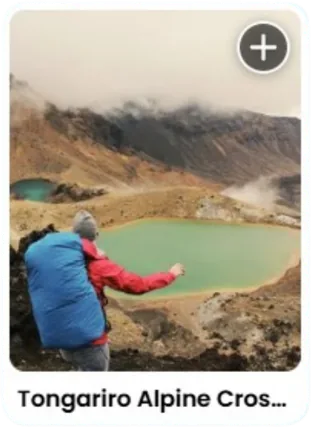
Naomi's favourite moment was the Tongariro Alpine Crossing. Because it's such a tourist highlight, she half expected it to feel touristy. It was amazing. She'd never done it before, and it had snowed a little.
Walking among the steaming vents and all those colours, with the white snow against the green, the red of the rock and the black, she felt a direct connection to the processes under the surface:
"I really felt connected to the universe … it was just the building blocks of life which was right before you"
She'd waited several days at National Park Village for the weather to clear. The day started and finished at the hostel, so she even got a shower afterwards, a very luxurious day by trail standards. It was definitely the happiest she felt, and it's her favourite day hike in the Lonely Planet Day Hikes New Zealand guide she'd updated when we recorded.
Getting there the long way
Getting to that day took some doing. Heading north means going against the flow of the Whanganui River, and you need a jet boat up one section. There were no jet boats going up, so she walked the river road to Pipiriki, got stuck, and walked the very unsafe, winding road to Ohakune. Then she walked the Round the Mountain track on Ruapehu, icy and snowy and beautiful at that time of year, and connected to the crossing.
Her advice: don't miss the New Zealand highlights. Seasoned Kiwi trampers might turn their noses up at the Great Walks, and they're great for a reason.
I did the crossing years ago as part of the Northern Circuit, in summer, when it's brown with blue lakes. The winter photos, white with blue lakes, look so different.
How hard Te Araroa is, body and mind
The physical shock
What surprised Naomi most was how difficult it was and how unprepared she was. She was reasonably fit for a desk jockey, and she got hammered. Her first 27-kilometre day was flat, along the beach, and she was stuffed: puffy eyes, a gritty throat, a swollen face, everything aching. She'd never been physically challenged like that day after day.
Then she noticed a pattern. If she listened to her body and gave it enough rest, she'd be raring to go again. Walking into Wānaka was a hot 36-kilometre day straight out of the middle of the Motatapu, and she had to take the next day off. Halfway through the second day, she'd usually start feeling better.
Watching her body respond in real time was humbling, and she ended up with a lot of faith in it. By her second-to-last day, she walked 62 kilometres along Ninety Mile Beach, from 5.30am to 8.30pm, singing, dancing and skipping, and sat down once.
That's wild, because Ninety Mile Beach usually kicks people's butts in their first few days heading south.
Her feet were the exception. Once they got wet, it was agony, and her toes were a massive problem in the last couple of weeks.
The mental side
Naomi was never close to quitting. She was obsessed with the line (capitalised in the book): once someone draws a line on a map, she felt beholden to follow it.
Her lows were situational, a hundred times a day, with a lot of crying and despair, all overlaid by absolute determination. About 2,000 kilometres in, she'd wake up having forgotten everything from the day before, and that turned into a life lesson:
"Those horrible feelings, they just pass. … If you just scream, sit down and cry and cry and cry … and just give yourself the time to feel absolute despair. It does pass."
The trail taught her how natural and important it is to feel things. We're biological creatures, and emotions are part of it. In the months since, very little bothers her.
Her determination reminded me of Red, who sea kayaked around Aotearoa and kept paddling the whole way. I was halfway through her book, Finding Solo, when we recorded.
Staying safe alone in winter
Naomi had pretty settled weather, and because she was alone, she avoided storms and didn't take what she considered any risks, especially with rivers. As a reporter, she'd written several times about missing trampers, so she stayed put until the weather cleared. It took her three chances to get into the Tararuas, and she finally went in on the first day of winter.
A fall on Pirongia
There were still close calls. On Pirongia, she couldn't hitch back to the trail before dark, so she walked out of town and up an alternate route, off Te Araroa itself. She fell backwards off a vertical edge, her pack pulling her off balance, and scrabbled at the air for a long moment before she grabbed something and pulled herself back. There were so many moments like that she forgot to put this one in the book.
She also got dangerously cold several times, when even her warmest Sea to Summit winter sleeping bag took hours to warm her up.
Two days in a woolshed near Waitomo
Near Waitomo, a storm came up in the night. The wind blew her tent in, a guy line ripped out and a hiking pole bent. So she packed up at midnight and staggered along a farm track in the rain and wind, holding her wet tent, heading for the black squares on her topo map that meant buildings.
Past a locked gate to a house, she found a woolshed. She stayed there for two days while the storm raged, sleeping on the floor she'd swept out, in a sleeping bag, wearing her wet gear to dry it. She'd run out of food, drank water off a drainpipe and had next to no reception. On the second morning her clothes were dry enough, and she had to get out of there.
To her, it was a very standard night. It also taught her what mattered:
"if I stayed put and could drink water, even if I'd run out of food, I was okay. And that was quite a nice lesson."
Listener questions: food, the Longwoods and loneliness
Do you need to post food ahead?
Naomi overprepared. She dehydrated a lot of her own food to save money and posted it ahead, and it was a waste of time and money: when she got to town, she didn't want her powdered pumpkin soup with peas. She wanted pies and chocolate milk.
You don't need to post a parcel to Boyle River if you're okay hitching to Hanmer, or to Arthur's Pass if you'll hitch to Christchurch. Hitching got her anywhere, though it's a bit of a risk.
By the end, she stopped caring about food. She bought a can of whipped cream and lollies to eat on Ninety Mile Beach, which she does not recommend. Her advice: over-plan to be safe, then chuck your plans when you want to.
Birchwood to Bluff
James found the last few southbound days, from Birchwood to Bluff, monotonous and surprisingly hard, and asked if starting there was good prep. For Naomi, the Longwoods did her head in, and the section was a good indication of the rest of the trail: private land, roads, local maunga, beach and a lot of walking alongside State Highway 1. With all the closures, she did a lot of 30-kilometre detours on backcountry roads, especially in Northland. She got fitter, and it still sucked.
Loneliness
The last question came from Anurag, who was walking northbound when we recorded and raising money for charity. He found it brutal to meet the wave of southbounders in their cute little trail families for one night, then move on to the next hut alone.
I walked the Auckland section with him shortly before we recorded, which was so fun.
Naomi totally gets it. The loneliness was devastating. The trail families were all so happy, and she felt jealous, lonely and like an outsider, and that didn't improve. Towards the end, she got happier as she got fitter, dealt with some personal stuff, met more people heading north and had some lovely encounters with locals and strangers. The central North Island, though, was miserable.
That was part of it. Life sucks sometimes. You keep walking, and you hang on. Feel it, accept it, notice it, write it down, talk about it, and keep moving.
I'm a big crier too, and I'm with Naomi: crying is your body telling you there's something to deal with.
Places from this episode
- Te Araroa
- Bluff
- Longwood Ranges
- Birchwood
- Wānaka
- Motatapu
- Boyle River
- Hanmer
- Arthur's Pass
- Tararuas
- Whanganui River
- Pipiriki
- Ohakune
- National Park Village
- Ruapehu
- Tongariro Alpine Crossing
- Pirongia
- Waitomo
- Ninety Mile Beach
- Cape Reinga
- Te Puke
- Papamoa
- Lake Taupō
- Nelson
Follow Naomi
- Instagram: @naomijarnold
- Website: naomiarnold.net
More like this
- Section Walking Te Araroa over Multiple Seasons and Battling Cancer with Te Aroha Hohaia
- Setting the Fastest Self-Supported Record on Te Araroa with Billy Meredith
- A Healing Journey on Te Araroa Trail with Germaine
- Thru-hiking the Te Araroa Trail with Zoe
Until then, keep adventuring :)
The ultimate
NZ road trip adventure guide
Packed with insider tips and stunning photography, this is the only resource you need to plan your journey.