Episode 173
Section Walking Te Araroa over Multiple Seasons and Battling Cancer with Te Aroha Hohaia

Episode 173
Section Walking Te Araroa over Multiple Seasons and Battling Cancer with Te Aroha Hohaia
Spotify Apple Podcasts Everywhere else Download
I talk to a lot of people who walk Te Araroa in one big season. But section walking it is really common, and I'd never had a proper chat about it. So I was really excited to talk to Te Aroha, who's been walking it in chunks, autumn and spring, since 2022.
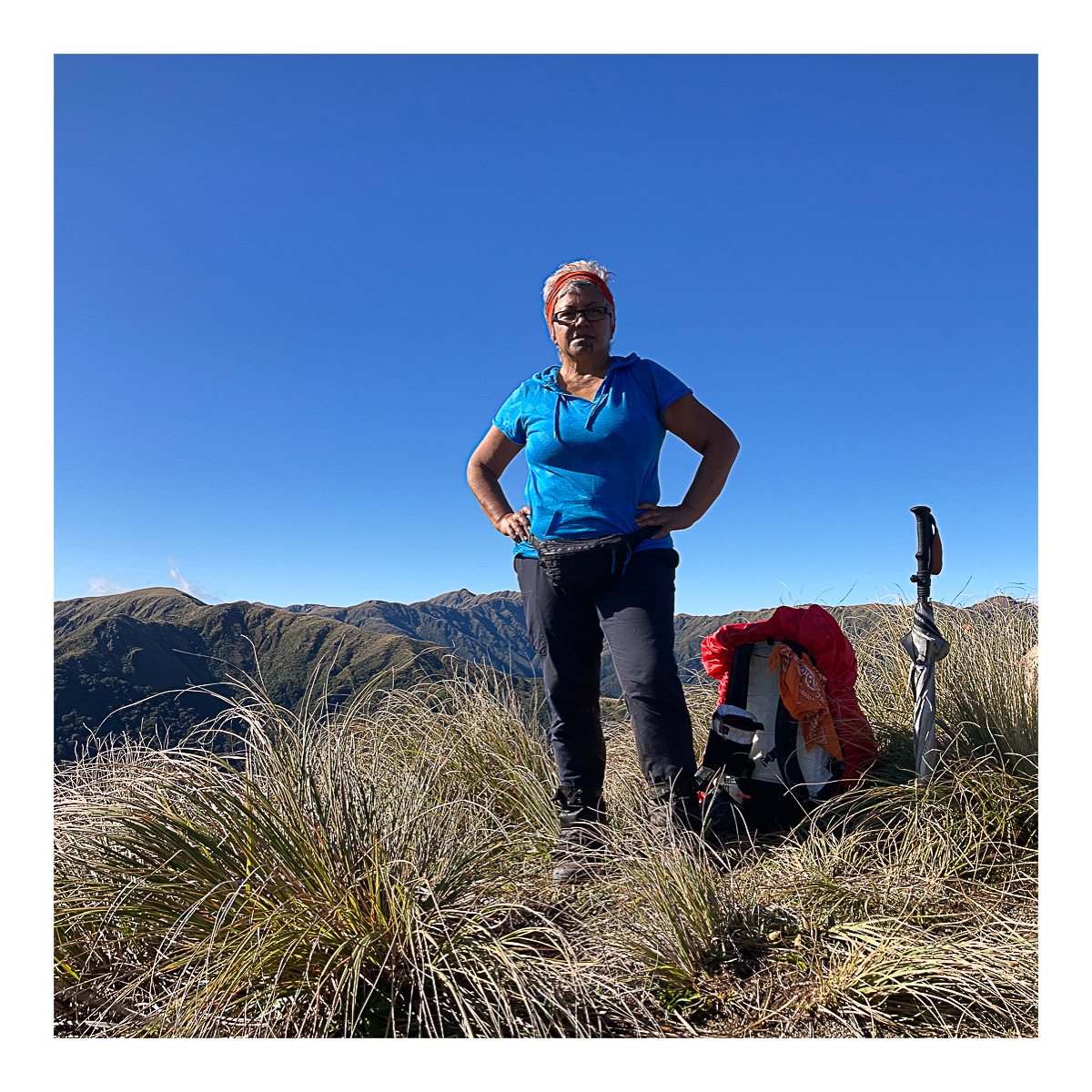
Te Aroha is 60, lives in Taranaki, and got into tramping in the most full-on way possible: a summit climb of Taranaki as her first ever tramp. She's been back to the crater 11 times since. And she walks the trail her way, slowly, with a tarp, an umbrella and sometimes her teenage mokopuna in tow.
So we cover how she plans each section, what happens when the weather (or a teenager) changes the plan, and her gear and food tips. She also shares, very openly, how a routine mammogram led to a breast cancer diagnosis and surgery in the middle of her Te Araroa plans, and how she got back to carrying her pack. Her message on early detection is one I want everyone to hear.
In this episode
- From caravan life to a first climb of Taranaki
- How Te Aroha started section walking Te Araroa
- Section by section, autumn and spring
- Planning distances, tarps and campsites
- When the plan changes: weather and a teenager
- A breast cancer diagnosis mid-trail
- Recovery and getting back on the trail
- Life on the trail as a section walker
- Gear, food and tips for section walkers
From caravan life to a first climb of Taranaki
Te Aroha has whakapapa links to Taranaki, but she didn't grow up there. She was born in Taumarunui and grew up in the Waikato, mostly around Te Awamutu. For the first five or so years of her life, her family lived in a caravan and moved around a lot. She tells herself they only moved into a house because she had to start school.
Tramping wasn't part of her childhood. She was introduced to it in February 2007 with a summit climb of Taranaki, on one of the open climbs the local alpine clubs organised, with rovers, paramedics and a doctor on hand. Experienced trampers raise their eyebrows when she tells them. It isn't a recommended first tramp.
She was fit for living around town, but not for that terrain. On the dry scree it was two steps up and three steps back, so she set micro goals: the next rock, three metres in front of her, then the next. Because she was struggling against the cut-off times, she'd been assigned a rover without knowing it, and a lovely couple stuck with her all the way to the summit.
On the way down, on wobbly legs, she swore she'd never set foot on the maunga again. The next morning, with her muscles screaming at her, she declared she'd like to do it again.
And she has. She's been to the crater 11 times and to the summit three times, including once for sunrise. When we recorded, she was about to head up as a tail for the open climb, as a member of the Taranaki Alpine Club.
I've done the Pouākai Circuit, but I've never been to the top of Taranaki.
How Te Aroha started section walking Te Araroa
Te Aroha has YouTube to thank. She watched people walk the Pacific Crest Trail and the Appalachian Trail, and thought, that's all very well, but what do we have here? Then she found a woman walking Te Araroa and sharing her response to its mental and emotional challenges, and started wondering if it was something she could do.
She never meant to walk the whole thing. She planned one section, from Kāniwhaniwha on the northern slopes of Pirongia down to Whanganui, because she'd lived along that stretch: she was born in Taumarunui, lived in Te Awamutu near Pirongia, and had worked on farms along the way.
She chose autumn on purpose. The weather tends to be a bit more settled, generally speaking, there's still enough light to walk a fair distance, and she wouldn't be competing for beds or tent space, having missed the main season.
She walked it in April, over three weeks. She had to skip the 42 Traverse and the Tongariro Crossing, because the canoe hire in Taumarunui stopped operating on 1 May, and she reached Taumarunui on Anzac Day. She'd hoped to get off the Whanganui River at Tieke Kāinga and walk home, but logistics meant she went all the way to Whanganui.
It was meant to get it out of her system. Instead, she loved the rhythm of walking and seeing parts of the country she'd never normally see. Driving, the world passes by so quickly. On foot, she slowed down. In her words:
"I just love the meditative rhythm of walking, especially on gravel, because you can hear your footsteps really, really nicely."
When Anurag walked through Auckland on Te Araroa, he stayed with us, and the next morning I walked across the isthmus with him. Something on his pack rattled the whole time. He liked the noise, because it told him he was walking.
At Tieke Kāinga, a ranger suggested she carry on and do the rest in sections. It would take a few years. So she committed to taking a month off each autumn, planning three weeks of walking with a week spare for weather or injury. Then she worked out how many years that would take, and added spring walks too.
Section by section, autumn and spring
Here's how her sections have gone so far:
- Autumn 2022: Kāniwhaniwha to Whanganui.
- The next autumn: Whanganui to Wellington.
- That spring: north from Kāniwhaniwha towards Takapuna, with her mokopuna (more on that below).
- Another autumn: Ship Cove along the Queen Charlotte Track, then on through the Richmond Range to St Arnaud. Her husband walked the first seven days with her.
- Spring 2024: Ōrewa to Ruakākā, 122 kilometres, with two of her mokopuna.
- Just before Christmas 2025: a repeat section with her mokopuna, from Ōngarue along the Timber Trail to Te Kūiti, after a logistics problem changed her plans.
When we recorded, she'd walked 1,365 kilometres of the 3,000. There are a few gaps, like the 42 Traverse and the Tongariro Crossing, but she isn't wedded to walking every single inch. Some parts aren't that interesting, and she's already mapped out a Tararua trip that will cover one gap.
She doesn't have a finish date any more. After the year she had, she realised there's no point. She'll go with how things roll. Meanwhile, she watches YouTubers like Kurt Fenton walk the trail, especially the sections she's about to do, for up-to-date intel.
Planning distances, tarps and campsites
Her first section took exactly as long as she expected. By then she'd been tramping for years and knew her own pace.
On real tramping tracks, with routes, she's comfortable around 12 kilometres a day, less if it's gnarly, and four to six hours of walking. She rarely goes longer, because she wants to be in the space and not rush from place to place. She meets walkers doing 40 or 50 kilometres a day, and she always asks them what they saw.
I'm at the slower end too. I'll sit next to the track looking very closely at the moss. After this chat, I was talking to a fastpacker, so I got both sides.
In autumn, Te Aroha looks for a camp spot by five, preferably four. She uses a tarp, which means she can pitch up almost anywhere, with no need to make it to a hut. On the Mangaokewa section between Te Kūiti and Pureora, the track was falling into the river that season, and with no safe way to reach the next campsite, she pitched up beside a farm gate.
When the plan changes: weather and a teenager
Her first two autumns were about 400 kilometres each. She thought, at this rate, this is going to be great. Then her first spring section came in at 60.
She took her mokopuna, a teenager who thought he was going on a day walk with his nan, when she'd planned a couple of hundred kilometres. That changed the pace and the way they did things. It was a wet year, and by Huntly the trail along the Waikato was underwater or deep in mud, so they caught the train to Auckland. When they walked into Takapuna, a major weather system was coming down from the north, so they went home.
Her achievement-oriented self didn't get very far that year. But the time with her moko was enriching and precious. Filtering water became his job, he worked out how fast they'd need to walk to reach the next thickshake, and with his phone often flat, his questions tested her general knowledge.
The next spring, he and his sister came along from Ōrewa to Ruakākā. They both had jobs by then, so they could only get two weeks off. More quality time, she says.
In the Richmond Range, she planned for 10 or 12 days and still had to do a double-hut day to beat another weather system. Finishing with a spare week, she stopped at Palmerston North on the way home to fill a gap from a previous autumn, when she'd set off from Whanganui without her insoles and got a huge blister by Koitiata, 34 kilometres short of Bulls.
A breast cancer diagnosis mid-trail
The year before we recorded, she'd planned to walk from St Arnaud to Lake Coleridge in autumn. In January, she got a call back after a routine mammogram she'd had in December. They wanted to investigate some calcifications. Magnified imaging, an ultrasound and a biopsy followed, and a week later she was told she had ductal carcinoma in situ, high grade, in her left breast: stage zero, pre-invasive breast cancer.
She cried lots of tears. Then she had to wait two weeks for a GP appointment, which she found really challenging. She hunted down information and tried very hard to stay in her lane, focusing on what stage zero meant. Then there was telling her whānau and responding to their questions. Thankfully, the report was sent straight on to the breast surgeon, and she met the surgical team the day after seeing her GP.
Te Aroha read the size of the area in her diagnostic report, and expected a mastectomy would be needed. She was 60, and with her life stage and how she felt about it, she decided on a bilateral mastectomy, with no reconstruction. The surgery was set for April.
What annoyed her most was that it was going to interrupt her autumn walk. One of her whānau pointed out that she sounded more annoyed about missing the trail than about the cancer. In the end, other appointments ruled out the walk too. She saw it as a different kind of hīkoi that year.
The histology after surgery showed the area was bigger than first thought, with an incidence of micro-invasion, and no malignancy in the lymph nodes they removed. Her next routine mammogram would have been two years later. For Te Aroha, it showed how much the timing mattered, and how grateful she is for early detection. Her message:
"don't put off those mammograms … don't let them slip by"
Check your breasts, she says, and if anything is unusual, go to the doctor and get it sorted out, whatever it is.
I've heard this from a few guests now, whether it's cancer, concussion or injury: you have to be your own best advocate, because often you're the only one who can tell something's wrong.
Recovery and getting back on the trail
Instead of walking Te Araroa, Te Aroha spent most of March in Te Papakura o Taranaki, the national park. She took the time to be with the tupuna maunga, acknowledge the worries that had arrived, settle her wairua and strengthen her tinana for surgery. She was grateful to be released from her governance and project work, and for support from her whānau, friends and colleagues.
She'd read about other women's surgery and how it affected their ability to carry a pack, and she wasn't happy about some of the prospects. Her rehab started with gentle walks around town, carrying nothing, and resting when she needed to. Her mokopuna fetched and carried anything too high or too heavy. Going into surgery fit and strong helped, she says, and that month on the maunga carried her into her rehab.
From there:
- Yoga and other training, to strengthen her chest.
- Day walks in the national park with a day pack, two months after surgery.
- An overnighter in July to the lake at the former site of Lake Dive Hut.
- Lymphatic massage and scar management, to keep swelling to a minimum.
- The Timber Trail in December, walking through to Te Kūiti with her moko.
- Eleven days on the maunga across three trips since Christmas.
The first time she put on her nine-kilo pack, she was very, very happy.
When we recorded, she had her dates locked in: three and a half weeks from St Arnaud, where she'd left off, down to Lake Coleridge.
Life on the trail as a section walker
A listener asked about people's attitudes to section walkers. What amazes her mokopuna is how much interest people take in them. At the motor camp in Huntly, some contractors working at the power station chatted with her grandson over dinner, then told him, good on you for taking your nan for a walk. Excuse me?
They're amazed at the generosity of strangers, too. One nan picked up all three of them, packs and all, because she takes her own mokopuna tramping.
Walking out of season, she hardly sees other Te Araroa walkers, and once saw no one for five days. She's happy with her own company, but enjoys a chat, especially with walkers from overseas with different gear. Te Araroa is like walking through a gear catalogue.
In the Tararua Range, she read comments in the hut books from locals unhappy about how many people now walk over the ranges, and the trail is taking a beating. When we recorded, there had been recent upgrades, including tent platforms at Nichols Hut and Dracophyllum Hut.
Does she compare herself to younger walkers who've been going for months? No. She used to think she'd be 42 forever, and she's about to turn 61. She's happy walking her pace, though her mokopuna think she walks too fast.
Gear, food and tips for section walkers
Te Aroha's favourite piece of kit is an umbrella from Zpacks, silver outside and black inside, with ribs that flex. It saves her in the heat of the sun. In a light shower she doesn't need a raincoat, so she doesn't get wet from sweating inside one. In a slight breeze, it works as a windbreak, and under her tarp it goes at her head for extra weather protection.
I'd assumed our wind and rain would rule umbrellas out here. She swears by hers, especially for our hot sun.
Her tips:
- Get to know what you like. Time in the national park taught her what she likes to carry, eat and walk.
- Know your gear. She's watched YouTubers who hadn't even tried their tent before they left. You might have to put it up in the dark.
- Eat what you like. She won't have noodles every night, and she's happy to carry wet food.
- Use section walks for luxuries. On the Queen Charlotte Track with her husband, they carried cheese, crackers, a frying pan, broccolini, coffee and a grinder, a chair, an extra tarp for a porch and a 700-gram book she never opened. At Havelock, it all went home with him, and she pared down for the Richmond Range.
- Expect to settle in. On a section, she finds her rhythm and routine at around day four, and then it becomes a natural thing.
As she puts it:
"the only objective of the day is to be alive at the end of it."
Her final words: get out in nature, whether that's the garden, the water, the shelter of the forest or servicing trap lines. It's been good for her wellbeing and her health on so many levels. Get screened for whatever you're eligible for. And be prepared for the different forms of hīkoi that might come your way.
Getting outside every day is one of my goals this year, and on the days I don't, I feel a bit off. Cabin fever.
Places from this episode
- Taranaki
- Te Papakura o Taranaki
- Taumarunui
- Te Awamutu
- Kāniwhaniwha
- Pirongia
- Whanganui River
- Tieke Kāinga
- Whanganui
- Koitiata
- Bulls
- Palmerston North
- Mangaokewa
- Te Kūiti
- Pureora
- Timber Trail
- Huntly
- Takapuna
- Ōrewa
- Ruakākā
- Tararua Range
- Ship Cove
- Queen Charlotte Track
- Havelock
- Richmond Range
- St Arnaud
- Lake Coleridge
Links from this episode
- Follow Abigail on Instagram: instagram.com/abigailhannnah
- Follow Aotearoa Adventures on Instagram: instagram.com/aotearoa_adventures_
More like this
- Nine Months of Solitude Walking Northbound on Te Araroa with Naomi Arnold
- Five Months SOBO on Te Araroa and Finding Community with Deni Estivill
- Finishing Te Araroa as a Family Two Years Later with Deanna Gerlach
- Tramping, Hut Bagging Goals, Cancer and Recovery with Verity Jackson
Until then, keep adventuring :)
The ultimate
NZ road trip adventure guide
Packed with insider tips and stunning photography, this is the only resource you need to plan your journey.