Episode 087
Overlanding in New Zealand up the Godley and Havelock Valleys with Jack Laurent

Episode 087
Overlanding in New Zealand up the Godley and Havelock Valleys with Jack Laurent
Spotify Apple Podcasts Everywhere else Download
Jack and I met on a big group summer road trip around the South Island, and it all started with one of my friends bumping into him at a service station in Queenstown. Of all places. Billy Nunweek was on that trip, and so was Bri, who came on the podcast to talk four-wheel drive adventures.
Jack lives and breathes vehicle-based travel. He's spent years living on the road and exploring every valley he can find, and he owns Roam Vehicle Outfitters, kitting out trucks for everyone from the extremists to people who want a bit of advice to get out there.
So this one is a proper story. We go up the Godley Valley, where he kayaked to a glacier face, then up the Havelock Valley, where rain and a huge dump of snow trapped the group for four days and ended in a river crossing I watched on the big screen at the premiere of their film (everyone in the room was holding their breath). Then Jack's so so refreshing advice for getting into four-wheel driving without spending a fortune, and what's next for him.
In this episode
- How Jack got into vehicle-based travel
- Jack's Prado and his favourite places to drive
- Back to the Godley Valley
- Kayaking Godley lake to the glacier face
- Rain and snow in the Havelock Valley
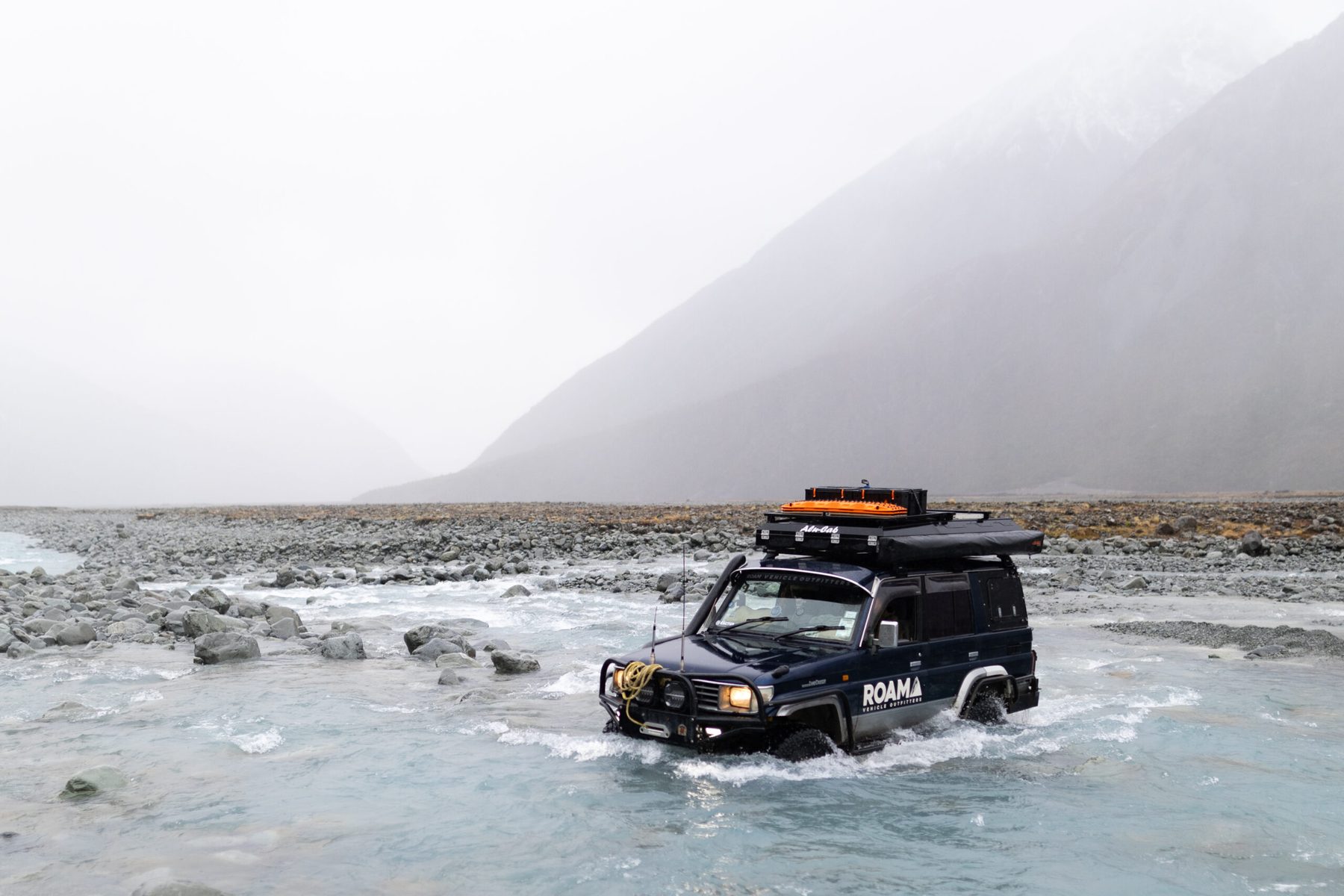
- Crossing a flooded river by 4WD
- Getting into four-wheel driving as a beginner
- Starting Roam Vehicle Outfitters and what's next
How Jack got into vehicle-based travel
Jack was born and bred in New Plymouth, and while he's moved away a few times, he always gravitates back. He was exposed to the outdoors from a young age, with summer holidays camping at a local beach, though not much vehicle-based exploring.
That started when he moved to the South Island at 16 and got a job. At first it was about using four-wheel drives and campers to reach inaccessible places for fishing, hunting and hiking. As he got older, the trip ideas grew, and for a long time his life revolved around seeing every bit of the country, with a four-wheel drive as a base to explore from.
Jack's Prado and his favourite places to drive
The Prado and the troopy
His first truck was an older double cab ute, which opened up vehicle-based exploring for him. After a couple of years he bought his trusty Prado, the truck he's done most of his travelling in.
He bought the Prado with 302,000 kilometres on the clock. On its last trip, in the September before we recorded, it flicked over 900,000 on the way home. A lot of those 600,000-odd kilometres went on every inch of explorable road, track and valley in the country.
These days the Prado is parked in a paddock waiting for a bit of love, and its replacement is a Land Cruiser troop carrier, which will be a very cool build once Jack finds time away from other people's vehicles.
The far north and Kahurangi Point
In the North Island, Jack's pick is the far north, with its vast, open, long beach drives. He resonates with the coast wherever he is, and it feels like home to him.
In the South Island, his number one spot is Kahurangi Point. It's very hard to get a vehicle to, with salt water crossings and lagoons to get across and plenty of risk, so it's definitely not for the faint-hearted. It'll always hold a special place in his heart, and he says anyone who gets the chance should put it at the very top of their bucket list.
Back to the Godley Valley
The Godley Valley is up the Lake Tekapo valley, where the valley splits into the Macaulay Valley on one side and the Godley on the other.
It's also where Jack and I spent time together. On that summer trip, Isaac and I had our four-wheel drive van, but it wasn't ready for the valleys of the South Island, so we jumped in our mates' trucks. We went up the Macaulay Valley first, then tried the Godley the next day and couldn't get all the way to the end.
Billy had been researching the Godley for years and really wanted to get up there, so that following September, the group went back in winter. Jack had been up a couple of times before: sometimes it's not too challenging, and other times it takes a lot of patience to get through the big boulder fields up to the lake.
Planning two weeks off the grid
The plan was three vehicles: Jack, his best mate, and Billy. A filmmaker Jack had never met came along to document a bit of the trip, and it turned into a full-blown feature-length film.
The whole trip was planned at two weeks off the grid, with no chance of coming back for fuel or food. So you pack exactly what you need, plus extra supplies in case things don't go as planned. Most of the planning went into locations, the itinerary and backup spots if the weather turned.
Kayaking Godley lake to the glacier face
It took a while to get up the Godley, and they arrived just before sundown. Jack calls it spectacular. At the top of the valley there's a big glacial lake, commonly known as the Godley lake, fed by glaciers above it and flowing out into a river. Very few people get to venture up there in their four-wheel drives. To reach it, you drive about 26 kilometres of riverbed at very slow speeds.
The weather was really good, if windy and very cold.
On the second day, Jack and his best mate threw the kayaks off the roof and paddled the length of the lake to the glacier face on the other side. They paddled right up under the big glacial face, then jumped out of the kayaks for a walk around. On the way over, Jack's GoPro caught a big avalanche coming down in front of them.
About a month after the trip, they sent a batch of images to glacier researchers, who were astounded that anyone had made the effort to get up there.
Rain and snow in the Havelock Valley
A whole day to the top
Next was the Havelock Valley. Jack knew the first half of it well, but the top end was new to the group, apart from one mate who'd been part of the way up the year before with a Land Rover club.
It started as a nice easy drive, and the forecast was supposed to be fine for the week. It took a whole day to get up there, with a couple of bonnet-deep river crossings but nothing out of the ordinary, and they settled in at a hut at the top.
The river rises overnight
Overnight, the rain came down extremely heavily. The weather turned on a dime. When Jack wandered down to the river with a coffee, the water had risen well over half a metre in one night. It was impassable. But they had plenty of food, which is exactly why you pack extra.
So they explored: some of the group hiked to a bivvy a couple of kilometres up the valley, and they checked out an epic waterfall.
Waking up to snow
Then, at about 2am the next night, everything went silent. A massive dump of snow fell overnight. It's always nice to wake up to snow, Jack says, but a long way up a valley from civilisation, it's a bit less than ideal.
Most of Jack's travel is in the middle of winter, and snow is always a special moment. It was Billy's first time waking up to snow, and he was pretty excited. In that first half hour, the valleys are silent and you're surrounded by vast landscapes. It makes you feel very small, and Jack loves every second of it.
The photos of that morning, with a blanket of snow over everything, are magical.
Crossing a flooded river by 4WD
Waiting it out
Stuck at the hut, they stacked rocks at the river's edge to keep an eye on the level, checking every couple of hours. For the next two days, if anything, the river was getting slightly higher. In the back of their minds was the big dump of snow: once it started to melt, it would push the river up even further.
So they were dancing a fine line between risking it and waiting it out. They had enough food, but there were outside pressures and timelines, including a flight to catch in Christchurch. When Jack walked in to test the depth, the water came up to his shoulders, in a really fast-flowing torrent. No matter how capable your vehicle is, in water that deep it will float.
Looking back, Jack reckons they potentially overthought it a little and got in their own heads. He doesn't regret waiting those four days, because it would have ended badly if they hadn't. But as he puts it:
"if you think about it too much, plan it too much, it … plays on your mind. So sometimes it's best you just dive straight in, obviously in a safe manner."
Making those calls takes experience, and Jack says that only comes from years of travelling and seeking out remote places. You can watch YouTube tutorials, but real-world experience is where the value is, and not giving in to the pressure to leave worked in their favour.
Floating, then crossing
On the afternoon of the fourth day, with the river dropping very slowly, they decided it was time. They unhooked the camp trailer from his mate's truck and hooked it to Jack's, because if anyone could pull themselves up the other side of that river, it was his mate.
Jack positioned his truck behind boulders with his winch attached to the back of his mate's vehicle. It looked good for the first bit, then halfway across, the river picked the whole vehicle up and it started floating downstream. Luckily the winch line went tight and stopped it going any further.
As Jack winched him back, he expected his mate to be freaking out. His mate jumped out of a truck full of water and asked if they should give it another nudge. The second time, with a slightly different line through the big boulders under the water, and a bit of luck and skill, he made it.
Then they threw a snatch strap across the river, hooked the front of Jack's wagon to the back of his mate's, and the good old Prado, towing the big camper trailer, drove across quite easily without taking on much water. Billy's vehicle had much smaller tyres and less suspension and clearance, so they dragged him through.
Getting to the other side was such a good feeling. Without that one big crossing, they'd have been stuck up there a lot longer while the snow melted.
Getting into four-wheel driving as a beginner
Find your community
Jack says the overlanding and four-wheel drive community in New Zealand is growing rapidly, with awesome people, groups, clubs and businesses that put you in touch with like-minded people.
Start simple
His biggest piece of advice is to ignore what social media and businesses try to sell you: that you need all this gear, thousands of dollars and a particular vehicle to get out there. That couldn't be further from the truth. Most people trip themselves up believing they need everything, when:
"in all reality the money is best spent on petrol or diesel in the tank … out there and exploring that's how you figure out what you need how you want your vehicle to be set up."
It might even show you that your car was fine all along and you mostly enjoy the hiking. Simplicity is key at the start, and trends get expensive. The outdoors market is so flooded that it's overwhelming for beginners, so reach out to experienced people who'll give you an unbiased opinion.
Jack pointed to Isaac and me as an example, with a four-wheel drive van that suits our needs. Sometimes I use the four-wheel drive to get off the grass paddocks we're parked in. It gets us to the beaches and down gravel roads, and it's peace of mind for going off tarmac.
Everybody's needs are different. We prioritise comfort inside the van, because we spend months in it. For someone else, it might be a weekend vehicle with a proper roof tent.
Starting Roam Vehicle Outfitters and what's next
How Roam started
Jack is a qualified builder by trade, and ran a small construction company for a number of years. He got to the point where he wasn't enjoying it and felt stuck in a rut. Then a drunken conversation with a mate, very much spur of the moment, turned into Roam. When Jack commits to something, he goes all out.
It cost a small fortune to start. The best part for him is the community around it, and helping people with products and trip ideas. If Roam isn't suited to what someone's after, he'll often send them to other businesses around the country that suit their price point better.
Isaac and I popped into his workshop earlier this year to have him look at our van ahead of a big build later in the year. He came up with ideas we'd never thought of, like a stand-up fridge, and took us out of the ruts you get stuck in on your own build.
Jack's favourite work is big living fit-outs for vans and troopies, for people spending long stretches on the road, and seeing them out there using it and enjoying it.
Australia, America and more films
Jack has explored every inch of New Zealand he can find, so the dream is a twelve-month lap of Australia in the troopy, then on to America. Planning is already underway for the next film, at the end of the year.
I love that he's explored this country so thoroughly first. More Kiwis need to do that before setting their sights on the rest of the world.
Places from this episode
- Godley Valley
- Godley lake
- Havelock Valley
- Macaulay Valley
- Lake Tekapo
- Kahurangi Point
- New Plymouth
- Queenstown
- Christchurch
- Far north
Follow Jack
Jack's business is Roam Vehicle Outfitters, on Instagram and Facebook, and he's happy for anyone to get in touch for advice, wherever they are in the country.
Links from this episode
- Follow Jack on Instagram: instagram.com/roamwithjack_/
- Follow Roam Vehicle Outfitters on Instagram: instagram.com/roamoutfittersnz/
- Follow Will on Instagram: instagram.com/will.scown/Roam
- Follow Abigail on Instagram: instagram.com/abigailhannnah
- Follow Aotearoa Adventures on Instagram: instagram.com/aotearoa_adventures_
More like this
- 4WD Adventures across the Length of the South Island with Rich Soult
- 4WDing and Camping as a Family in the South Island with Kerry Quigley
- An Epic 4WD Summer Road Trip at the Top of the South with Brad Willetts
- Exploring Northland and Living on the Road in a 12-Ton Unimog with Kyla and Louis
Until then, keep adventuring :)
The ultimate
NZ road trip adventure guide
Packed with insider tips and stunning photography, this is the only resource you need to plan your journey.




Keep listening