Episode 104
Avalanche-Bealey Traverse and Pursuing Adventures with Neurological Disorders with Nick Allen

Episode 104
Avalanche-Bealey Traverse and Pursuing Adventures with Neurological Disorders with Nick Allen
Spotify Apple Podcasts Everywhere else Download
I had to do a lot of Googling before this chat. I hadn't heard of the Avalanche-Bealey Traverse, and I hadn't come across FND or fibromyalgia either. So I learned so so much from Nick Allen.
Nick is based in Christchurch, originally from Auckland, and he runs a charitable trust called Mastering Mountains. He also lives with two neurological diagnoses, functional neurological disorder (FND) and fibromyalgia, and the outdoors is a huge part of how he manages them.
And this one is a big story. A few years ago Nick could walk for about 12 minutes a day. When we recorded, he'd just done a nine-hour alpine traverse with 1,500 metres of climbing, in snow.
So we cover how he got the tramping bug, what FND and fibromyalgia are, the slow rebuild, the traverse itself and tips if you want to try it, the charity he started, and what the rest of us can do to make the outdoors more welcoming. I'm already rethinking how I plan group trips.
In this episode
- The Pinnacles and the tramping bug
- Living with FND and fibromyalgia
- Rebuilding from 12 minutes to nine hours
- The Avalanche-Bealey Traverse in Arthur's Pass
- Tips for the Avalanche-Bealey Traverse
- Mastering Mountains
- Making the outdoors more welcoming
- Ring-fencing time and what's next
The Pinnacles and the tramping bug
Pinned above Nick's desk is a photo from his seventh birthday, when he tramped to Pinnacles Hut in the Coromandel and climbed to the top of the Pinnacles. That's when the tramping and climbing bug bit hard. It felt like a real adventure, and getting up high above the Coromandel Peninsula and looking over the other peaks was amazing. He knew this was what he wanted to do.
The Pinnacles is one of those places I hold a grudge against. We drove through the night, started walking at 3am to be up for sunrise, and got zero sunrise. It was so foggy I could barely see my hand in front of my face, and I was super grumpy all the way down. I haven't been back since. I know the views are spectacular, so I need to go back and let it make it up to me.
Living with FND and fibromyalgia
Nick lives with two diagnoses. Functional neurological disorder is a pretty under-researched neurological condition that causes a breakdown in communication between the brain and the body. Sometimes his muscles might not fire properly, or he might sense things that aren't there. Part of that is the body sensing pain where there is none, and that's the fibromyalgia component, which is chronic pain.
His neurological symptoms started at about 19, at first as a lot of weakness in his legs. He was cycling about 500 kilometres a week and thought he wasn't training hard enough, so he kept pushing, and it kept getting worse. At 21 he crashed completely and the pain started. He was later diagnosed with multiple sclerosis, which turned out to be a misdiagnosis, and after a huge relapse in 2019, his neurologist re-diagnosed him with FND.
When he got the FND diagnosis, he thought, what the heck is this? He'd never heard of it. Most people haven't, and even his GP, who he says is fantastic, had heard of it without knowing anything about it.
There's also the question of whether it's all in your head. In Nick's case it's literally in his head, but it's physical, and he describes asking himself whether he's imagining it as deeply unsettling. When the pain stops you doing the things you love as well, it's a double whammy.
Rebuilding from 12 minutes to nine hours
When I Googled fibromyalgia, one of the top results said not to be so active, which isn't very helpful for outdoorsy people.
Nick says managing it can feel like walking a knife edge. Movement is a real way of reducing his experience of pain, and climbing in particular gives him relief:
"for me, rock climbing in particular, when I'm focused on the climb, the pain actually disappears, or at least I'm not aware of it anyway."
If he pushes too hard, though, he can have a flare-up. Sometimes he'll push on purpose, because what he's about to do is totally awesome and the flare-up will be worth it. Most of the time it's about pushing his limits very slowly, in a controlled way, so he builds capacity without a flare. He's not always super good at it, he says, but he's made progress, which has been encouraging.
After the 2019 relapse, he went from being very active to walking on crutches. By 2020 he could walk for about 12 minutes at a time, and that was his max for the day. He got into Burwood Hospital for weekly therapy and built up very slowly, increasing his walking by 10% every two weeks. From 12 minutes to nine hours has been quite a lengthy journey.
The Avalanche-Bealey Traverse in Arthur's Pass
The traverse links two peaks in Arthur's Pass: Avalanche Peak, a really popular climb with amazing views and a bit of a grunt to get up, and Bealey, a couple of peaks along, which has its own track. It's a little bit technical, with 1,500 metres of vert, and quite a big day.
Nick went in feeling quite anxious. It had been a few years since he'd done anything like it. He'd had a couple of days on crampons the season before, on easy terrain, and he'd done nine-hour tramping days, but nothing with long stretches of deep snow, technical terrain or that much climbing. He went with a really great mate he can talk to openly about all of it, and they agreed to see how it went.
Up Avalanche Peak
The snow line wasn't too far down, which was nice, and it was a grunt to get up. They'd checked the avalanche forecast before they left, but on the way they had to judge the avalanche risk for themselves and make sure they were getting into okay terrain, which took some figuring out with both of them a bit rusty.
Moving into more challenging terrain, Nick wondered how he'd handle crampons, ice axes and technical ground again. Then it all came back to him and felt familiar. That was a huge confidence boost: the technical skill and knowledge were still there.
Golden hour on the tops
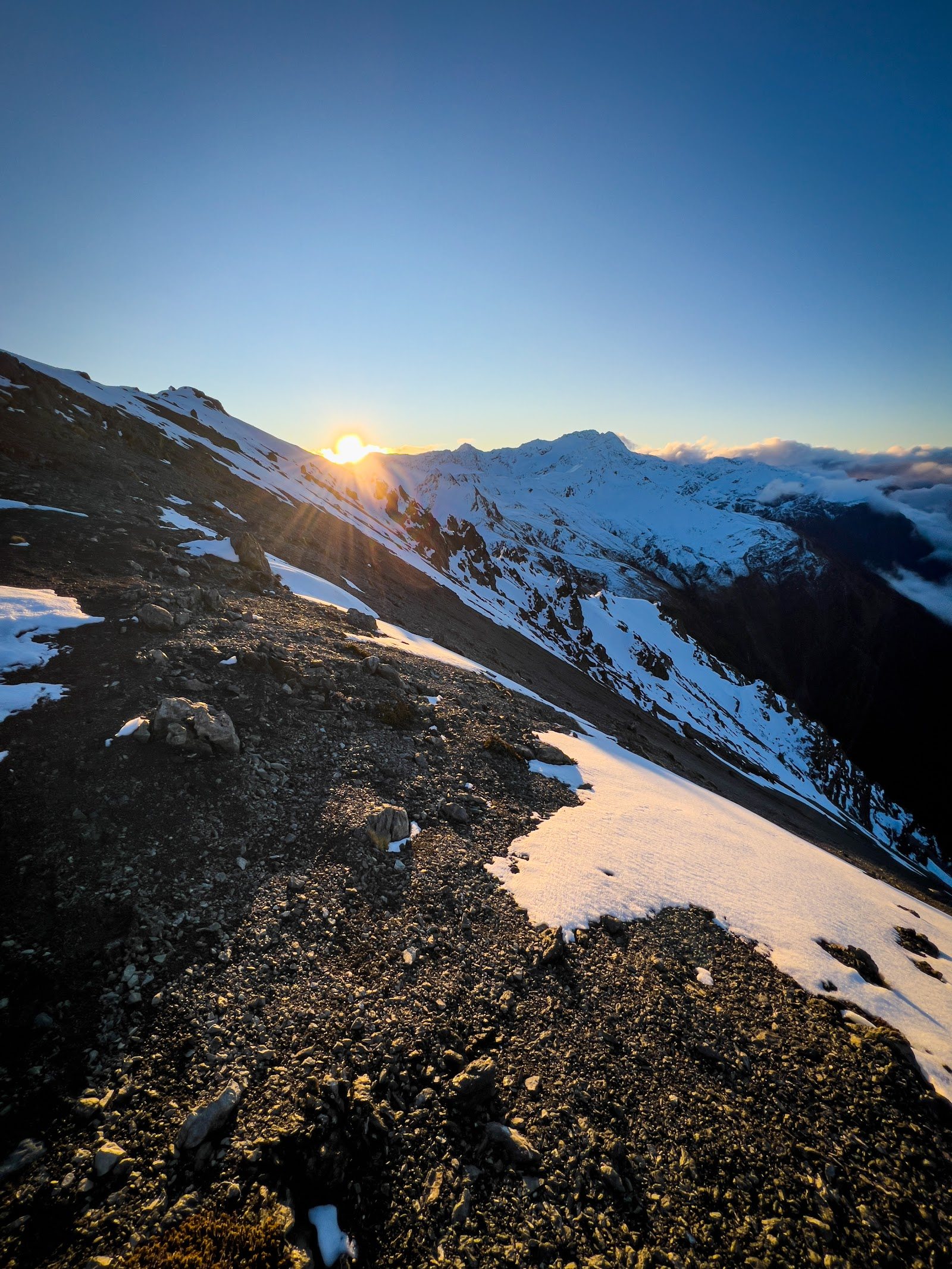
It was clagged in to begin with, then it all cleared, with not much wind. Nick describes being up on a snow-covered peak looking into the deep valleys towards the end of the day, with that deep blue shadow across the valleys and beautiful light on the tussock:
"it was just magic. I was like, oh, this is why you go climbing. It's just so good."
Most importantly for Nick, he came out of it without being destroyed. He'd gone in thinking it could cause a flare-up, and that at least he'd learn where his limit was. He was pretty tired for a couple of days afterwards, but there was no big flare-up.
Having good people around you makes such a difference, even as an able-bodied person. On the Round the Mountain track at Ruapehu, the terrain pushed me out of my comfort zone (I'm a bit of a Great Walks girl), and I knew everyone in the team was way more skilled than me.
Tips for the Avalanche-Bealey Traverse
They went from Avalanche to Bealey, mainly because the Avalanche track was closer to where they were staying. For doing it in winter, Nick's advice:
- Check the conditions and the avalanche forecast before you go.
- Talk to the DOC rangers. There's one at Arthur's Pass he calls a wealth of knowledge.
- Take the right gear. It's semi-technical terrain.
- Brush up on your skills. Nick wants to practise building snow anchors again, and his self-arresting felt a bit rusty when he practised it recently.
You can also do it in summer, when it's rockier, with a bit of scree.
I've only done the short trips in Arthur's Pass, like Devil's Punchbowl Falls and Castle Hill, and after this chat I need to get in there a bit more.
Nick feels so grateful to live in Christchurch, with so much variety on his doorstep. As a kid, he was given a Craig Potton calendar every Christmas, and one year it featured Waimakariri Falls Hut. He thought it was the coolest looking hut, and it went to the top of his bucket list. After moving to Christchurch, he finally went, and it did not disappoint.
Mastering Mountains
Nick started Mastering Mountains in 2015, after finishing a lengthy rehab process himself. He was doing a lot of climbing then and wanted it to count for something more. He was at university, and with family support behind him he could put his money into rehab. He was very aware that without that, he couldn't have paid for it.
He was planning a climb in the Himalayas and thought he'd raise some money. One thing led to another, and the charity snowballed. Almost 10 years later, he says it's the most meaningful work he's ever done.
How it works:
- Mastering Mountains pays for rehabilitation for people with multiple sclerosis and FND, for about a year.
- Each person comes with a goal, like walking a particular track, and Nick mentors them along the way as they build up towards it.
- The goal is a means of learning skills, with a strong educational focus, so people can keep pursuing any outdoor goal they want long after.
The aim is to help people with MS and FND secure long-term access to the outdoors. What makes it rewarding for Nick is working with really inspiring people and walking with them for a year.
Community is a key part of it too. A disability can stop you getting outdoors and isolate you from the wider community, so connecting people who also have disabilities and get outdoors matters. People feed off the sense of being in it together, and Nick learns from them all the time: you mention something weird that happened, and someone else says they've had that too.
Making the outdoors more welcoming
I asked Nick what able-bodied people can do. One of the big obstacles, for him and for others he's spoken to, is the belief that you'll be a burden, slow everyone down, not be understood, or have to hide your disability, which is jolly hard work. Those thoughts can stop people joining a club or going out with others.
He does have to take things a bit more slowly than some of his contemporaries. The main thing, he says, is:
"creating an environment where it's okay to have open and honest conversations"
In some groups he's been out with, there's a real focus on the summit or the objective. He's all for it on one hand, but if he's having a bad day, pushing too hard to keep up can be costly, and you do it anyway and regret it later. So hold goals lightly. If someone is struggling, be happy to sit down, have a good lunch and turn around. That flexibility goes miles for the confidence of people like him, and Nick points out it matters for people with less experience too: charging into a hard day can be terrifying, and you wouldn't want to put someone off on their first tramp.
That's exactly what happened on our Round the Mountain trip. The weather was coming in, and we didn't have ice axes or crampons. We made the call early to stay in our hut and check in the next day, and one person in the group was really good at asking every single one of us what we wanted to do and what we were comfortable with. For one person it was their first ever tramp, and I'm a very slow walker who struggles with feeling like I'm slowing everyone down. On day two we split the group, and those of us who went the long way out had a 10-hour day, because I walk slowly. Having that psychological safety goes such a long way.
Ring-fencing time and what's next
Mastering Mountains is now Nick's main work. One of the impacts of FND is that visual processing is really difficult for him. His background was technical writing, all on a computer, and looking at a screen for long is hard now, so he's pivoted towards the charity, with a bit of video and writing on the side. His physical rehab and exercises take up a chunk of time too.
To fit in adventures, he ring-fences one day a week and guards it with his life, whether that's a day mission or an overnight. When he started, he blocked it out in his diary as a visual reminder. He also heads to the climbing gym early in the morning when he can.
I run my own business, and the emails never stop, so I might have to steal that one.
Next, Nick's big goal for the winter was to climb Rolleston in Arthur's Pass via Rome Ridge, a goal he's had for a few years. It's more technical, but the Avalanche-Bealey Traverse has about the same vert and altitude gain, so it told him he can do it. Now he's working on getting his confidence back with the technical skills.
Places from this episode
- Pinnacles Hut
- The Pinnacles
- Coromandel Peninsula
- Christchurch
- Arthur's Pass
- Avalanche Peak
- Bealey
- Devil's Punchbowl Falls
- Castle Hill
- Waimakariri Falls Hut
- Rolleston
- Rome Ridge
- Ruapehu
Follow Nick
Nick is mostly on Instagram, and Mastering Mountains is at masteringmountains.org.nz.
Links from this episode
- Follow Nick on Instagram: https://www.instagram.com/nick_allen/
- https://www.masteringmountains.org.nz/
- Follow Abigail on Instagram: instagram.com/abigailhannnah
- Follow Aotearoa Adventures on Instagram: instagram.com/aotearoa_adventures_
More like this
- Having an Accident on the Routeburn and a Five Year Recovery Journey with Sarah Heffron
- Mountain Biking, Towel Ponchos and a Brain Injury with Debs Brockelsby
- Hiking the Three Passes Route from Arthur's Pass to Hokitika with Pat Nolan
- Tramping, Hut Bagging Goals, Cancer and Recovery with Verity Jackson
Until then, keep adventuring :)
The ultimate
NZ road trip adventure guide
Packed with insider tips and stunning photography, this is the only resource you need to plan your journey.