Episode 166
Caravan Living as a Family and Writing Music on the Road with Emily & Charles

Episode 166
Caravan Living as a Family and Writing Music on the Road with Emily & Charles
Spotify Apple Podcasts Everywhere else Download
I recorded this one from the van, only my third episode recorded on the road, and the hotspot dropped out on me twice. So thank you, Emily and Charles, for being so so patient (and for the cameo from your littlest, who joined us for a bit).
Emily and Charles are Aro, a bilingual music duo. They live on the road full time in a caravan with their two young tamariki, writing and performing music and running workshops as they go. When we recorded, they'd been on the road for seven months. And I'd been living in my van full time for about a month, so I had a LOT of questions.
So we cover how the dream started, the big move out of their house and into a brand new caravan, and what living with 190 litres of water looks like with two kids. Plus the Arthur's Pass climb that didn't go to plan, the best playgrounds and coffee stops, how they wrote a whole album in the first three months on the road, and their advice for anyone with a dream of doing life a bit differently.
In this episode
- Meet Aro: Emily and Charles
- From van dreams to a caravan
- Moving into a brand new caravan
- Life on the road with two kids
- Water, power and caravan living day to day
- Arthur's Pass, the Haast Pass and Alexandra
- Caravan travel tips for families
- Writing music on the road
- Advice for living your dream
- Next on the list: summer in the South Island
Meet Aro: Emily and Charles
Emily and Charles are husband and wife, and Aro is their duo. They travel the country with their two young tamariki, making music, writing and performing, and running workshops along the way.
Charles whakapapa to almost the whole west coast of the North Island, all the way to the tippy top. Growing up, his whānau always went back to Manukau, on the other side of Herekino, where there's a Herekino forest. There was time on a family farm, helping milk the cows, and camping every now and then.
Emily's family had loads of adventures: every school holidays they were off somewhere with a tent, and later a little pop-top caravan. At the end of high school, the family went down to walk the Milford and Kepler tracks, and she loved being in the wilderness together as a family. She remembers couples rocking up to the start of the track in little vans they were obviously living in. She thought they were the coolest humans in the world, and that marrying someone who wanted to live on the road would be the dream. She reckons she really, really lucked out.
From van dreams to a caravan
In high school, Emily drew little VW Kombis all over her books whenever she was daydreaming, which was most of the time. Like most dreams, she didn't think about the logistics, especially with kids in the mix.
What drew her was the lack of routine:
"I've never really liked routine at all. … you wake up to a different view every day and just get to explore this beautiful country"
Charles never drew caravans in his books (he was doing his schoolwork). He enjoys travel, but for a long time he's put his effort into working towards an outcome for his community and whānau, travelling or not. He's grateful to have an ambitious wife, so he can come along and make the things happen.
Before they had kids, they did a two-year stint in a Toyota Hiace, and that's where the dream really started.
The moment they decided
For Charles, the turning point came when he finally took a break from work. Since COVID, they'd got busier, and he'd started working with his iwi. Everything they did musically had to work around his work schedule, and they wanted to tip the scale the other way.
Emily could see that if Charles kept working that way and the kids started school, they'd settle into the rhythm of school life, and that would be it. There's nothing wrong with that, and they'd love their kids to be in a community one day. But now was the time to go, before they were locked in.
Emily kept bringing it up, they started looking at caravans, and then: let's just do it.
Moving into a brand new caravan
They set a date around tenants moving into their house. On the same morning the tenants started moving in, they moved into the caravan.
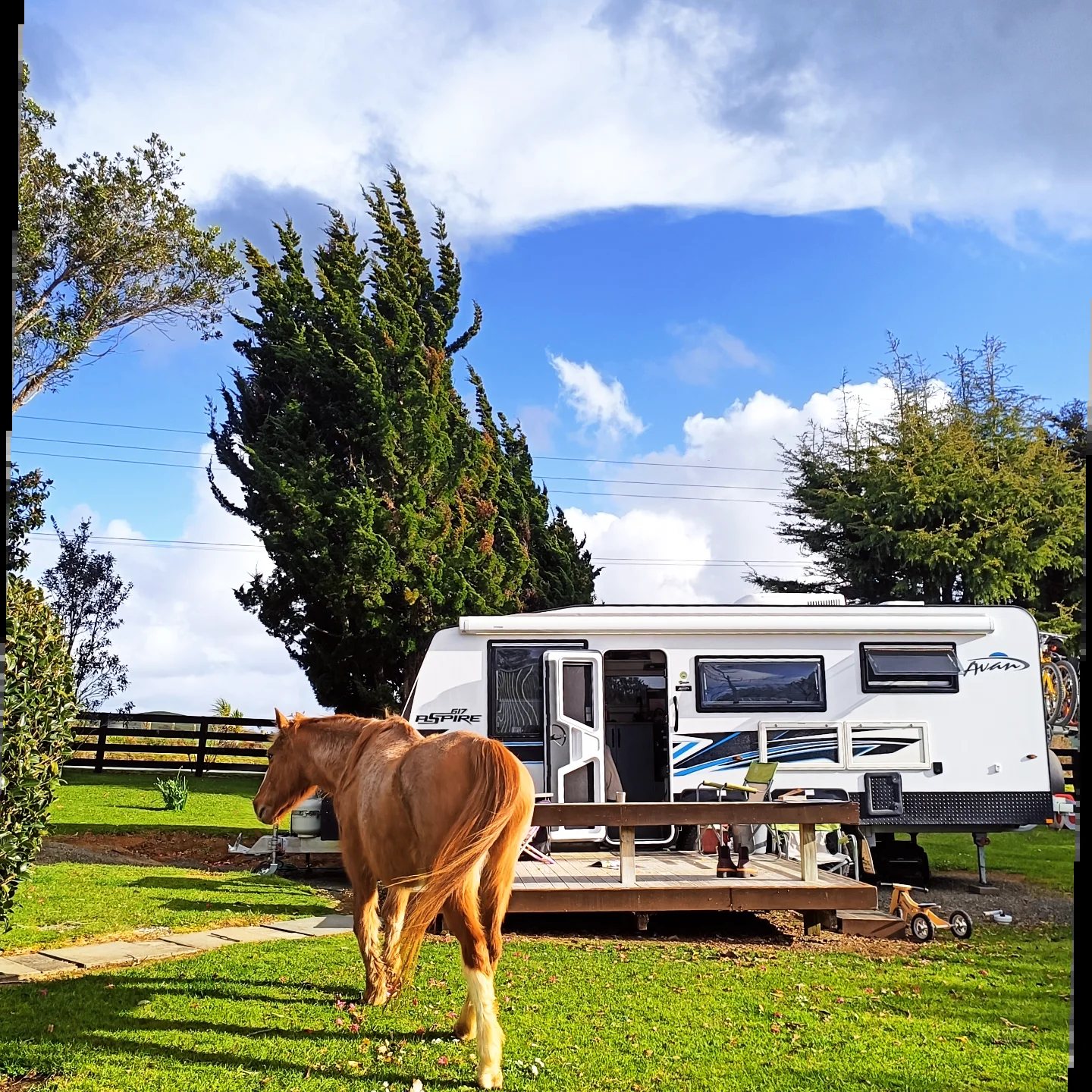
They got a brand new caravan for the same price as the second-hand ones they'd been eyeing up, fitted out the way they'd dreamed it. It's flasher than their home, Emily says. Much smaller, but very nice.
The caravan came over on a ship, and they could track it. As moving day got closer, Emily watched the dot sit in the water outside Brisbane, messaging the company to ask what was happening. Then it arrived, and it was a very quick move. They sold a lot, stored a lot, pulled one all-nighter, and were living in the caravan the next day.
I love a declutter. Our move into the van has been a slow transition over a couple of years, getting rid of furniture and asking why we had five of the same thing. A workshop did our cabinetry, and I sewed the curtains (the bane of my existence).
Life on the road with two kids
The kids have adjusted easily. The biggest adjustment was for the grown-ups. Charles had been working almost full time, with Emily at home with the kids every day, and he says he had to learn his place as a parent once he was around just as much. Learning how to be together all the time, and still get some space, with two kids who need you constantly, was the biggest change.
A big part of why Emily wanted a home on wheels was the music. They already travelled a lot for gigs, setting up in a new Airbnb each time, and that was a lot for the kids. Now the kids have their familiar space and their toys wherever they park. Every now and then their girl asks to go back to their house, and they explain another family is living there for now. It passes quickly.
Water, power and caravan living day to day
Water and the dump station
The caravan holds 190 litres of fresh water, and even less for grey water. Because the tanks are attached, they have to move the whole caravan to the nearest dump station to empty them, and to fill up and clean the toilet tank. There are free dump stations around Aotearoa. They average two to three days before they need to do everything, and that's with short showers and being really careful.
One thing that gutted them was giving up reusable nappies: with no washing machine, it meant laundromats every second or third day. The upside of carrying a toilet everywhere is that when their girl needs the whare paku, they pull over and it's right there. That's been a real treat.
I thought 190 litres sounded like heaps. We've got 100 litres in our Hiace, and it usually lasts us a week, but we don't have a shower or use it to flush the toilet.
Solar power
They've been really impressed with the solar. They moved in expecting it to be interesting, and they've never run out. Once they left the inverter on all day (they use it to charge laptops or run the blender for a smoothie), and it barely moved the battery.
Electricity is the one we have to watch in our van, because the induction stove chews through the battery. So we're always asking how sunny it is and how much driving we're doing to recharge. Our one problem is the two big kayaks on the roof, which shade the solar panel half the time. We've got a second panel we can pop out, or we could move the boats, but we're a bit lazy.
Arthur's Pass, the Haast Pass and Alexandra
Their most memorable trip started with a climb up Arthur's Pass that didn't go well. The signs said it wasn't recommended for towing, and as North Islanders they took that to mean the road was too narrow. With giant trucks going up, they figured they'd be fine. The warning was about how steep it is.
They were driving up from the West Coast, on their way to a workshop at a school in Darfield the next day. About halfway up the hill, their 2.2 litre diesel engine couldn't handle it and cut out. Fortunately they were right next to a car park, and they managed to reverse in while they could hear a truck coming up the hill behind them. It was raining. Emily found it scary, and Charles was very calm.
They turned around, rescheduled a bunch of workshops and took the whole week to go the other way, down the West Coast and over the Haast Pass. In their first month or two, they'd been staying one or two nights in each place, which wasn't manageable with the kids. Having a whole week to get down to Dunedin was the first time they realised they'd been travelling far too fast to enjoy any of it.
With a 1.8 in our van, any incline means we're doing 40 up the hill, and we've become masters of finding good pullover spots to let the traffic past.
Alexandra, the surprise favourite
Next they went across to Alexandra, the most surprising, lovely spot. They stayed at the NZMCA park there, a plain slab with no dump station, right next to an ice skating rink, a BMX track, a scooter park, pools and a bike track that runs to a secret garden cafe.
It was winter and freezing, and it was exactly the rest they needed. At the start of the cycle trail there's a cafe with toys and a kids' menu, so the kids played away and Emily and Charles could eat their food in peace.
Caravan travel tips for families
Playgrounds, coffee and the beach
Most playgrounds in Aotearoa have roadside parking with space for the caravan, and they don't think they've ever had to skip one.
In a new town, the search is always the same: where's the best coffee, and where's the best playground? Coffee in hand while the kids play happily is a good day, right there. The Tauranga waterfront playground is an epic one, with water play, and they spent so many hours there while playing the Tauranga Arts Festival. Even happier than the playgrounds, though, the kids are completely in their element at the beach.
Tips for a first family road trip
For families visiting in a big motorhome, or anyone on a long trip with kids:
- Two hours is the window. If you're planning anything over two hours, take a chunky break after two hours, 45 minutes to an hour.
- Arrive before dark. Always plan to get where you're going before dark.
- Expect to go slowly. Plan for it from the start.
- Do your research. There are heaps of caravan and motorhome blogs and pages online where people share the best roads to take with your kind of vehicle, and the roads to avoid.
- Read the reviews. For Kiwis, the NZMCA app has a great community, and its reviews help with choosing freedom campsites, because some could do with a bit more love.
They've found more towns in the South Island that are caravan friendly than in the North, and the South Island has bigger roads. They're proud North Island ambassadors for Te Ika-a-Māui, though, and they reckon you have to go everywhere. Come for months, at least.
Winter in Northland
They spent their winter up in Northland and it was incredible. It felt like they'd dodged winter because it wasn't that cold, while caravans down south were covered in snow.
I'm keeping that in my back pocket: if it gets too cold next year, we're going to Northland.
Planning a route and where to stay
Their route is mostly planned around work. Where they stay is often decided the week they move, or on the day: freedom campsites, park-over properties and the odd campground (more expensive, though there are good discounts through winter).
Writing music on the road
Their music is bilingual. Emily is Pākehā, and Charles is Māori and spoke te reo Māori before he learnt English, so the language has been a massive part of his world. Aro is a combination of their musical upbringings: a bit jazzy, a bit pop, sometimes a bit R&B, and kapa haka.
Alongside the move, they were awarded funding from Te Māngai Pāho, which is meant to allow twelve weeks off work to give full-time music a proper go. Being in inspiring places helps too. It's a settling kind of inspiration: being near water loosens them up, and they'll follow any idea.
The challenge is finding time to write with two littles, now that their village isn't just around the corner and they're all in one big room. Fortunately, the kids sleep really well once they're finally asleep, so most of the writing happens in the evenings, from ideas picked up during the day's travels.
That's how they wrote a whole new album, 13 songs, in their first three months on the road. When we recorded, the first single had come out on 21 November, a second was due in February and the album was out on 20 March, followed by a nationwide tour.
I'm definitely adding that album to our road trip tunes.
Advice for living your dream
Emily's starting point is that the kids are only small for a short time:
"These kids are only going to be young for a little while, you know? So I just feel so grateful that we get to spend these days being fully together as a whānau, getting to have this awesome adventure"
A lot of jobs can be done remotely now, and they've rarely been out of reception. They've met so many people in their 50s and 60s who say they've always dreamed of living on the road. Emily's advice: when you have a dream, find a way to make it work.
Charles's three things
It's not an overnight thing, Charles says. It might look like they jumped straight in, but after jumping, they spent months and months preparing. He has three things he'd like to say.
The fear is valid. The uneasiness, discomfort, doubt and fear are real, and so are the risks you imagine.
There's always a dip. It's something he learnt growing up, and he thinks it's legit:
"there's always a Jordan before the promised land … don't be discouraged by a little mistake or a little bump"
Take your time. Build yourself up and set things in place, a step at a time. You don't have to jump all the way off. Edge closer and closer, because you can spend so long dreaming that you think yourself out of it.
That advice hit home for me. We bought our first van in 2020, and living in a van full time was a dream from before then. Getting here took five years: quitting my corporate job, building an online business, and three years of dreaming up exactly how we wanted this van to be. So do the dreaming and the wishing and talk about it, and take baby steps towards it every single day.
On a women's kayaking course in Raglan a couple of months before we recorded, a lot of the women were in their 40s and 50s. When I told them I live in my van, they wished they could have done that. Where were the remote jobs in their 20s? I'm so grateful for the chance to do life a bit differently.
Next on the list: summer in the South Island
As a family, they're most content by the water, especially the beach, the moana. They love lakes and rivers too, but cruising around the coast of the whole country would be a dream.
The other one is a summer in the South Island. They always seem to end up down there coming out of or going into winter, so they've never seen it in summer.
I love the South Island in summer, especially the top of the South. Two summers ago, Isaac and I spent six weeks up there and didn't go further south than St Arnaud: Abel Tasman, Queen Charlotte, Nelson Lakes National Park, Tākaka, Golden Bay and Kahurangi.
They wondered about getting a caravan over the hill to Golden Bay.
We made it in our 1.8 diesel. The hill is definitely a hill, but there are pullover bays, so it's doable.
Charles's favourite spots so far are Whites Bay in Marlborough and Ahipara, where they'd recently been. Those two campsites have come closest to what he pictured when Emily said they should live in a caravan. Beautiful spots, and great for seafood too: catching kai and going bush.
Places from this episode
- Herekino
- Milford Track
- Kepler Track
- Arthur's Pass
- West Coast
- Darfield
- Haast Pass
- Dunedin
- Alexandra
- Tauranga
- Northland
- Raglan
- St Arnaud
- Abel Tasman
- Queen Charlotte
- Nelson Lakes National Park
- Tākaka
- Golden Bay
- Kahurangi
- Whites Bay
- Ahipara
Follow Emily and Charles
- Instagram and Facebook: @aromusicao
- Website: aromusic.co.nz
- YouTube and Patreon: Aro Music AO
Links from this episode
- Follow Aro Music on Instagram: www.instagram.com/aromusicao/
- www.aromusic.co.nz
- Follow Abigail on Instagram: instagram.com/abigailhannnah
- Follow Aotearoa Adventures on Instagram: instagram.com/aotearoa_adventures_
More like this
- Coming Home to New Zealand and Living in a Kombi as a Family with Kirianna Poole
- Living and Travelling in a Caravan as a Family with Bronson and Chelsea
- Exploring Northland and Living on the Road in a 12-Ton Unimog with Kyla and Louis
- Planning an Adult Gap Year to Full-Time Van Life with Sagar and Ami
Until then, keep adventuring :)
The ultimate
NZ road trip adventure guide
Packed with insider tips and stunning photography, this is the only resource you need to plan your journey.