Episode 201
The Rakaia Redemption, Driving a 4WD to a Glacial Lake with Billy Nunweek
Episode 201
The Rakaia Redemption, Driving a 4WD to a Glacial Lake with Billy Nunweek
Spotify Apple Podcasts Everywhere else Download
Billy Nunweek was my very first guest on this podcast. Two years ago he came back to tell us about a trip into the Rakaia Valley where the team didn't reach their goal. So when I heard they'd gone back, I was really really excited. And a little bit nervous (more on that later).
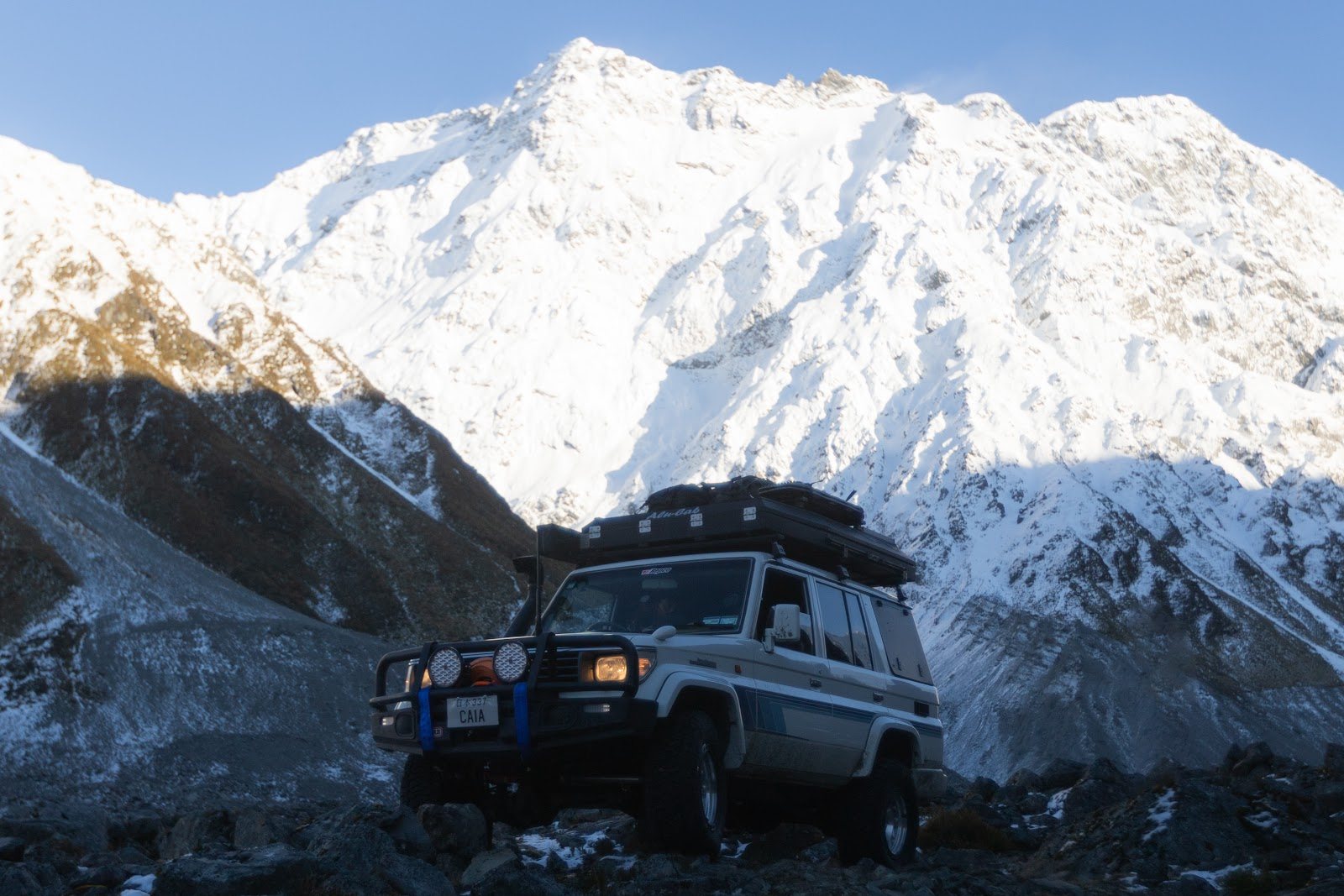
Billy is a landscape photographer and filmmaker who works in health and safety in the central Waikato. He also has a long love affair with Caia, his 1994 Land Cruiser Prado, who spent a lot of this year in surgery. Only some of it was Billy's doing.
This was my first time hearing the whole story too. So this post covers the lot: the earlier attempts, everything that broke before the trip even reached the ferry, a river crossing that went very wrong, a driveshaft delivered into the valley, and the snowy day they finally drove to a glacial lake the locals say no vehicle had ever reached. Plus Billy's advice for anyone stuck in the messy middle of a big goal.
In this episode
- Landscape photography and a Land Cruiser called Caia
- The Godley, the Havelock and the first Rakaia attempt
- Planning a winter 4WD trip up the Rakaia
- Breakdowns before the trip began
- Driving the Rakaia Valley to Reischek Hut
- A failed river crossing and a broken driveshaft
- Crossing the Rakaia River at last
- Snow, boulders and the glacial lake
- Advice for chasing a big outdoor goal
Landscape photography and a Land Cruiser called Caia
Billy grew up in South Auckland before moving to the UAE and Malaysia, and first found photography in Kuala Lumpur, taking photos of the Petronas Towers. He rediscovered it when he moved to Christchurch, completely in awe of the landscape. That passion turned into an obsession, and he calls it the most complicated and the easiest thing in his life, all at once.
It started with the stars. To photograph the night sky, he went where the skies were darkest, then started shooting sunrises and sunsets too. He bought a truck to take him further, and then noticed he was photographing less. That's the thread running through this whole story.
He still leaves the camera behind on little beach camps sometimes. But photos he's really happy with are part of the reason he goes:
"I want to go out, I want to get remote, I want to see something beautiful, I want to photograph it, and I want to cook a lovely meal."
Photography is what first got me outdoors too. Back in 2017, Isaac wanted to buy a camera, and I figured that if we were going to spend that money, we had to use it. So it got me out to places like Piha, and Mount Eden for sunrise, and it put the spark in me to see what else was out there.
Billy calls her Caia 3.0, the third build of the same truck, which he's had for five and a half years. She's a 70 Series Prado with a three-litre turbo diesel, a lift kit with airbags holding up the rear, and an Alucab rooftop tent (a phenomenal one, he says). He lived out of the old setup for six months on a road trip a couple of summers ago, and it showed him how little you need to enjoy life out there.
Billy and I have bonded many times over fitting out a vehicle you want to live in.
The Godley, the Havelock and the first Rakaia attempt
The story goes back to 2022. Billy had hit a creative rut, and part of that was down to the truck. He'd drive to places he thought would take his photography to the next level, arrive late, set up camp and cook, and never see the best of them, let alone photograph them.
So he and some friends designed a trip up three of New Zealand's river valleys: the Godley, the Havelock and the Rakaia. The aim was to take one photo that blew his own socks off and made him proud of himself.
They made it up the Godley Valley, no problem. The Havelock Valley was a cool challenge in itself, but unforecast snow and rain pushed the rivers up and almost trapped them for a couple of days, leaving no time for the Rakaia.
They came back in 2023, and it went wrong in every way it possibly could. The truck was damaged badly enough that it needed about a year of repairs. Gale-force winds topped 200 kilometres an hour, campervans crossing the Rakaia bridge tipped over that day, and over 100 millimetres of rain fell.
Billy says the disappointment wasn't gut-wrenching. They'd pretty much decided it couldn't be done, and he'd tabled it completely.
Planning a winter 4WD trip up the Rakaia
Then last November, his business partner, Jack Laurent, called and said they should give it another go. It's been the fire in Billy's belly ever since.
Billy self-funded the first two projects, and one of his conditions this time was not to. So the two of them set up a business together and got a couple of really cool clients on board.
They first looked at April. That didn't work, and it turned out to be a blessing in disguise (more on that below).
They settled on August. It's cold enough that there isn't significant melt, and it misses the heavy rain, high winds and snow that July and September bring. It had been a snowy winter, so they knew they'd have to contend with that.
The river was Billy's key concern. It had beaten them before, and years earlier Jack blew up a diff trying to cross it.
The catchment is so large that very little rain pumps the river up. On the 2023 attempt, without any flow data on them, they tried to cross at 1,500 cumecs, which the organisation collecting the data rates as a one in ten year event. Last October it ran at just shy of 8,000 cumecs, which Billy calls biblical, end of the world stuff. This time they crossed at 114 cumecs.
Breakdowns before the trip began
In early April, Caia decided she didn't want to run anymore, and the whole fuel system needed rebuilding. Then she developed a violent steering wobble, which got worse when new suspension went in right before the trip. It took six months to diagnose: a bent radius arm. For Billy, every step forward felt like five backwards.
Billy kept me updated as things went wrong, and it got to the point where I said to Isaac that I really didn't know if they should be doing this trip. How many signs are too many signs? I was so nervous for him once they'd gone.
The week before the ferry was chaos. Billy needed a warrant of fitness, the regular check that says a vehicle is fit for the road. The wobble felt like being grabbed and shaken to bits, in up to three tonnes of truck at 80 kilometres an hour, and it blew the tyre valve stems out three times. One went on the Auckland Harbour Bridge, dropping all 40 psi with no warning, and Billy limped down to Shelly Beach Road with no tools until Jack came to save the day.
The truck was towed to his mechanic in Cambridge, who found some of the suspension hadn't been installed correctly, or at all, and the shaking had bent the radius arms. This was three days before the ferry.
The truck got its warrant. Billy caught up with friends for beers in Auckland and woke up the next morning sick as a dog, and you can hear it in some of his talking in the film.
Before they'd made it past Cambridge, he blew out another tyre. Near the ferry, another truck blew a wheel bearing. A sponsor was supplying spare parts and tools, so they had none with them. They limped onto the overnight ferry, picked up parts in Blenheim the next morning, and in Christchurch had to take it all apart and do it again. They reached the river about two days late.
Driving the Rakaia Valley to Reischek Hut
They got into the valley late in the day. At the first river crossing you air down and go straight across, then drive up through the tussock. The first day and a half is easygoing on marked trails, all the way to Reischek Hut. One of the crew de-beaded a tyre and got stuck, but his truck was carrying everyone else's stuff, so that was to be expected.
On the second day they went past Reischek to what looks like a crossing on the south side. The rocks were too big for most of the vehicles, and even with the river so low it looked gnarly, deep and churny. They gave it a crack with two vehicles, decided it wasn't feasible for everyone, and went back to the hut for the night, still feeling good.
The second and third days were drizzly, with low cloud hiding the valley, and the camera gear suffered. They recorded anyway, because these trips don't go perfectly.
A failed river crossing and a broken driveshaft
On day three they used their old topo maps of where they'd crossed in 2023, and even found the piles of rocks they'd put up to mark their own little trail.
That's where it went wrong. They thought they knew what they were getting into, and they didn't walk the river. Billy says you should always walk a crossing you haven't done before, or one that's changed, because of the rule of thumb:
"if it's hard for you to stand still and the water's pressing against your body you imagine what it's going to do to the side of your truck"
They'd always walked crossings before. This time they were too eager and too excited, and the flow was low. The one thing they did right was attach the first truck, Jack's Troopy, to someone else's winch.
The Troopy got stuck, went into reverse and got stuck again, having lost drive. As they winched, it dropped into a rut, and the water came up to the top of the rear door, on a truck with a four-inch lift and massive tyres. Billy says it was really scary. With some clear minds in the crew they got it out, front wheels spinning and rear wheels still, with the remnants of the driveshaft smacking against the truck. Of all their spare parts, a driveshaft wasn't one of them.
After a call-out on their stories for anyone in Christchurch with a driveshaft, two legends drove two of them into the valley, arriving early the next morning. They were the wrong size. So two of the crew drove a 100 Series out of the valley, another group brought the right part to Windwhistle, and the boys met them there and drove back in. On day four, the correct driveshaft went in.
Crossing the Rakaia River at last
Day four was beautiful and sunny, and day five was the same: everyone in shorts and T-shirts in the middle of winter.
Back on day three, once everyone was safe, one of the crew had gone for a walk and found a spot that was significantly shallower, with a less vicious flow and a rock on the far side to winch off.
They spent the morning of day five building a little track back towards civilisation to reach it. This time three people walked the river, checking every rock, and the weather let them fly the drone to survey it. A different truck went first, with a rope set up on the winch rock in case of drama. It was a walk in the park, and all four trucks got across.
Billy reckons if they'd done all that on day three, they wouldn't have tried to cross where they did, and might have found this spot anyway.
Crossing was a phenomenal feeling, with so much still left to do. The rocks on that side are bouldery straight away, slow rock crawling, to Lauper Bivvy, directly across the river from Reischek Hut, as far as they'd got in 2023.
Some of the crew found a way across the stream on the western side of Lauper Bivvy, in theory the last water crossing, and with the sun gone at five, they went for it. Past the stream it was like a highway, and one of the crew got up to 30 kilometres an hour.
The valley gets tight, and the four-wheel driving gets harder. They rounded the corner towards the glacial lake as the light faded, close enough to almost smell it, and hit boulders. One of the crew rated what lay ahead at 120% of their capacity.
They walked down to the lake, 350 metres away and hidden by a rise. Jack's call: set up camp and do it tomorrow, even if they only get one vehicle there.
Snow, boulders and the glacial lake
They woke up to snow. The forecast had been for a light dusting on the bonnet, and it had covered everything. Billy was first out of bed and asked one of the crew what he reckoned: 120% yesterday, 180% today.
I thought the snow might fill the gaps between the boulders and make it easier.
Billy explains why it made things harder: the snow doesn't compact in, so you can't see the holes and you fall into them, and on that much rock it gets icy and slippery. If the people weren't slipping, the trucks were. They had Starlink this time, and the forecast said the snow should have stopped half an hour ago. It snowed all day, in big fluffy chunks.
Fifteen metres out of camp it got difficult. They winched trucks through, used the winch to move rocks, put Maxtrax down and built little sections of track. It took an hour and 45 minutes to get the first truck to the lake, and only 45 more minutes to get everyone else's there. The slowest part was walking back for the next vehicle.
Billy says he didn't feel anything at that point. He, Jack and Caia had been trying since 2022, and he wasn't going to feel it until they were all there. There were big cuddles and a lot of emotion, but it didn't hit him for a couple of days. On the way out, alone, he looked around and started giggling:
"I have no reason to come back here. I've done what I came for."
They spent a couple of days at the lake. The snow cleared that evening, it dropped to minus 13 overnight, and the lake froze solid. In the morning, as the sun hit it, a thin layer of water formed on top of the ice and turned it into a complete mirror. Billy didn't get his photo until they were driving out on the last morning, when he saw it, hopped out and took it: a full mirrored reflection. Chef's kiss, as he says.
On the way home, Caia's brakes locked on outside Rakaia township, and she had to be freighted back to the North Island. When we recorded, he'd had her back for a week, the happiest week ever. His screensaver is a photo of her around the corner from the river on the way out, and to Billy, that photo is five years of hard work.
Advice for chasing a big outdoor goal
Billy's first piece of advice is that it's worth it, even when it doesn't feel like it at the time. When you get there, you go numb for a while, because there's so much emotion it's hard to quantify.
- Keep pushing. It tested his resilience to breaking point, and the people who know him know he's resilient already.
- Learn from the setbacks. On the 2023 trip, the radio at Reischek Hut didn't work, and that service isn't provided anymore. As much as they love being out of reach of the world, Starlink was a necessity this time, to do it safely and to know when bad weather was coming.
- Give yourself time. Five days wasn't enough in 2023, so this time they allowed 13. Two went before they even got there, and they were in and out in seven.
- Plan. Improvise, adapt, overcome. The amount of pre-planning for a week in the valley is ridiculous, and that's the nature of getting things like this done.
Billy says it's the biggest and most impressive thing he's done in the outdoor space, and it pushed his personal limits. Now they're all asking what's next. They have a couple of ideas in Aotearoa, but he's not giving any places away, because he doesn't want anyone to beat them there.
When we recorded, Billy was editing the film of the trip, which will be free to watch on YouTube.
Places from this episode
- Rakaia Valley
- Rakaia River
- Reischek Hut
- Lauper Bivvy
- Windwhistle
- Rakaia township
- Godley Valley
- Havelock Valley
- Christchurch
- Blenheim
- Cambridge
- Auckland Harbour Bridge
- Piha
- Mount Eden
Follow Billy
- Instagram: @billynunweek
- Caia has her own Instagram too, and the details of the film, its premieres and screenings will be shared on both accounts.
Links from this episode
- Follow Billy on Instagram: https://instagram.com/billynunweek/
- Follow Caia on Instagram: https://instagram.com/caiathecruiser/
- Follow Abigail on Instagram: instagram.com/abigailhannnah
- Follow Aotearoa Adventures on Instagram: instagram.com/aotearoa_adventures_
More like this
- 4WD Land Cruiser Adventures with Bri Woolnough
- Overlanding in the Old Man Range and 4WD Trips with Jono Hitchcox
- 4WDing and Camping as a Family in the South Island with Kerry Quigley
- Solo Adventures, 4WDing and Being Multi-Passionate with Grace Reeves
Until then, keep adventuring :)
The ultimate
NZ road trip adventure guide
Packed with insider tips and stunning photography, this is the only resource you need to plan your journey.