
Spotify Apple Podcasts Everywhere else Download
Jenifer tramped a lot in her twenties, then life happened: a degree, an office job, a child. And now she's back into it with gusto, which I love.
So when I heard she'd spent eight days walking the Kaimai Mamaku Ranges on her own, south to north, I wanted to hear every bit of it. The planning. The food (her first ever attempts at dehydrating, a week before she left). The day her pack turned into a water carrier. And the sunrise that made it all worth it.
Jenifer is a former outdoor instructor and a self-confessed gear geek, and she runs a Facebook group for talking about gear that works in New Zealand. So there's really really useful gear chat in here too.
This post covers how she first found the bush, how she planned the trip, the lost day and how she made it back, her favourite views, what she carried and what she'd change, and the Kaimai day walks she rates.
In this episode
- How Jenifer found the New Zealand bush
- Gear forums and the idea of a thru-hike
- Planning eight days in the Kaimai Mamaku
- A soaked pack and a lost day
- Motutapere Hut and the ridge views
- Tents, pack weight and a few luxuries
- Ultralight gear and wet New Zealand bush
- Track conditions and Kaimai day walks
How Jenifer found the New Zealand bush
Jenifer was born in Portugal and moved to New Zealand as a small child. Her family did a bit of car camping here, and that was about it. The outdoors came to her in her early twenties.
At the time she was working at Youthtown in Auckland, running the after-school programme. One day she spotted a photograph on a noticeboard. In her words:
"I walked up to that photograph and I said what's that, and the answer was literally, that's the New Zealand bush. I did not know what I was looking at"
The photo was from a trip run by Youthtown's adventure therapist, who took young people out into the bush as a healing tool of sorts. She volunteered as a helper on the next trip, out to Lane Cove Hut. It was her first ever trip into the bush. She didn't know huts existed, and she remembers being shocked that there was only cold running water. She loved all of it, especially watching the kids learn they could achieve more than they thought.
The leader was American, army trained and quite gruff. So Jenifer decided then and there that she wanted to do what he did, with a softer, more mothering touch.
She moved to Nelson to train as an outdoor instructor, covering tramping, kayaking, rock climbing, white water, sea kayaking and caving. In her second year she specialised in tramping and adventure-based learning. She spent another seven or eight years in that life, working in Australia and New Zealand and helping on camps for youth at risk.
It was a wonderful lifestyle, but she couldn't support herself or save on it. So she ended up in Wellington doing a degree, then working in an office, with weekends mostly spent mountain biking. Then her son came along, and for years it was day walks with him as he grew up. Now he can handle a good long walk, and she's out as much as she can, with him and on her own.
I'd recently had Morgan on, talking about a whole South Island trip in a station wagon, so it was fun to hear car camping come up again.
Gear forums and the idea of a thru-hike
When Jenifer started tramping overnight again, she rummaged through the garage for her old gear and realised it needed updating. So she went looking online, and was really pleased to find so much information about gear.
Back when she trained, gear knowledge was very paywalled, as she puts it: you did a course, asked your instructors, or went out to a hut and hoped someone had the thing you were thinking about.
Reading the forums, she came across the idea of thru-hiking, which was new to her. Then she found out you could do a north-south crossing of the Kaimais. She'd already been dreaming of walking the South Island section of Te Araroa northbound in a couple of years, so seven or eight days in the Kaimais felt like the perfect introduction to walking for a long time.
Her dream is to head to the South Island with no responsibilities other than tramping as much as possible. Te Araroa is how she gives that dream some focus: northbound, ending up in Nelson, in a shoulder season when there might be fewer people, and adding in Kahurangi National Park, which feels like her spiritual home.
Planning eight days in the Kaimai Mamaku
Jenifer walked south to north, starting from State Highway 29, ten minutes up from Matamata. Her partner and son walked in with her for the first night, camping in the tent, and her partner always planned to meet her on the last night at Daly's Clearing Hut. That meant she only needed to carry six nights of food (and she made the boys carry the food for the first night).
She'd been gathering food for weeks, packing it, repacking it and thinking about it again. Then, a week before she left, someone randomly lent her a dehydrator. Cue a huge learning curve. Some of her meals ended up homemade, and some were even nice, though the beef was a bit gravelly.
The logistics were mostly about knowing where she'd stop each night. Her partner had her draw up a little spreadsheet with the date, the hut and the grid reference for every night, so he'd know exactly where she was. She carried a PLB and her phone, knowing there wouldn't be reception the whole way.
A surprise at Te Rereatukahia Hut
Once she got cell reception, she worked out that her partner was coming to meet her a night early, at Te Rereatukahia Hut. He brought a whole bunch of chocolate, and because he knew she was running out, toilet paper.
Then he took her rubbish out. The next day, not having to carry it reduced her to tears.
A soaked pack and a lost day
The plan for the first full day on her own was to lunch at the second hut, about three hours on, then push on to a campsite. Most people would push on further, she reckons. She hadn't wanted to give her son two long days back to back.
It was raining when the boys turned back to the car, and absolutely pouring as she walked. She got really cold, so she pitched just the fly of her tent with her poles, on an uneven bit of ground, and made a hot lunch under it.
Her quilt was a bit damp from condensation in the tent the night before, so she planned to dry it at the second hut. Then she opened her pack. It had leaked. The dry bag she was using as a pack liner had leaked too, and her pack was working as a water carrier. It's the worst luck a tramper can have, she says.
Luckily, that hut is a fantastic place to dry things, with a huge covered deck and a massive line. By three o'clock it was pouring with rain and thunder, so she stayed the night.
Making up the time
That lost half day meant hours of walking faster than she wanted to. One morning she woke at 4.30, decided there was no point trying to sleep, and put in a 12-hour day. It's quite difficult to make up time in the bush, but she got to one of her planned campsites at 8.30 one morning, around when she'd have been leaving it anyway, and knew she was back on schedule. That was a huge relief.
Camping between the huts
You have to camp on this trip. Between the second hut and Motutapere Hut there are two nights with no hut. There are designated campsites, but she didn't make it to either, so she camped in little scrappy bits of bush.
Motutapere Hut and the ridge views
The 12-hour day got her to Motutapere Hut, the next hut on her schedule. It was a difficult walk, with a lot of learning about body functions and smell, and she arrived completely chafed and sore.
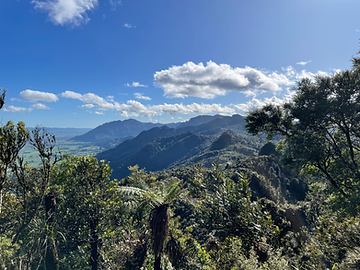
One of the highlights of the whole trip was waking up there the next morning. She was rested, the chafing had stopped, and she could wash and dry her clothes. And as a complete bonus, a little track climbs about five minutes from the hut to a big flat lookout over the whole East Coast. She was there for sunrise, with the sun coming up over the ocean, and she's planning to go back and camp up there. She didn't expect views like that in the Kaimais, because you think of them as big dense bush.
As Jenifer puts it:
"it was just such a nice feeling knowing that I'd gotten there on my own steam and that you know it was a hard walk there but it was just wonderful."
The ridge from Motutapere Hut to Te Rereatukahia Hut has views all the way along. You can see up and down the East Coast, and out over the plains to the west towards the mountains. There are some incredibly steep little pinches, and for Jenifer, some of the best views of the whole trip.
Tents, pack weight and a few luxuries
Jenifer took both her tents for the first night: a single-wall tent for her son and a heavier, double-wall two-person tent for her and her partner. Her son said the condensation in the single-wall tent was so bad that when it rained, it was raining inside.
She'd originally timed the trip, on the first weekend of winter, around a new single-wall tent arriving. In the end she took the heavier double-wall tent, and she's so pleased she did. It pitches fly first with tramping poles, and the inner clips out, so you can keep the inner dry in a bag. Pitching only the fly gave her instant shelter on that cold, wet first day, basically an emergency bivvy.
She learned that trick as an instructor. Someone in the group always carried a big plastic mattress bag, which you could pull over a whole group for instant warmth and rain protection if someone was getting cold.
For New Zealand, she wouldn't recommend a single-wall tent, because of the condensation and because a double-wall tent can double as that emergency shelter. It was the one piece of kit she was most glad to have.
Pack weight and luxuries
She put a huge effort into going ultralight. Normally she tries to keep her pack to ten kilos, which she knows counts as lightweight, and it was more for this trip, her first long tramp in a while. Ultralight doesn't necessarily work for New Zealand winter in the bush, she's learning: you need a double-wall tent, and a sleeping bag that can cope with condensation.
She does like a few luxury items:
- A Zenbivy quilt. She's a terrible sleeper and sleeps on her side, so it gives her heaps of room to wriggle around.
- A chair kit for her Thermarest. At six in the morning, making coffee, she likes to sit up in a chair and relax back a bit.
Ultralight gear and wet New Zealand bush
The thing she was cross about was her pack. She'd bought what she thought was a good ultralight pack without thinking about waterproofing, after years of heavy canvas packs that kept the rain out. And at the last minute, she'd swapped the plastic pack liners she'd used for years for a big seam-sealed dry bag. Water pooled in the bottom of the pack and the pressure pushed it into the dry bag.
So now she uses pack covers and pack liners. In her Facebook group, she tells everyone to do the bath test:
"If you own a dry bag … anything that you think is supposed to keep out water, fill up the bath put a t-shirt, a cotton t-shirt, in that bag … and dunk it in and hold it under and then you'll see whether it actually is a dry bag"
She does the same with every op shop jacket she buys, standing in the shower with a white t-shirt on underneath.
Ultralight forums are interesting, she says, because a lot of the people posting are walking through dry deserts, on tracks where you can see the sky. Since she started tramping properly in January, she hasn't been on a tramp without rain. And in New Zealand the bush encroaches on the track, so she's had things ripped off her pack that she thought were securely attached. Gear strapped to the outside, no pack cover and a bin liner for a pack liner don't last here, in sticky, horrible bush.
Her advice for the trip itself: walk it north to south, the opposite way to her. It's flatter at the end that way. And the second hut from the southern end, the one where she dried out, would be your second-to-last night. It has a solar bank, lights in the hut and a dedicated phone charger with cables for iPhone and Android, plus your power banks. Very useful on day six, seven or eight.
Track conditions and Kaimai day walks
Jenifer first tramped in the Kaimais around twenty years ago, on trips while visiting Auckland in the summer holidays. She remembers it being really scrappy, and getting a bit lost.
What she's noticed lately is that she's walking a lot of tracks in about double the track time. She thinks the tracks aren't in the condition they used to be, with a huge amount of treefall that hasn't been cleared, whether that's budgets or cutbacks. The weather in the last five years has been worse, so there are more trees down. Even in the Kaimais, there were bits where she had to take her pack off, climb under a tree and pull her pack through after her.
Then there's the mud, which she thinks is worse than snow because the earth is literally sucking you down.
Day walks in the Kaimais
If eight days isn't for you, Jenifer says anything marked as a day walk in the Kaimais is usually well worth doing, and there are lots of entrances to the park.
- Waiorongomai Valley. Her favourite, going in from Te Aroha, which she calls a lovely little town. It's incredibly good for kids, with old tramlines and gold mining equipment up and down the valley. There are gentle, easy tracks with lots of interesting information, and huge inclines too: vertical sets of stairs disappearing into the misty clouds.
- Waterfall walks and straight bush walks, depending on what you're into.
For planning, she recommends the Kaimai track and hut users group on Facebook, a wealth of up-to-date information. When we recorded, a track had recently closed because of kauri dieback, and there was lots of treefall. In winter especially, current information is extremely important, wherever you're tramping.
I've done the Te Aroha summit, and I was really upset to find a road at the top. It's an access road for the tower up there, but still. We could have driven up!
Places from this episode
- Kaimai Mamaku Ranges
- Matamata
- State Highway 29
- Te Rereatukahia Hut
- Motutapere Hut
- Daly's Clearing Hut
- Te Aroha
- Waiorongomai Valley
- Lane Cove Hut
- Nelson
- Kahurangi National Park
Follow Jenifer
- Facebook group: New Zealand Outdoor Gear Chat
- Blog and YouTube: Jenifer Walks
Links from this episode
- Follow Jenifer on Facebook: facebook.com/jenifersilva
- Follow Jenifer on YouTube: youtube.com/@jeniferwalks
- 8 Day North South Kaimai Conservation Park Walk
- Follow Abigail on Instagram: instagram.com/abigailhannnah
- Follow Aotearoa Adventures on Instagram: instagram.com/aotearoa_adventures_
More like this
- Solo Tramping the Mangamate Loop in Whirinaki Forest Park with Sharon Evans
- Solo Tramping the Richmond Ranges and Running an Outdoor Store with Emily Thompson
- Accidents and Beauty Found in Solo Hiking Whirinaki Conservation Park with Kurt Fenton
- Quitting his Corporate Job and Preparing for Five Months of Thru-Hiking Te Araroa with Anurag Sharma
Until then, keep adventuring :)
The ultimate
NZ road trip adventure guide
Packed with insider tips and stunning photography, this is the only resource you need to plan your journey.