Episode 065
Exploring the Skies, Paragliding in New Zealand with Josh and Caleb
Spotify Apple Podcasts Everywhere else Download
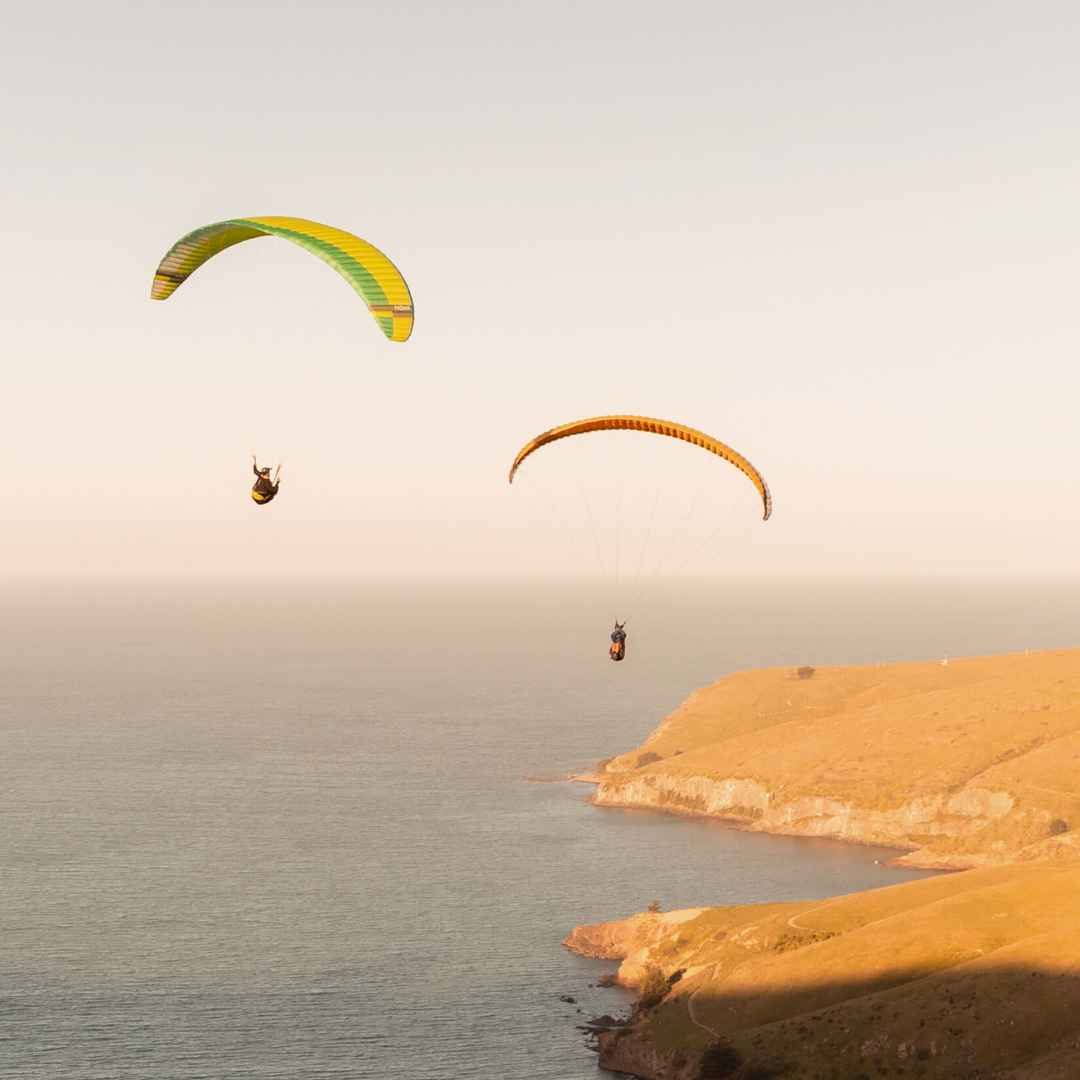
I've been paragliding exactly once, and I'll save that story for later (it's a good one, at my own expense). I find it such a fascinating sport, so I was really looking forward to this chat.
Josh is a paragliding instructor in Christchurch, and Caleb is one of the students he taught, now aiming for his own instructor's licence. Both of them grew up active and outdoorsy, and both of them caught the bug hard.
So we get into how you learn to fly, and it surprised me: you fly solo on your first day. We go through the licences, the gear and what it costs, hike and fly, the best places for a tandem flight, and why flying in cloud is a bad idea. Plus Josh's two gnarliest landings, which had Caleb pulling faces the whole way through. By the end I was pretty much sold. See you in the summer, boys.
In this episode
- Meet Josh and Caleb
- How to learn paragliding
- Paragliding safety and gnarly landings
- Paragliding gear, costs and hike and fly
- Best places for a tandem paragliding flight
- Flying in cloud and motion sickness
- Favourite flights and bucket list spots
Meet Josh and Caleb
Josh teaches paragliding in the summer, with new students on intro days and current students working towards their licences. In the off-season he studies, and he's getting into life coaching.
He was a very active kid, outdoors whenever he could be. At 20 he joined the army and spent five years there. For Josh, paragliding was a way back to those roots: being in the outdoors on his own time, still carrying equipment, with the freedom to explore.
Caleb does photography and media on the side and is aiming for his paragliding instructor's licence, inspired by Josh. Growing up, he got into kayaking and rock climbing, then skiing and helicopters, anything outdoors with or without a motor. He loves the sense of achievement from learning a new skill, and every time something's fun, he gets the bug for a new hobby.
Paragliding started for him when he saw it one day and decided to have a go. Everyone thought it was random. He hasn't looked back, and Josh was his instructor.
How to learn paragliding
To start, you contact a paragliding school.
Your intro day
On your first day you sign a health and safety waiver. The sport comes with risks, and Josh is clear about them, from twisting an ankle or breaking a wrist if you fall over or get dragged, to the worst, death. Then comes ground training:
- The equipment. You learn to lay out the wing and connect to it properly.
- Launching. You run with the wing behind you until it comes up above your head like a kite, then run the length of the training field keeping it there.
- Stopping. You choose when to stop and bring the wing down.
Once you can do that, you fly solo on your first day. That gets people every time, and Josh was terrified when he learned. You get two flights, top to bottom, of two to five minutes depending on conditions, with an instructor on the radio telling you when to look, lean, turn and brake, and when to land.
Up there, you're in control and nobody can get you out of it. The equipment is very safe, though: Josh calls it bulletproof and almost foolproof, and it's the instructor's job to pick conditions you can fly yourself down in.
The first moment is very scary, says Caleb. Then:
"it's actually a surprisingly peaceful thing too"
PG1 and PG2
How long the licence takes depends on the weather first, then instructor and student availability. Schools teach every day the weather is good through the peak season. Caleb caught the bug, so it took him a short time.
- PG1 comes after your intro day, at around 10 flights.
- PG2 is about 40 flights from up to seven sites. Once you have it, you're signed off to fly on your own at any PG2 site in New Zealand, which is most of them, and at normal sites around the world, after an international accreditation step before you go. PG3 is an advanced qualification for a few sites.
During PG2 you're taught a height loss technique for coming down quickly, full 360 turns in both directions, and the speed bar, which changes the wing's angle of attack and makes it a bit faster.
Learning to soar
You also learn to soar. Most schools in Canterbury use a coastal soaring site, where the sea breeze pushes up off the face of the hills, like water flowing up and over a rock in a river. You find the lift band and do figure 8 turns in it until you can hold your height. Once you can launch, land and do that sustainably as a safe pilot, you're signed off.
Paragliding safety and gnarly landings
Caleb has done over 100 flights and has never had an injury or even a close call. He's had what he thought were close calls, being new to the sport, and Josh would tell him he was fine. It goes the other way too. Early in training, students often don't know how deep they've pulled the brakes, and Josh has pulled every student aside at some point to tell them they were really close to stalling or spinning.
Caleb's gnarliest so far was stalling his wing early on, when he put the brakes on to come down, found out how deep they go, and dropped about a metre.
Josh has two stories, and both are pilot error. New pilots worry about the equipment failing, and in his experience it's the pilot most of the time.
Knots at Sumner Beach
Josh also paramotors, flying with a motor on his back, and often launches from Sumner Beach. He'd lent his wing to a friend for ground handling, and his friend packed it differently, leaving knots in the lines. Josh always packs his wing the same way, so he didn't check.
On a light-wind forward launch, he powered on, took off, and realised the brake lines and lines on his right side were all knotted, pulling that side down into a hard right-hand turn as he climbed. All he could do was brake the other side to slow the wing and ride the turn, very close to the stall point. He did a full 180, came back to where he'd launched, thought he'd crash into the Sumner Surf Club, stopped the wing right before it and landed in the bushes.
The Heathcote Valley tailwind
The other was soon after he was signed off, when he was itching to fly. He took the gondola up and committed to flying from John Britten Reserve down into Heathcote Valley, where he'd watched people land when he first started. It's deep in the valley, and when the wind's strong or the easterly kicks in, it gets turbulent and you're not supposed to fly there.
At the top, the sea breeze kicked in and the wind started coming over the back, when you have to launch into it. He went anyway, sprinting off the edge with a tailwind, and motored across the valley at twice his usual speed with only a handful of solo flights behind him.
Over the gondola car park it got rough, with half collapses and big oscillations he didn't know how to control, and he kept getting boosted up while trying to come down. Not knowing where the lift is coming from is one of the scariest things in flying, and Caleb agrees it's the worst.
The cabbage trees below looked like they were in a typhoon. A class of kids at the pool yelled at him to land in the pool, and Josh, swinging like a pendulum, feared for his life. By sheer luck he timed one swing just right, landed softly on his feet, and his wing blew into a tree.
His big lesson was picking the conditions right. Picking the wrong conditions, or rushing your flight checks or takeoffs, is the number one thing that gets paragliders into trouble. There's a saying: it's better to be on the ground wishing you were in the air than in the air wishing you were on the ground.
Caleb puts it this way: like every kind of aviation, takeoff and landing are so important. If something goes wrong high up, you've got a lot of time to sort it out. Close to the ground, you don't.
Paragliding gear, costs and hike and fly
The wing, or glider, is normally between three and five kilos, and harnesses from three to 10 kilos, from solid acrobatic harnesses to very light cross-country or hike and fly ones. A very light set-up can come in under two or three kilos.
Hike and fly
Many harnesses turn into a backpack with the wing inside, so you can hike up somewhere like Mount Herbert for a few hours and fly back down to the car. A lot of people get passionate about that side of the sport, and Caleb thinks he'll head that way. He's always found walking down harder on his knees, and he loves the idea of hiking into a DOC hut, staying the night with mates, then flying down and having lunch at the car while everyone else is still walking.
There's a lot of hill walking anyway. On light days you can take off, fail to hold your height and have to slope land halfway down the hill. With no ride up, you're walking back to the car, which might be more than you bargained for in the middle of summer. Caleb calls that scratching around for lift and sinking out: a gut-sinking feeling, usually on the day you've worn comfy flying shoes.
I've always told my husband that paragliding will be my midlife crisis in my forties, because it looks pretty chill. Josh had a couple of corrections: you want to learn with younger knees and ankles, because learning is when you'll have your hard landings, and there's all that hill walking.
What it costs
When we recorded, Josh put a brand new set-up with cheaper gear at four to five thousand dollars, and second hand at around two and a half to three thousand. Caleb puts a top set-up that will last decades at around 10 thousand. He used to love sports cars, and that's part of why he started paragliding: you can't drive like that on New Zealand roads, and the race track is a really expensive hobby.
Sports car or Sunday drive
Caleb's modern wing is a sports car, all big turns, G-force and wingovers, and you can still cruise it like a nan out for a Sunday drive. Josh agrees:
"it can be quite cathartic and meditative if you want it to be … but it also can be a rollercoaster in your pocket if you want it to be as well"
Josh compares it with skydiving, which is over very fast and needs a plane. A paraglider is a backpack: you walk up the hill, and if the wind is there, you can fly for two and a half hours, or cross-country for 300 or 400 kilometres, thermalling like a hawk. Our ancestors would have watched the birds and wished they could do that.
Best places for a tandem paragliding flight
Josh's picks:
- Queenstown is beautiful. He's flown it solo, and it's amazing from the ground and in the air.
- Tekapo and the Mackenzie Country are amazing to fly, though they aren't official tandem sites.
- Christchurch is fantastic. The hills face multiple directions, so there's a very high chance of getting a tandem flight in during the week, whatever the wind.
Flying over Christchurch, you look out over the city, the beach and, especially in winter, the snowcapped Southern Alps. Flying at the cliffs at Taylors Mistake is surreal: the water below, the mountains behind, and on a good day, the view up the coast to the Kaikōura ranges.
Caleb's goal this season is to take off from Taylors Mistake, get to the cliffs, land at Sumner Beach and go for a beer, which Josh calls one of the big milestones. One of Caleb's most surreal moments was flying over those cliffs for the first time with an instructor, looking down at the birds below him:
"this just doesn't make any sense … it's just magic"
Caleb can't fault the instruction, and stayed on with instructors for as long as he could. He's hoping to train up as an assistant instructor, and his advice is that there's no reason not to get into it if you're fit and healthy.
Flying in cloud and motion sickness
My one and only paragliding experience was a tandem flight in Pokhara, Nepal. Taking off was terrifying: the guide starts running at a cliff and you keep your legs going until you lift off. We went straight into a massive cloud, spinning around in all that white, unable to tell up from down. Then we came out for the most incredible flight along a ridgeline, with massive mountains in the distance and the lake below where we landed. About 30 minutes in, I was sick over the side, onto the houses below. He landed us pretty quickly after that.
Josh says paragliders aren't supposed to fly in cloud. They're aircraft without instruments, so pilots can't tell whether other aircraft are around, and if several paragliders are in a cloud, the chance of a collision is quite high. It's very disorientating, especially the first time. He's seen plenty of tandem passengers be sick, and the drill is to go into a turn and hold it, so you're curling around the vomit.
Caleb rarely gets motion sick. The exception is cloud, as a passenger during helicopter instrument training. We're visual beings, and we balance with our hearing and inner ear as well as our eyes, so when one of those is disturbed, add vibration or the sound of the lines through the air, and most people get thrown.
Distances get distorted up there too. You can cross a valley in half a minute that would take an hour on foot. Josh has even paramotored to McDonald's: he and a friend flew from Sumner to Ravenswood in Woodend, landed at the BP, ate, and flew back.
Favourite flights and bucket list spots
For Caleb, it's soaring at sunset with mates while his partner took photos, a few weeks before we recorded. You can't be on your phone up there, so you're so present. Josh says it's magic being around people who are into the same thing, because everyone knows how much they love it.
Josh thinks there's something very instinctive about wanting to fly. His favourite moments are flying barefoot in summer: hot days with hardly anyone on the hill, or paramotoring on an empty beach, in shorts and bare feet, flying close to the ground, hitting tussocks with one hand and kicking pine cones off the tops of forestry blocks.
Bucket lists:
- Josh: the Dune du Pilat in France, the home of freestyle flying, low over the sand dunes. That on-the-ground, off-the-ground flying is what he loves most, and he preaches ground handling as much as flying.
- Caleb: the fire lookout huts in Canada, which you can hike up to, stay in, and fly down from.
When I've seen paragliders at Mount Maunganui and in Wānaka, I've always thought it looks so awesome. After this chat, Josh might be hearing from me about an intro day this summer.
Places from this episode
- Christchurch
- Sumner Beach
- Taylors Mistake
- John Britten Reserve
- Heathcote Valley
- Mount Herbert
- Ravenswood
- Woodend
- Queenstown
- Tekapo
- Mackenzie Country
- Southern Alps
- Kaikōura ranges
- Mount Maunganui
- Wānaka
Follow Josh and Caleb
- Christchurch Paragliding on Instagram
- Caleb shares his flying and photography on Instagram
More like this
- Surfing and Skydiving in NZ with Cody and Callie Chase
- Helicopter over Aoraki with Billy Nunweek
- Best Christchurch and Canterbury Adventures with Kids with Jasmine Trafford
Until then, keep adventuring :)
The ultimate
NZ road trip adventure guide
Packed with insider tips and stunning photography, this is the only resource you need to plan your journey.